One thing we have learnt this week – fracking

DSC_1715Fracking has been in the news again this week.  An anti-fracking camp has been set up near Blackpool, Ineos have announced they have bought all the fracking rights in Central Scotland and protesters glued themselves to DEFRA’s entrance in London amongst other things. Ineos a somewhat controversial company want the gas to run their oil refinery at Grangemouth.  Last year they got UK and Scottish government money (mostly UK money) to keep their refinery open.  The money is to be used to build an import terminal for cheap foreign gas.  The fracking is a means of hedging their bets.

Its not easy to find the wholesale price of gas in the UK but one of the small providers does put it up.   Natural gas prices projected one year in the future have fallen a lot since January being high and remarkably stable up until then.  Ineos are right to be worried though, the price falls over the summer and we had a mild winter.  Russia has cut gas supplies off to the Ukraine, this has little impact yet because of low summer demand and Ukraine’s declining indigenous production, but expect trouble this winter*.  With reserves being possibly at a peak even with shale gas, prices can only move up.  Where I think Ineos are wrong is to put their faith in fracking.  Its highly likely that trying to start fracking in the most crowded part of Scotland will not go down well and lead to mass protest.  The process will not be as easy as they think and as we outlined in our book the fact that wells deplete very fast only puts back the day a little when you have to manage without gas.

Neil

* much of the remaining production is both Crimea and Western Ukraine.

Posted in energy costs, Fracking, gas | Leave a comment

magic bullets

cartoon_bulletThe other week the news was full of how bad diesel cars were for the environment, diesel cars being one the latest green magic bullets.  Apparently particulates from diesel engines not only harm our immediate environment but also add to climate change by ending up on glaciers in India.  As you might remember dark materials absorb infra-red radiation and light coloured materials reflect radiation.  Thus the argument goes we are adding to global warming.  In addition diesel engines put out more nitrogen oxides.  These cause acid rain and are bad for our health.  A few years ago governments were encouraging diesel car purchase.  Not so much in the UK, but in Europe the duty on the fuel is lower and thus the cost per litre is cheaper than petrol.  Wood-burners are also I think are wrongly blamed for the same problems. This got me thinking about some other green “magic bullets”.

Biofuels

One of the biggest ones.  I fell for this one.  For a short while it looked like guilt free driving.  Even some green groups as well as governments encouraged its use.  (For a climate sceptic potted history see here).  We worked out that with current technology there were several problems to do with food competition and energy returns, these are outlined in much more detail in our book.

Nuclear power

The next of the magic bullets that I want to cover is nuclear power.  I’ve never fallen for this one, but governments have.  Again we outline the drawbacks in our book.  As an example of the problems with nuclear as solutions to energy security and climate change, Tony Blair said the UK should build new nukes in 2005.  In 2014 nothing has happened except some site preparation has taken place one one site.  There is still no certainty anything will ever get built.   In the US the situation is much the same.  In countries that are building reactors such as France and Finland huge delays and cost overruns have occurred.

Clean coal

Clean coal is the next of our magic bullets.  Again governments were very keen on this pre economic slump.  I remember going to meetings on this exciting technology and how it was the answer to our problems.  There are some small pilot scale projects in place but nothing on a major scale anywhere in the world.  Cost has been the main problem.  The electricity will be very expensive and governments at the moment don’t want to subsidise it.

Wind power (onshore)

Governments at one time were very keen on this one of our magic bullets.  Then local opposition wore their support down (and the cost of subsidy). It should be added that polling suggests wind is a very popular source of power, opposition is very vocal and localised and effective.  Some parts of the UK government and climate sceptics have wrongly blamed them for the high cost of electricity (the real culprit is natural gas).  I like wind turbines but even I don’t want to see them everywhere.  They are also not a total solution since the wind does not always blow.

Offshore wind

Offshore wind is definitely one of the UK’s magic bullets (we have more capacity than the rest of the world put together).  It has the advantages that potentially the turbines are out of sight (although some offshore farms have been opposed in the UK and US since people will see them) and the turbines are much more productive than on shore turbines.  The main problems are peoples opposition to the grid connections where they come ashore and the high cost.  Unless this high cost can be lowered then magic bullet status is assured (plus the wind does not always blow).

Electric cars

I have a suspicion these could be the next of our magic bullets.  Again in our book we have outlined some of the potential problems.  The biggest ones are cost, range and where the electricity is coming from.  Again the danger signs are there, that is governments are very keen.  The problem is that if costs fall some of the other disadvantages may come to be major problems.

Fracking

Current biggest of our magic bullets is fracking, if only people in Europe would put up with the noise, traffic, contaminated water etc. then the gas prices would plunge.  The only problem is this makes windpower NIMBYism look like a kids teaparty.  Also even the ex CEO of BP has said it won’t lower gas prices in the UK.  Wells deplete very quickly and only a tiny % of the gas is extractable.  Don’t hold your breath on this one.

Solar power

This technology has some of the unfortunate signs of being one of the magic bullets.  Its a technology I love and have fitted to my house. Governments also love it, or loved it, again its blamed for inflating electricity costs (perhaps unfairly).    The problem is that it works too darned well.  Yesterday Germany produced most of its electricity from renewables (mostly solar).  The drawback is what to do with all that surplus power (something we have covered here before).  The Germans are starting to find ways round it including energy storage and other countries with high penetration of solar PV need to do the same fast, especially as  falling costs mean no subsidy will be needed in less than 10 years pretty much anywhere.

Energy conservation and lifestyle change is not seen as one of the above magic bullets by governments.  Yet funnily enough this is where some of the most effective action has been.  In the EU white good/cars/lightbulbs/houses have been energy rated A-G.  The EU and Australia phased out incandescent bulbs.   These less publicised changes have had real effect on energy demand in my country.  In the UK 17:00 hours is seen as peak demand, this peak demand according to national grid is now falling.  The private sector has innovated massively, white goods are much more energy efficient and LED’s have a fantastic quality of light at a much lower cost.

Many of the problems with the magic bullets above can be solved.  Diesel cars can be fitted with particulate filters (although these bring their own problems) and catalytic converters to deal with nitrogen oxides (as long as platinum supplies hold up).  Renewables output can be stored (technologies exist).  I’m just not sure that peak oil and climate change have any single magic bullets.

Neil

Posted in Book, climate change, Fracking, Nuclear, Renewables, Transport, Uncategorized | Leave a comment

One thing we have learnt this week – oil prices

oil pricesOne of the big surprises of recent weeks has been  oil prices.  With all the turmoil throughout the middle east I would have expected oil prices to be soaring.  Instead they are doing the opposite.  Certainly throughout my life whenever there has been violence between Israel and its neighbours oil prices have soared.  But apart from that consider other flash points which should have increased oil prices.

  • There is barely any oil coming out of Libya as it slides towards civil war.
  • Syria is in chaos and it has some oil, many of the oil fields are under the control of the rebels who sell it the Assad regime.
  • ISIS have captured a refinery and major oil fields from the Iraqi government.

The reason for this fall in oil prices is simple the Saudis have opened the taps.  The question is how much longer the Saudis continue to be the swing producers of last resort? There are indications from Wikileaks that this situation may not be able to continue much longer with very high oil prices the result.  Remember for every extra barrel they pump now that is one less barrel they can pump in the future.  It is also worth remembering that the IEA is relying on Iraq boosting production to meet future global demand, something that seems very unlikely to happen.

Neil

Posted in energy costs, Peak oil, Uncategorized | Tagged | Leave a comment

eating meat

Is eating meat sustainable?  This controversial subject has been raised again in a couple of recent academic studies.  However, like most areas to do with the environment the whole subject of eating meat is more complicated and less open and shut than it might seem.  Some of the issues that need considering are what type of meat, where its grown, where its consumed and if we stop eating it what we eat instead and also where that is grown.

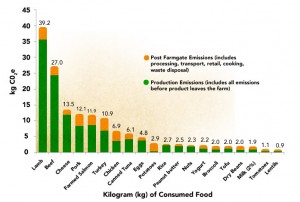
Emissions and energy use (of direct interest to this site) fall into the energy consumption of the feed used to feed cattle, the emissions from the cattle (belching and breaking wind) and the transport of large animals to market and the meat preparation and storage.  Plus the use of water.  The infographic below from the Environmental Working Group shows the relative carbon emissions for different foods.  Please click on the graphic to visit their site which has a lot more info and is well referenced.

green_house_proteinsThere is no doubt that growing grains to feed to beef cattle as happens in the US is crazily inefficient.  Ruminants turn a tiny proportion of what they eat into protein.  But the situation in the UK is slightly different.  Much of our sheep and cattle are raised on marginal land and are largely or solely grass fed.  This is particularly the case in Scotland.  There are few other agricultural options for this land, although we could grow wood on it for future biofuel.  Whilst this grass fed beef gets round the energy use from growing grains as feed it still doesn’t overcome the next objection to eating meat that of methane emissions.  These however, come from cattle, eating pork and chicken reduces these emissions greatly (see graph).  There is also research going on to vaccinate the cattle against the gut bacteria that cause the problem.

The final issue of eating meat is that of the energy use in the transport, preparation and storage of the meat.  This is an issue common to many foods.  The best thing to do is to eat as locally grown food as possible (preferably growing some it yourself).  As the graph above shows these emissions are surprisingly small for all foods and make-up a minority of the energy use for everything apart from potatoes.  In a post oil world though with energy shortages this “post growing” energy use could be an increasing problem.

If we are going to stop eating meat we need to replace the protein.  The main alternatives are fish and soya.  The graph from EWG gives little information on fish apart from tuna, which has little advantage over chicken and nothing on soya (although Tofu is very low on the graph).  But he second paper by Scarborough et al. referenced in the link above on UK food emissions does and they are about the same as tofu.  The problem with fish and soya is that neither are very sustainable.  Fish stocks are being overfished and soya is mostly grown in the tropics intensively, with issue of rainforest deforestation.  There is little point in growing soya when we release the carbon from trees chopped down to grow it on into the atmosphere.  In addition a lot of soya is used to feed cattle and fish.

I hope you have seen from the post that the issue of what to eat to reduce your environmental impact is not simple.  I think there are a number of key points.

  • Eat less meat.
  • If you do eat meat, eat chicken or pork.
  • Cut down on cheese and milk.
  • Minimise waste at your end.
  • Eat as locally as possible (grow as much as you can yourself).

There are good health reasons to do much of the above.

Finally a word on vegetarianism in the bible.  Genesis 1v29-30 seems to suggest anything is permissible to eat as does Acts10v9-15.  Paul suggests (Rom 14v2-3) believers who eat or don’t eat meat should not look down on their fellow believer who does the opposite.  As a Christian I am think the bible is neutral on the issue and its up to individual conscience (1 Tim4v1-4).

the kingdom of God is not a matter of eating and drinking, but of righteousness, peace, and joy in the Holy Spirit Rom14v17

I’m starting to look at my meat consumption.  The paper from Scarborough et al. suggests around a 100g of meat person per day doubles emissions and its very easy to eat that much.  I’m going to see if I can aim for 50g, I have already cut my dairy consumption back hard (eating almost no cheese).

Neil

Posted in climate change, Food, Peak oil, Uncategorized | Leave a comment

One thing we have leant this week – Can eating meat save the planet?

Can eating meat save the planet? This is this weeks controversy.  homegrown saladA man called Allan Savory thinks you can have your cake and eat it, or meat and and eat it. He has developed a theory of “holistic grazing”. Savory suggests that putting cattle onto marginal desert land so they intensively graze it makes the land surface broken up. This and the manure they produce encourages growth of grass which fixes carbon helping to reduce greenhouse gas emissions. He also suggests this is because bare soil will otherwise grow algae. He also suggests that soil treated in such a way will hold more moisture.

It sounds great doesn’t it. Reducing my guilt over meat eating. There are a number of problems though. First I don’t live in the USA, but I really see algae growing on bare soil. Second, only part of the problem with eating meat is to with what the cattle eat, its the methane they produce and the energy required for feed/transport etc. Third, it seems surprising to me that putting cattle on marginal desert land does not do such land great damage. I would expect cattle and goats to strip everything and leave nothing to grow after they have moved on. Needless to say experts who have looked at his methods are not impressed. Can eating meat save the planet. Unfortunately it seems not. We need to reduce our meat and dairy consumption for energy and climate reasons.  I will be returning to this subject soon from a different angle in the near future.

PS Sorry about any lack of posts, we have a problem with our broadband.
Neil

Posted in Food, Lifestyle, One thing we have learnt this week, Practical low carbon living | Leave a comment

Ukraine

DSC_1715The news agenda moves on and the Ukraine crisis has moved off the front pages.  However, it unfortunately it has not gone away.  The shooting down of MH17 has led to further sanctions being implemented by the EU and the US.  At the moment both sides are avoiding energy sanctions but how much longer this will continue we cannot say.  The news reported that Russia is suggesting today that they may stop overflying rights by Western airlines, something that would push up airfares that fly around the globe very considerably.   Today it definitely stopped agricultural imports from Western countries.  However, if relations get worse than energy sanctions from one side or the other could happen.  Its also interesting to note that whilst Ukraine has no oil, it still has a lot of gas, albeit its production has peaked,  Where is this gas?  Largely in the Crimea and Eastern Ukraine.

The effects on the West of energy sanctions could be fairly significant.  We are looking at $200/barrel oil prices with much higher gas prices and energy prices in Europe.  However, the Russians would find things worse.  Europe after a couple of previous Ukraine crises has lowered its dependence on Russian gas.  The transition to renewable energy is in full flow in Germany and other countries.  But Russia has not lowered its economies dependence on selling fossil fuels.  It makes up 80%+ of Russian GDP.  Russia’s economy would rapidly be brought to its knees.

To solve the Ukraine crisis everyone needs to talk and compromise.  Ukraine needs to allow the Eastern part more autonomy, settle the dispute as peacefully as possible and recognise Russian as a legal recognised language.  Russia needs to clear out of Crimea and stop interfering in Eastern  Ukraine.  At the very least we need a proper referendum in Crimea.  As I know at the moment its difficult to get people to engage in such a campaign in over 2 years much less 2 weeks, the referendum was a farce.  We also need a proper investigation into MH17 with if necessary Russia accepting a degree of responsibility.  I personally couldn’t care less whether the Ukraine is in Russian or European sphere of influence, but whatever the majority want, couldn’t it be in both?

Neil

Posted in Economics, energy costs, gas, Renewables, Uncategorized | Leave a comment

One thing we have learnt this week – coal mining

coal reserve dataCoal mining is still big business. It was announced this week that the Queensland government has given the go ahead for a super mine (Carmichael) in the Galilee region of this state. Unfortunately its not just burning the coal that is going to do the harm but transport of the coal by rail to the port of Abbott point. This puts the great barrier reef at risk in three ways. First from dredging to get the ships in with the spoil from this being dumped on or near the reef. The second way is by the ships sailing close to the reef with the possibility of accidents (which have occurred in the past). The third is CO2 emissions from the coal which is going to China and India causing acid damage to the reef in the long term. The irony is Australia’s CO2 emissions are falling and its wind solar capacity has leapt. Even more ironic solar is nearly competitive on the Aussie grid. However, like in the US these emissions are being exported partly as coal and this is burnt by others. This explains the renewable conundrum that as renewables installations rise steeple (albeit from a low level) emissions globally are still rising. As we covered in our book coal reserve figures have plunged worldwide over the last decade or so but in the last year have increased a bit (graph above). Coal still looks like a dicey way of generating electricity though from both the climate and energy security point of view, but coal mining with all its negative environmental impacts for the moment looks set to continue.

Posted in climate change, coal, One thing we have learnt this week, Renewables | Tagged | Leave a comment

solar hot water payback

Solar hot water payback is possible.  In the summer of 2008 I was helping man a transition stall when a very posh woman told me that my solar PV system would never pay for itself.  She said should know since she was a banker.  A few months later her bank and many others had to be bailed out due the worldwide banking crash, which to my mind puts her advice in some kind of context.

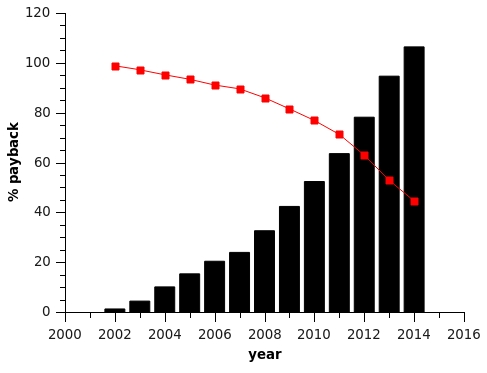
Unfortunately whilst she is not completely right, the payback on my PV systems is slow and at the end of the year I will put a post up on this.  (She is however wrong that they will never pay for themselves.)  However, my first renewable kit has just paid for itself this quarter as at least on one way of calculating it as the graph below shows.

SHW paybackThe first thing to say is my system was subsidy free and has to compete with mains natural gas.  Six months after the installation the grant scheme was introduced,  but grants could not be retrospective.  So the system has always had two financial handicaps.

I have used two methods of calculating the solar hot water payback.  Both use the average Q2/Q3 gas usage before the SHW system was installed as a basis to model the savings using the difference between what it is and what it would have been.   The first method is just that.  Its a bit crude but this one is showing that solar hot water payback has occurred in Q2 this year.  The second is my preferred method (red lines on graph above).  Solar hot water output is not metered, it is possible to buy meters but I don’t have one.  In 2004 however I had a PV system installed on the same roof.  This is metered and using the relative efficiencies of both systems allows me a reasonable guess at how much energy I’m capturing using the SHW system.  I can then work out assuming a 25 year lifespan of the system how much I have bought the energy up front (cost of system/average output kWh/year*25).  This is currently around 8.2p/kWh.  I then use direct proportion to multiply the savings in the first method (saving x cost of gas/8.2).

In 2008 churches in Edinburgh organised a climate change conference.  I was talking on SHW and PV and thought I ought to look at the costs.  I had used another method of calculating the solar hot water payback and had assumed since gas prices had started rising payback was humming along nicely.  Looking again at the solar hot water payback method I had used up until then I decided I didn’t like it and came up with the alternatives described above.   When I bought the system I was paying around 1.3p/unit and as can be seen from the graph payback was negligible.  (Although carbon savings were good, which was the aim of buying the system.) However, by the time the conference came around I could see it was all change in 2008.  Global oil prices reached an all time high as did gas prices in the UK (too that time) and the wholesale electricity prices.   The savings jumped massively that year.  This trend has continued and accelerated since.  I am now paying 5.57p/kWh, down slightly from an all time high this spring.

Other points to note.

  • The solar hot water payback calculations are a bit crude but I have yet to find a better way.
  • Running costs are zero.  The system is freeze tolerant, uses the existing pipework and is solar powered.  Its never gone wrong.
  • 2014 includes Q2 only.  Q3 savings are about half this so on my preferred measure we will be at about 40% still to go.  But even on this trend the system will pay for itself in 2-3 years if gas prices keep rising at the longterm historical trend.
  • I include a small boiler maintenance saving of £20/year, a hidden saving of SHW.  My gas hot water system unlike some does not use a pump.  So there are no electricity savings from this.  There might be on some hot water systems.
  • The payback is slightly higher though in reality since we used to have a washing machine with a hot water feed.  Obviously when using hot water heated by the sun we were saving on electricity costs.  But the savings are impossible to quantify.   Our current machine like almost all now is cold water only.
  • The system used not to work in Q1/4 at all.   In fact on the 30th September for two years in a row we had a glorious warm sunny day.  No solar water.  Then I had a burst lead pipe elsewhere in the house.  I asked the plumber to remove all lead pipes.  Some were those used by the SHW.  He insulated these after replacing them.  This cost is negligible and is not included since its unrelated to the SHW system I would have had the pipes removed anyway and the insulation costs were a few minutes work.  This made the system usable in Q1/4.  I use a slightly different payback system of avoided gas use (gas use measured over 30 minutes and converted to kWh)  to calculate the savings in these quarters since the heating system is more likely to be on which means the above calculation method would not work.  To count I must use the water before the heating system goes on.  Q1/4 savings are pretty small, a few years ago they were £19, less last year.
  • The plumber left some of the existing pipe run uninsulated.  We had some electrical work done and whilst the floorboards were up I finished that section off myself.  The costs are so small I have not included them.
  • In 2008 I came up with the idea of switching the boiler off completely.  Often we were not using it and we have a pilate light that was ghosting.  This makes the 2008/9 jump a bit bigger than just gas prices influenced, but since then the increasing trend is gas price influenced.  I use the immersion heater to fill in.  We have a small double tank and the immersion is fast 15 minutes is enough for a shower/washing up.
  • I discovered I had to turn the upstairs radiators off otherwise they get warm from the SHW panel and the water is a lot less warm.  A pain in Q1/4 when you are using both.
  • A major pain was when I used to pay variable rates for gas.  You paid a lot (x) for the first units then less (y) for the next and sometimes z for the last bit per quarter where z would be even less.  Since we always used the boiler a bit in each quarter we would always be in one of the cheaper bands lowering our savings.  It also made the calculations complicated and a nightmare if the price changed mid quarter.  On one such occasion I spent an entire evening on the spreadsheet when the price had changed mid quarter.  Its one reason I am with my current supplier, who have one rate only and no standing charge.

Solar hot water payback is possible and the gas savings are impressive.  SHW is as we said in our book a basic technology that most of us should fit.  My woodburner will also pay for itself in Q4 this year.  Payback on this will have been much faster than for the SHW.  I will blog on this in the new year.

Neil

Posted in climate change, Economics, energy costs, gas, Peak oil, Practical low carbon living, Renewables, Uncategorized | Leave a comment

One thing we have learnt this week – Gaza

00001Is the war in Gaza not about terrorism but control of energy?  This idea was raised this week in the Guardian (other links in this article).  A few years ago it was announced that a very large gas field had been found of the coast of Gaza/Israel (Leviathan @18 trillion cubic feet).  When I read this my heart sank, but I’d almost forgotten about it until this week.  Some other fields have also been found as far back as 2000.  Part of the issue is that Israel does not show up under the gas heading as an individual country in the BP Statistical Review of World Energy, i.e. little if any of this gas has made it ashore (one field Tamar started producing gas last year).  Maybe it will show up next year.   British Gas have tried to reach an agreement to bring the gas ashore from the field found in 2000 first with the Palestinian authority but in 2001 with another uprising Israel put a stop to that.  Then Hamas came to power…  Its reckoned that in the Eastern end of the Med there is 122 trillion cubic feet of gas and 1.6 billion barrels of oil.  But these waters are disputed by Cyprus/Lebanon/Turkey/Palestinians/Israel etc.

Israel thinks its set-up with gas for a very long time (although this is disputed), but its certainly true that it has struggled with energy security for decades.  It was hit by the 70’s energy crisis’s very hard and its Arab neighbours were obviously not going to sell it oil.  Solar hot water collectors were made mandatory and despite being surrounded by hostile countries Israel built nuclear reactors (although this might have more to do with development of nuclear weapons).  Electricity is expensive and solar PV is taking off.

Its difficult living in a peaceful country to put yourself in mindset of those living in either Gaza or Israel, but lets try.  If you live in Gaza you have been squeezed into a small area (one of the highest populations densities in the world).  Your economy has been severely damaged by the Israelis and the Egyptians and is very dependent on foreign aid for its present high rate of growth1.  There is a maximum of 12 hours a day of electricity and a shortage of medicines at the best of times and you are ruled by Hamas which lives and breathes confrontation with Israel.  Much of what you need is smuggled in through tunnels (along with missiles).  Many Palestinians work in Israel2.  If you live in Israel you are surrounded by former and current enemies (the former just about tolerate you).  Every few years Hamas smuggles in enough rockets to launch attacks you on some pretext.  (We should remember why this particular repeat episode kicked off.  Hamas supporters brutally murdered three teenage boys.  Israel did some very heavy handed police work looking for the suspects who have not to my knowledge been found, killing other people in the process.  Some idiot(s)* in Israel (caught on CCTV) kidnapped a Palestinian teenager, burning him alive.  Hamas decided to check their rocket inventory…)

Most rockets from Gaza fail to get through and you respond, there is eventually a truce brokered by Egypt but huge destruction in Gaza follows and many more mainly civilian deaths.  A few years later the cycle repeats.  Things look bad enough to the outside observer but throw into the fact that the entire eastern Med is floating on gas reserves of which may have peaked globally then you have a recipe for conflict for decades to come.

It seems to me that the current situation is getting neither party anywhere fast.  Israel is not getting the security it deserves and the Palestinians have no life much less a state.  Both sides need to get back to basics.

  • At the moment its obvious neither side wants a permanent peace.  This has to change.  It was chilling on the TV to see the exiled head of Hamas smile when he said Israel was killing women and children.  Hamas has to stop launching its weapons from civilian areas.  We know they are doing it- we’ve seen it on the news.  The UN said they had rockets in one of its compounds. On the other side Israel’s military policy is not working.  I understand the reasoning behind it.  Hamas will eventually develop a rocket you don’t just launch on the general direction of your enemy, but one that can be targeted.  But riddle me this if the current strategy is so successful, why does the problem keep recurring?  I cannot see the current strategy stopping Hamas gaining better missile technology anyway.
  • There is no doubt that Israel is trying to if not destroy Gaza’s economy then its trying to stifle it.  Again I can see the logic.  If the economy of Gaza is doing well then the money rather than being spent on schools and hospitals will find its way to fund rocket development and pay the widows of suicide bombers, so the argument goes.  But again the current policy is not working.  We pay through our foreign aid budget for Gaza to be periodically rebuilt as a humanitarian gesture.  Wealthy neighbours generally won’t fight.  If the economy of Gaza was self supporting and prosperous its people would in all likelyhood lose interest in destroying Israel.  Its worth a try anyway since the current policy plainly isn’t working.
  • Perhaps in the words of a Jew who lived in Palestine 2000 years ago Israel should try turning the other cheek (Mathew 5v38-40).  We are in a cycle of revenge that we saw in Ireland, but that situation shows although its not easy, it is possible to break it. Just say Israel had not responded this week with drones and F16’s but had done nothing except shoot down incoming missiles. Where would worldwide sympathy lie, with Hamas?  Would Israel really look weak (we know they could do what they are doing).  More Israeli citizens would be alive since only a few of the deaths are down to rockets (which would regrettably still have happened since no missile shield is infallible).  Most Israeli deaths have happened since the IDF started fighting on the ground in Gaza.

As I  wrote this a UN compound (school), 15 children were killed.  Both sides are probably guilty of war crimes since they are launching ordnance in the general direction of civilians.  But both Hamas and Israel will ultimately have learn to live with each other.  This will involve compromise from both.  Hamas recognising Israel’s right to exist and Israel allowing truly independent viable Palestinian state(s).  I suppose the only good news for once is whilst all this is going on the fossil fuels will stay firmly in the ground.

* other words exist but I’m too polite and yes whilst not proven it was a revenge attack, its very naive to believe it was not.

1) see that well known liberal organisation, https://www.cia.gov/library/publications/the-world-factbook/geos/gz.html for full details.

2) http://www.jpost.com/Middle-East/20000-Palestinians-working-in-settlements-survey-finds-323222

Neil

Posted in Economics, energy costs, Faith, gas, One thing we have learnt this week, Politics, Renewables, Uncategorized | Leave a comment

CAT is 40

CAT is 40, CAT being the Centre for Alternative Technology.  Last year the BBC interviewed some of the earliest members in the Radio 4 programme “The Reunion”.  Started by aristocrat Gerard Morgan-Grenville in 1973 its now Europe’s premier eco centre and attracts around 65,000 visitors a year.  I went with the Scouts in 1976.  In those days it was a few hippy types in a bare quarry standing around a wind turbine with blades made of sails and a single solar hot water panel.  Nevertheless I was impressed and so were our Scout leaders.  Even my grandparents went to visit and came away with surprisingly positive comments.CAT solar roof

On the “The Reunion” the former members of the community remembered a pretty grime time.  Very primitive living conditions without proper sanitation and roofs with mice running around everywhere.  The locals had a pretty low opinion of the place too.  When people turned up wanting advice they thought perhaps they had better open it up to visitors, which was pretty difficult at first.  They also brought out a report on a sustainable UK which is amazingly accurate considering its age.  They have published two more recent ones called Zerocarbonbritain which we have mentioned in our book.

I returned in 2005 for a course and found the place transformed as you see from these pictures I took when I returned with my family twice when we were on holiday nearby in Wales.  The quarry is a wonderful garden with lots of educational exhibits on all aspects of greenliving and energy for all ages.cat gardens

00061What can the fact that CAT is 40 teach us?  The people interviewed I thought were surprisingly modest about their achievements.  Most of what seemed weird and experimental then seems mainstream now.  Recycling has mushroomed.  From no on grid wind there is 320GWp worldwide, solar PV has gone from astronomically expensive to just over £1/watt with 130GWp installed worldwide.  There are as  the programme covered many challenges left for CAT over its next 40 years.  Our fossil fuel dependency has not dropped and global temperatures continue to rise inexorably.  Visit it and get inspired.

Neil

Posted in Uncategorized | Leave a comment