Bikes on trains

2016-09-14-17-16-48One of the big complaints amongst cyclists in the UK is about bikes on trains.  I have been undertaking an internship with a view to rebooting my career, which involves cycle/train/long cycle.  People here think getting bikes on trains is a real problem and everyone I have talked to asks me if I have any problem getting my bike on the train.  However both from my experience and talking to other people this is much less of a problem than you would think and much less of a problem than in Europe.

The whole Eurostar row broke just before I cycled to Paris for the climate talks.  Eurostar wanted cyclists to partly dismantle their bikes to put them in the carriage.  They already wanted to you wrap them up in a box or a bag if taking them on borad yourself (and probably still do) after dropping the dismantling idea after much protest from cyclists all over Europe.  But Eurostar have a fairly European attitude to bikes.  You can send your bike as freight on the train (which we did on the way back from Paris).  The bikes were not damaged and were waiting for us in London.  However you cannot do this part route only to and from London/Brussels/Paris.  This idea is again fairly typically continental European.  Bikes on SNCF we found many years ago do not necessarily go on the same train as you.  For us one way this involved the extra cost of a hotel whilst we waited for our bikes to catch up with us.  (And the bike was damaged a bit on arrival).  Talking to one of my fellow Paris cyclists the situation in Germany is the same.

Then the commuting situation is not great either.  We discovered we could not take our bikes on the RER years ago (although the situation has changed I think)*.  Certainly in Paris last November I checked and we could not take our bikes on trains during peak commuting hours.  Whilst I can understand this at one level, surely this is the most useful time for most people?

Contrast this with here.  Getting me bike to London on my way to Paris and out to Surrey to start cycling was easy.  Virgin East Coast do not charge for carrying bikes.  When you book your ticket you simply add it in as an option (some other operators do charge on inter city).  The bike goes in the guards van with you.  I was effusive with my thanks on social media.  Getting the bike out to Surrey was as easy as putting it in the right carriage on the commuting train.  Here Scotrail make commuting with bikes easy, its free and on my train whilst there is a designated bike area you can put them by any door.  So far its been no hassle and lots of us do the same every day.  If only I could say the same for the cycle at the other end…

Neil

*Farcically on the way out we did somehow get away with it.  One the way back they refused which led to us cycling through the streets of Paris- a terrifying experience repeated last November (2015) and no better for the provision of the velibs and cycle lanes.  This led to a whole series of adventures 20 odd years ago which involved a puncture, an attempted mugging, my wife thinking she had lost the stone in her engagement ring, had all her cards stolen etc.  None of which turned out to be the case…


Posted in Cycling, Transport, travel, Uncategorized | Leave a comment

One thing we have learnt this week – world energy demand

954838_204501379701698_1765426126_nThe World energy council has predicted that world energy demand will peak by 2030. Or so the headlines in the press said.  What this group say in the report out this week is more nuanced.  They present three different scenarios.  The three different scenarios are described as different types of music but at this point I began to lose the will to live…

  • World energy demand per capita will shrink by 2030 but since there will be more people overall energy demand is going to rise.  In fact by 2060 the demand for electricity will double.  Meeting this demand will need a huge investment in infrastructure.
  • Demand for coal will peak in 2020 and oil in 2030.  Oil production will peak at 104mbd.  This may lead to “stranded resources”.
  • Renewables will grow at an enormous rate and make up about 20-39% of power generation by 2060.
  • Despite all the above good news limiting global temperature to a 2 degree rise will be very hard.
  • There will be very substantial growth of electric vehicles, but this will be very difficult to bring about at the same time?

My thoughts.

In all the OECD countries energy demand has peaked and its likely that energy demand will fall in real terms (although this depends on electrification of transport and heat- see below).  The exception could be the UK where population growth is continuing upwards, most other OECD countries have falling and ageing populations.  The reasons for this energy demand are straightforward if you buy any product in the West now it uses a lot less energy than its predecessor.  Where the increase in energy demand is going to come from is from the developing world where billions have no access to electricity.  Further demand will also come from electrification of transport and heat.  This could push up energy demand in OECD countries and developing countries alike.  It depends if efficiencies in other areas are larger than than this other electrification of the economy.

104mbd is a big increase in demand by 2030 from 91mbd now.  With all the talk about shale oil it should be remembered that almost all conventional regions outside OPEC and many in OPEC are in decline.  That is a lot of oil to replace.  There are exceptions at the moment, Iran is now ramping up production having underperformed due to sanctions, but peak oil could be back.  At the moment we are seeing a complex mix of falling demand, rising unconventional oil production and falling conventional production.  This makes it very difficult to predict what will happen.

This brings me to my final point.  The change could be far faster than this report envisages.  Wind and solar prices and deployment always beat predictions and then some.  Electric car deployment is also doing better than could be expected with low oil prices.

World energy demand may or may not be on a downward trend but the world energy scene is certainly changing more than it has in my lifetime.  One thing is for certain we need to get off oil and gas ASAP.  It causes pollution, wars and distorts economies.

Neil

Posted in climate change, energy costs, One thing we have learnt this week, Practical low carbon living, Renewables | Leave a comment

Cleaning the central heating system

dsc_2811Cleaning the central heating system is not for the faint hearted.  It requires time, care and if in doubt contact a reputable plumber.  If cleaning the central heating system goes wrong then you could even blow up your house.  Several houses in the UK (and I should add usually their neighbours houses) are destroyed this way when there is insufficient water in the system.  However all central heating systems need cleaning from time to time*.  If done right it suppresses gas production in the radiators, stops corrosion and makes it run more efficiently meaning you should get more heat for the same amount of energy use.

We had our system modified slightly over 10 years ago.  We had bigger radiators put in, one more added in a room and moved a small one into the downstairs toilet where there was none.  The plumbers concerned noticed that black gunge was coming out of the system.  They told me to clean the system out, gave me the materials and told me what to do.

The first thing is switch the gas off completely.  Including pilot light if you have one.  I’ll say it again switch the gas off completely.

The process takes place in two stages a week apart.  The first stage is to add cleaner.  All systems have a means of draining them and some kind of header tank.  Its vital in any event to know where they are in case of problems.  Usually the header tank is going to be high up (in the roof) and for obvious reasons the drain point low down.  Our header tank has its own ballcock and is fed from the cold water tank with a valve in between.  The drain point is in the sideway (in fact we have two which complicates things massively).  The valve is probably under a floor somewhere.  Last week I lifted the floor boards opened the drain valve up and the other one underneath a radiator and let the system run until both produced clear water opening up all the radiator valves.   I also cleaned out the header tank.  Once the water runs clear  you need to add the cleaner.  The easiest way to do this is is to pour it into the header tank whilst the valves are open.  I did this but thought of a more effective way of adding for the inhibitor stage (see below).  Quickly close the valves and let the system refill.

At this point the radiators will need refilling.  Doing so will pull in any remaining cleaner  in the header tank.  After this I pumped the system round cold (without my pilot light).  I listened to the sound from the pump.  Since we have two drain points due to a system extension the pipes go up and then down, we get an airlock at the watershed between the two parts of the system.  The way to clear an airlock in a radiator is to switch the valves off at all the unaffected radiators and pump the water round cold.  Having done this and having bled the radiators again to make sure they were full I then was ready to relight the pilot light and use the central heating.

You leave the cleaner for a week and use the central heating.  Then you do the whole thing again but add inhibitor.  In the meanwhile I went to the homebrew shop bought a large piece of silicon tubing.  This almost fitted over the exit pipe in the header tank whist the drain valves where open after the water was clear again I held the tubing over the end of the pipe in the tank and poured the inhibitor down the tube meaning almost all of it got into the system.

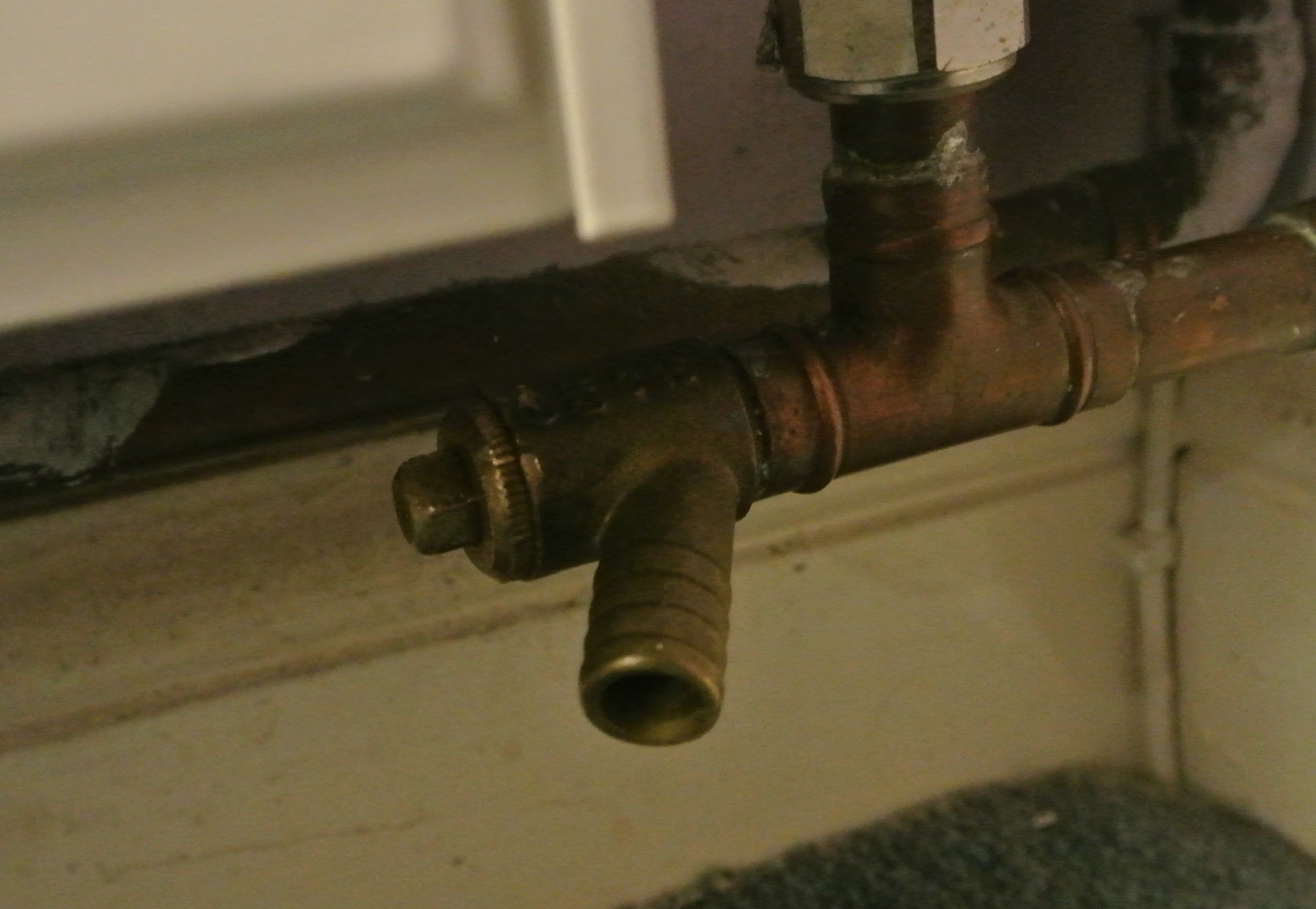
The only problem I had was with one of the drain valves (shown above) which leaked when closed.  I had to get the plumber out to fix it.  There are two washers in it.  The one furthest back instead of moving with the valve when I undid it stayed put and jammed in the pipe.  It was difficult to remove but would have been easy enough to do myself once the system had been drained and replace with a new one.

In my experience this stops gas buildup in radiators and is good for 8 years or so before the system starts to silt up again.  Cleaning the central heating system is simple enough to do yourself providing you are careful.

* This blog covers non sealed GCH systems, but presumably electric and ground source heating systems will require cleaning now and again although the dangers are far less.  It does not cover the GCH in hard water areas although the inhibitor claims to stop limescale build up.  We have no such problems having soft water.

Neil

Posted in Practical low carbon living, Uncategorized | Leave a comment

One thing we have learnt this week – solar has overtaken coal

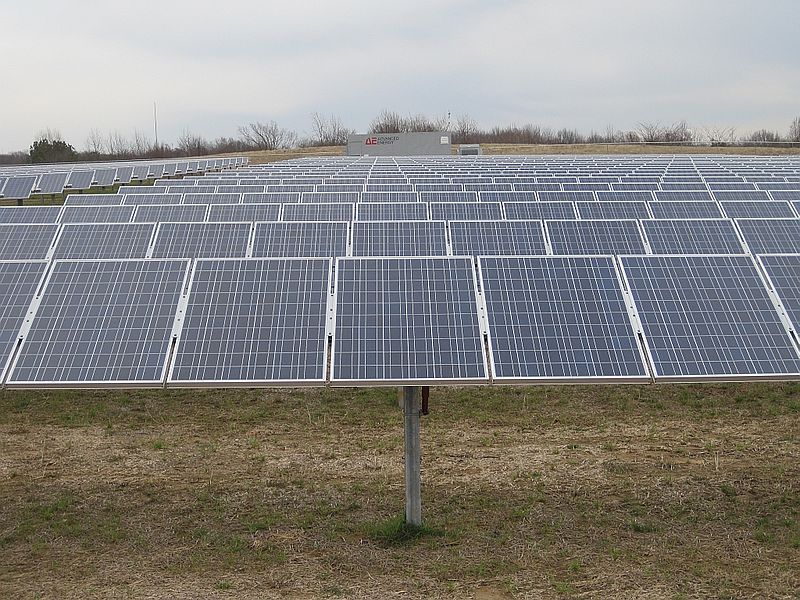
800px-Shelby_Farms_Solar_Farm_Memphis_TN_2013-02-02_008This week it was announced that solar has overtaken coal for electricity production in the UK.  Not only that, but on April the 9th there was no coal fired generation for the first time since 1882.  These figures are unofficial but likely to be true. This is an astonishing turnaround.  When those of us were lobbying for a German style feed in tariff we thought this day would be decades off (especially with carbon capture and storage).  For years coal has dominated our power profile although no coal fired power stations have been built in the UK since the early 70’s.  In fact it was the miners strike in in 1974 when I was kid and the resulting three day week that gave me my interest in energy matters.

Solar has overtaken coal not just because of the rise of solar capacity, but also due to the decline of coal.  I saw a very interesting documentary looking a Scottish and Southern energy.  They looked in one programme at an old coal fired power station.  The problems with it were multiple.  For starters it used to be run all the time as baseload.  In latter years when there was lots of wind etc. it really was switched off.  This is less good for the kit and was wearing it out faster.  In addition it was old – and there is a warning here for nuclear- people were loosing the knowledge to repair it.  Its since closed.  Even before the governments’ coal phaseout announcement by 2025 the trend was clear.  Soon solar will have overtaken coal permanently and its rapidly closing on nuclear and gas.  The future really is renewable.

Neil

Posted in One thing we have learnt this week, Renewables, solar | Leave a comment

Lime part 6. Lime paint the final (lime) word!?

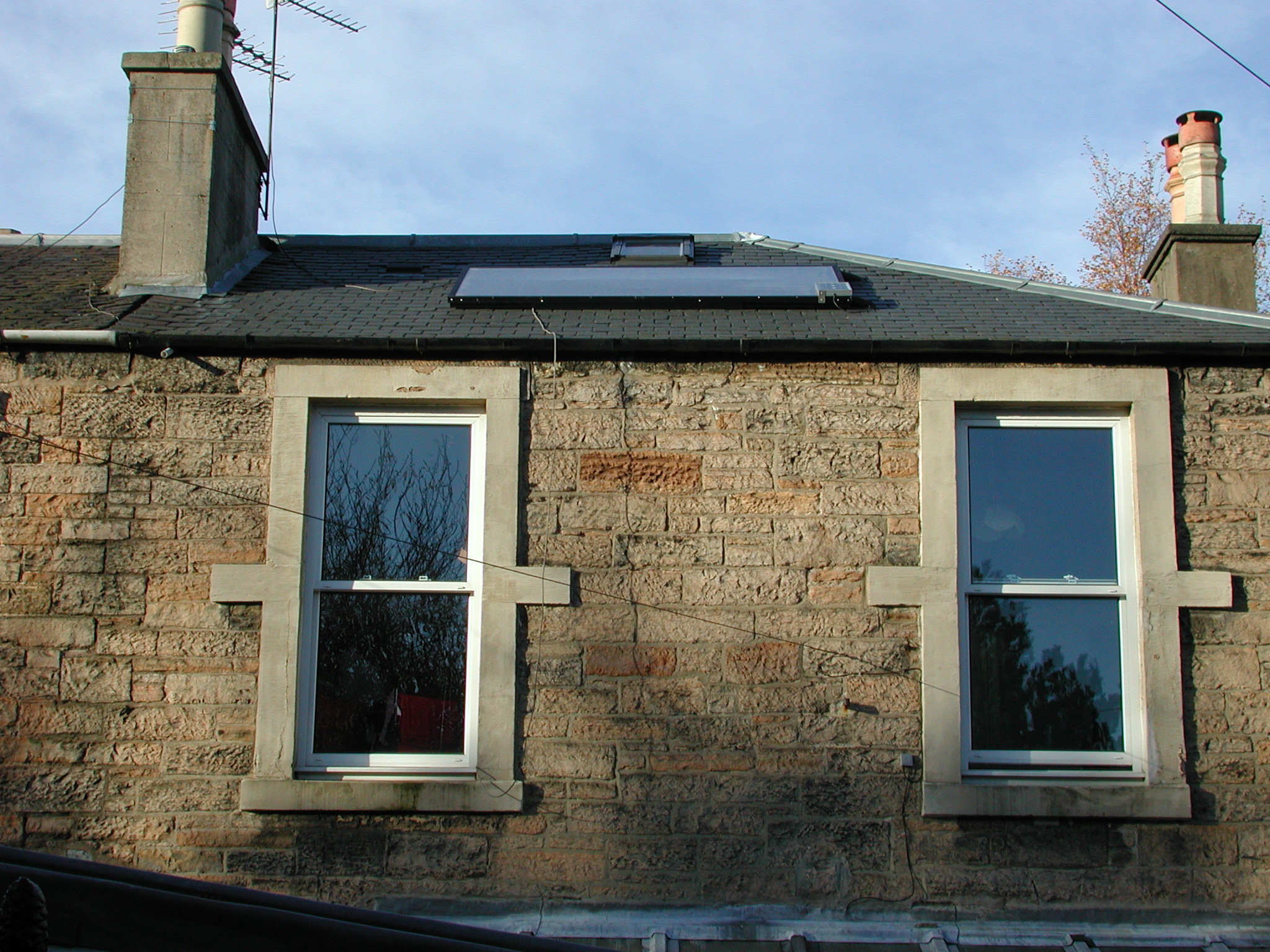
I’ve recently discovered a new lime product- lime paint.  A couple of years ago I realised just how much the stonework had deteriorated around our windows.  The reasons for this are simple when we had the double glazing put in 20 odd years ago they used cement rather than lime mortar.  I have been told and believe it that the stone is weight supporting.  This August I felt I had to do something about it. I’ve blogged extensively on lime and its importance but not used lime paint before.  This first image shows the house in 2002.  The windows surrounds look OK but already there are issues.

0023

By this year they looked like this.

rear-window

This has been a two stage process.  The first has been to patch up the stone which was in a as bad a state as I feared.  I used a lime mortar for stone repairs.  This window above was the worst.   Parts of the right hand bottom side fell off when I touched them.  I had to use the lime to build the edges up again.  This has been very successful.  The bottom left was even worse.  A football sized hole opened up as the sand ran out like that from an hourglass.  I packed the hole that was at the rear with lime, small stones and even bits of pottery and brick.

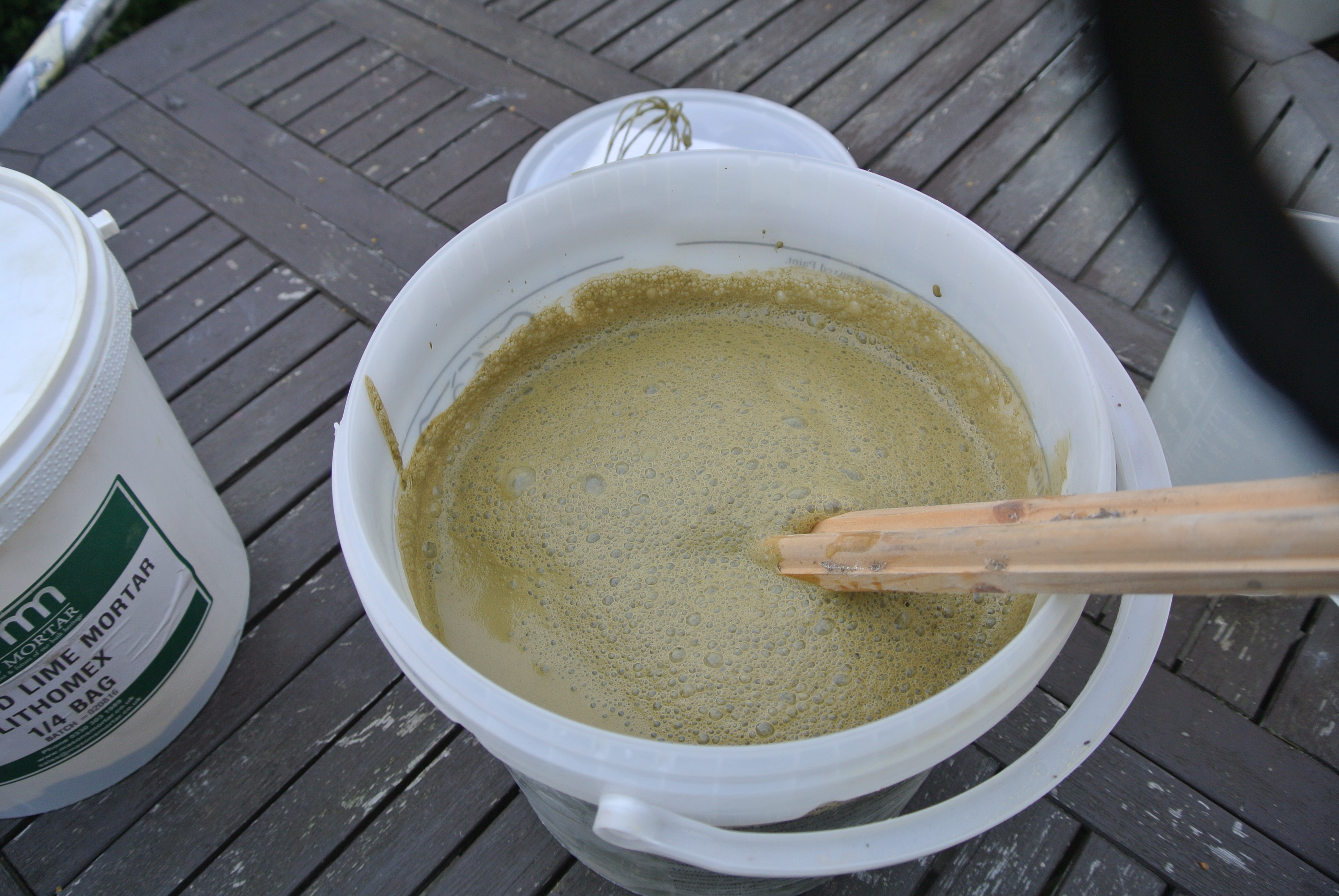
Once I had done this patched up other bits on other windows where I did the same (although they were not as bad) and rubbed down the existing masonry paint I was ready to paint on the lime paint.   The lime paint comes dry in a range of colours ready made and can also be customised, all made using mineral dyes.  You mix it adding water to a mark and you are off.

dsc_2798

It goes off after a couple of weeks although I have found its OK after nearly three.  You paint it on with a brush.  Its very runny but covers better than anything I’ve ever used.  It also sticks to masonry paint just fine.  It looks great.  Its not perfect but looks much better.  The underlying cement issue remains however.  One final thing to note the paint as you will see is a different colour when its dry from when its wet (permanently).  This is a weird feature of lime products but does mean the colour we thought we were choosing is not the one we ended up with.

dsc_2799

Neil

Posted in other, Practical low carbon living, Uncategorized | Tagged | Leave a comment

One thing we have learnt this week smart meters delay

metersThis blog has blogged on smart meters more than once.  As we said in our book smart meters are meant to “monitor total energy consumption in real time and predict and manage trends.”.   There are now 4 million in the UK.  Today a smart meter energy hub linking energy suppliers was supposed to open, but has been delayed for further testing.  Details in this hub are very hard to come by but it is costing 2 billion pounds and I assume links the household energy information to the grid in real time.

In principle smart meters are a good idea.  They allow smart use of energy and make managing large amounts of micro-generation much easier.  There are however some issues that I’m not happy with.  The first is the means of communication between the household and the energy supplier this is via 4G.  This has led to problems when installers have turned up and there is no 4G coverage.  This is in my view more easily hackable than power line modem technology (that is signals sent through the electricity grid itself ).  If a frequency far away from 50Hz is used then these signals do not interfere with everyday electrical equipment.  My old system PV inverter uses this technology to communicate with a computer for its settings to be altered (which had to be done once).

This leads onto my my main concern, global hacking of the systems.  The smart meters have in my view an outrageous feature.  They can do remote disconnect.  In my view people should not be disconnected anyway.  If there is a bill payment issue this should be sorted out in some other way.  If the energy companies are hacked then and hundreds of thousands of consumers cut off suddenly you could bring the grid down.  This is a huge security weakness.  Lastly there is a compatibility issue.  Some smart meters are only compatible with the energy company that installed them (this however seems to be a legacy issue).  Also the very people that smart meters are most useful for, those of us with with solar PV systems smart meters don’t work and according to the government we are supposed to be a priority.

At the moment both those who are against and those who are in favour are not happy.  Those against like the IOD say they are a waste of money.  One energy supplier was interviewed this morning said it was cheaper for low income families to have smart meters.  But there is no doubt in the short term these have to be paid for somehow and will raise bills*.  They should cut them in the long term though.  Those in favour say the rollout at 10,000 a day needs to be stepped up to 30,000 a day.  All I can say is watch this space.

*Even the costs are disputed with the IOD saying £400ish each and those in favour saying £200ish each.

Neil

Posted in energy costs, One thing we have learnt this week, other, Practical low carbon living, Renewables, solar | Leave a comment

One thing we have learnt this week – is battery energy storage here?

5240237605_a2ce66a6e0_bThe first grid scale battery energy storage is here in the UK.  A Tesla system (who else) has been connected to the grid at a 500KWp solar farm in Somerset. One of the major problems is the sun does not always shine and the wind blow etc.  This is less of a problem than it might seem but nevertheless with a power system you have to plan for the worst case scenario.  Various solutions are covered in our book although the traditional solution has been pumped storage.  This is hugely expensive and disruptive.  What if you could store the power where its generated in a distributed way?   This is what Tesla are aiming for.  There is an obvious synergy between batteries in cars and for grid electricity.  The biggest cost in an electric car is the battery.  If you could expand the market you could bring the price of the batteries down.  This is what is happening.

There is one thing that puzzles me about all this.  This is a commercial venture apparently without public subsidy.  The economics for home PV (or other technologies) system users will be a no brainer when the cost of batteries falls.  This is simply because in the UK the export price is so low.  Its best to use all the electricity yourself but this is impossible.  But a grid system in a field just gets one price and that’s it.  You just send it to the grid and get paid for it.  The price is better but there no economic reason to store the electricity.  I think national grid must be involved in some way.  The company involved say Tesla’s system is modular can be installed very fast and is very easy to install.  They have another 100MWp in the pipeline and that is just this one installation company.  There could be one major problem with all this.  The technology is lithium based and relies on there being enough lithium as well as it being mined in a responsible way.

Neil

Posted in One thing we have learnt this week, other, Renewables | Leave a comment

Earthrise from the moon what does it mean?

nasa-apollo8-dec24-earthriseAt our church last Sunday this photo of earthrise from the moon was shown.  We are doing a sermon series on worship and this was used as a pointer to get us to think about Psalm 8 by what did this image mean to us?

Lord, our Lord,
    how majestic is your name in all the earth!

You have set your glory
    in the heavens.
Through the praise of children and infants
    you have established a stronghold against your enemies,
    to silence the foe and the avenger.
When I consider your heavens,
    the work of your fingers,
the moon and the stars,
    which you have set in place,
what is mankind that you are mindful of them,
    human beings that you care for them?

You have made them a little lower than the angels
    and crowned them with glory and honor.
You made them rulers over the works of your hands;
    you put everything under their feet:
all flocks and herds,
    and the animals of the wild,
the birds in the sky,
    and the fish in the sea,
    all that swim the paths of the seas.

Lord, our Lord,
    how majestic is your name in all the earth!

Its a wonderful psalm that uses the natural world to get us to worship.  Many of us find this very helpful to get us to think about God.  It also shows us that as individuals we are precious and loved by God and I would say also reminds us we are responsible stewards of God’s creation.

Back to the original question which was when we look at Earthrise what doe it mean to us?  I’ve been thinking about this over the last few days.

First, it cannot be divorced from the fact that many people think the picture launched the modern environmental movement.  This is because the world looks small and fragile hanging in space, especially compared to the moon’s bleakness.  Its also since its one of the first (and the best up till then) of images taken from space showing our home.  Other thing it makes me think of is the atmosphere is not visible in the image, showing its relative thinness compared to the Earth.  An atmosphere that is being damaged by us with dramatic consequences.  Lastly it makes me think its the only place we have got.  Whilst there are other exoplanets being discovered almost every week, there may be alien lifeforms, they are totally unreachable with current (any?) technology.  This is our home, all we have and we need to look after it.

Neil

Posted in Creation, Faith, Uncategorized | Leave a comment

One thing we have learnt this week – councils generating energy

800px-Shelby_Farms_Solar_Farm_Memphis_TN_2013-02-02_008Councils generating energy was covered in “You and Yours”.   I have blogged before on how councils are trying to combat high energy prices by setting up energy companies to sell energy to their voters.  This week “You and Yours” had a report on them going further and covered two examples of councils generating energy.  I had never heard of this before.  Two councils are covered one has installed a huge “solar farm” (Forest Heath) and the other Bristol (no surprises there), has put up two wind turbines.  Both expect payback in 13 and 8 years respectively and neither is doing this primarily for environmental reasons.  Its a means of creating income to counter government grant cuts.

Whilst this has passed me by (almost), this story goes back to 2010.  Ed Milliband (remember him) when he was secretary of state for energy and climate change decided to overturn a law that banned councils from generating energy.  This was put into law when the energy companies were privatised by Mrs Thatcher to cut down on competition.  Labour were kicked out of power before this could be done, but Chris Huhne (remember him!?) in the coalition government changed the law.   There is a long history of councils in the UK owning energy companies going back to Joe Chamberlain in Birmingham.  He set up a gas company to provide money for social projects (and he was no lefty).  Anaerobic digestion is one obvious target for technologies since councils have responsibility for waste disposal.

Obviously all grants have been cut, but there is still talk on the programme of councils going ahead without them as the cost of solar falls.  Wind is more difficult due to planning changes at least in England and Wales.

Neil

Posted in One thing we have learnt this week, Renewables | Leave a comment

Mission to the stars -anyone got a spare 100GWp?

sol_view_from_alpcena1This blog likes to keep its feet firmly on the the ground and not up in the stars.  However on Sunday I happened to chance on the “Sky at Night” which was talking about a mission to the stars.  This is something I had heard about in the news, Professor Stephen Hawking is involved as are a load of tech billionaires.  The idea is to shoot micro probes to the nearest star or nearby stars at up to 20% of the speed of light.  At this speed getting to Proxima Centauri and even a peak at the newly discovered planet orbiting it.

The idea is to launch some very small probes (lots of them) in orbit.  They would unfurl a microspically thin solar sail.  LASERs on earth would blast the sail with light accelerating them rapidly towards the speed of light.  There are a number of technical problems with this.  How to communicate with the probes at such speeds, what to make the sail out of so it survives space and high powered LASER blasts and where the power is going to come from?

Leaving aside moral and cost concerns (the project is really only the same cost as the large Hadron Collider), a 100GW is a lot of juice.  There seems to be some question as to whether all this is needed at once, the projects website is very vague.  However, this amount of energy is not trivial.  This got me thinking would we need world wide power grid.  Maybe useful for a number of reasons, but technically probably be impossible with current transmission technology.  Also linking continents wouldn’t be worth it with the levels of transmission power that current interconnectors have.  Next it got me thinking about total spare capacity at night.  The obvious place to start is the US.  It has a 1000GWp capacity.  Obviously not all this is available all the time but in principle the US might be able to provide the power at night time.  This is today though and not in 20 years time when the starshot is being talked about. Then patterns of energy use such as electric cars and changes in capacity might make this far more difficult.

The wikipedia page is better than the official project website.

Neil

Posted in other, Uncategorized | Leave a comment