Six energy facts from BP Statistical Review of World Energy 2015

bp energy factsSix Energy facts as highlighted by BP…. Last week I looked at some of the facts BP seemed less keen to draw attention to.

1) Thanks to shale oil USA becomes largest oil producer questioning peak oil theory.  What I say in response is…  Hubbert to the best of my knowledge never considered shale oil and even the IEA suggest that conventional oil has peaked in 2006.  In addition the IEA suggest US shale oil (not so far replicated elsewhere) will peak in about 2018.

2) Second of the energy facts from BP is that oil production in non-OPEC countries soars undoing a long decline.  What I say in response is…  As BP point out a lot of this is due to US shale oil not making this such a different point to 1).

3) Energy demand grew by only 0.9% whilst the global economy grew by 3.3% last year.  The long term average is about 2%.  This is due to weather related issues in the US and Europe and a slowing economy in China.  What I say in response is… Maybe this is part of a trend.  With more efficient appliances and LED’s it could be that energy demand will fall.  A lot depends on what happens in China and India.

4) 4th of the energy facts. Coal use declines in China.  What I say in response is… According to BP’s data this is looking like a trend.  Pollution in China is a huge problem with protests taking place which in itself will worry the Chinese government.  This could be very significant but depends on what happens to the Chinese economy.

5) Carbon emissions from energy use rose at only 0.5%,  the slowest since the 1990’s.  BP say this is due to the slowdown in China.  What I say in response is…  Remember this is due to energy use and ignores emissions due to agriculture and forestry for example.  The overall situation is actually more encouraging with an overall fall in emissions last year.

6) Last of the energy facts is that renewables had a mixed year.  The growth in output was below its longterm average of about 15% but was still a robust 12%.  Only 3% of global energy comes from renewables. What I say in response is…  Everyone underestimates the growth of renewables.

Neil

Image from BP.

Posted in energy costs, peak gas, Peak oil, Renewables, Uncategorized | Tagged | Leave a comment

One thing we have learnt this week – call for climate action

Both the pope and the IEA have called for climate action this week.  Whilst both have been saying the same type of thing they have been saying it in very different ways.  The pope’s encyclical is apparently more about the moral case for climate action.  I have not read it yet but will be writing a blog post on it when I have done so.  The IEA is suggesting a technocratic approach.  The IEA wants to see four general outcomes these are;

  • A peak in global emissions by 2020.
  • A five-yearly revision of targets set out in Paris to see how things go and “raise ambition”.
  • “Lock in the vision” a long-term goal on emissions, this would effectively set a global carbon budget.
  • Monitoring emissions and fossil fuel use in the energy sector.  The IEA suggest some  ways of climate action here such as reducing leakage of methane in oil and gas extraction (easy to stop apparently but few bother), to  more difficult such as phasing out old coal powered power stations and a huge in increase in renewables and energy efficiency

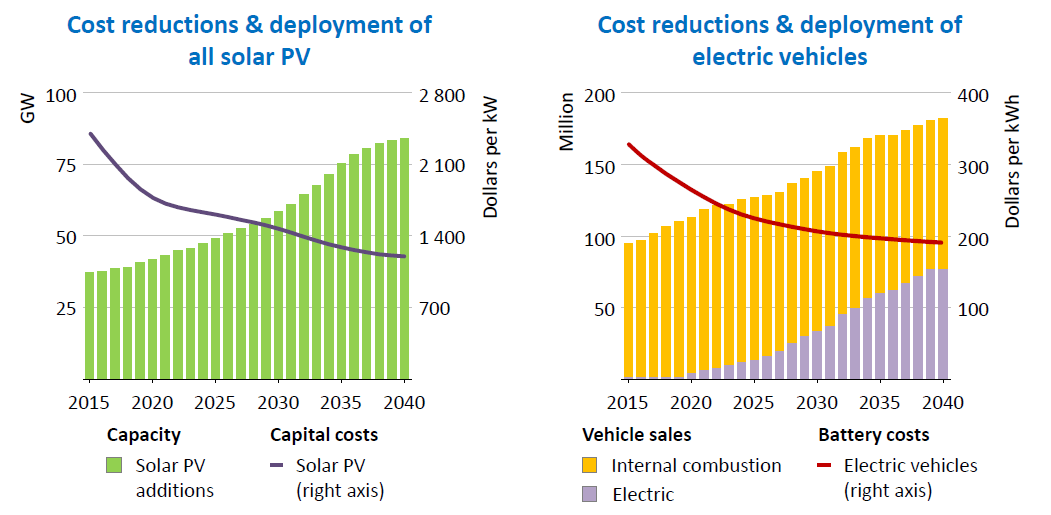
On the positive side the IEA see a huge reduction in the costs of solar PV and electric vehicles by 2040 with most of the cost reductions in both happening in the next 5 years (see IEA graphs below).  They also note that emissions fell last year when the global economy grew – a first.

solar and electric car data going fwd from IEA

Neil

Posted in climate change, One thing we have learnt this week | Tagged , , , | Leave a comment

oil and gas reserves show signs of peaking

Oil and gas reserves show signs of peaking.  These are two of the first facts I noticed in the latest BP Statistical Review of World Energy (one of the big two energy data events of the year).  In this post I will be looking at the stuff BP have not chosen to highlight.

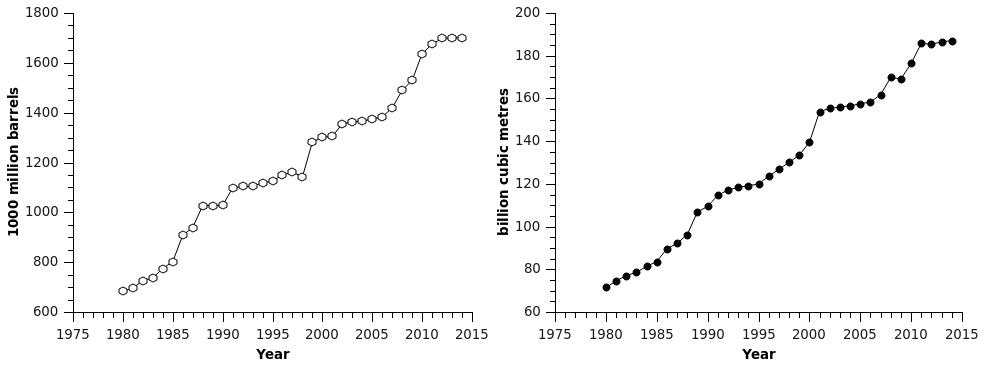
We have covered on this site before the possible peaking of gas reserves, but not oil and gas reserves together.  In 2014 the natural gas reserves increased very slightly by just 0.3%, this is just behind consumption, which increased by 0.4%.  This time the oil reserves have also shown a fall (the first for many years).  Its not huge one and all but invisible on the graph below (left hand graph).

oilandgasdataHowever, both the oil and gas reserves data are starting to look like a trend and that trend is the top of a peak.  Of course the production fall lags a reserve fall.  Peak oil theory suggests a 30 year lag at least on conventional oil.  Things are more complicated than that.  Unconventional oil and gas deplete much faster as we covered in our book.  In addition as the east to extract oil and gas disappear we are using more primary energy to extract the less easy stuff.  Again we cover this in our book.  It means we are using more and more energy to stand still and reserve data is probably much more flattering than it looks (although this also depends on demand).  Its however telling even with oil and gas reserves being flattered by unconventional oil and gas the reserves look like they are peaking.

Neil

Posted in peak gas, Peak oil | Tagged , | Leave a comment

One thing we have learnt this week- future oil and gas prices

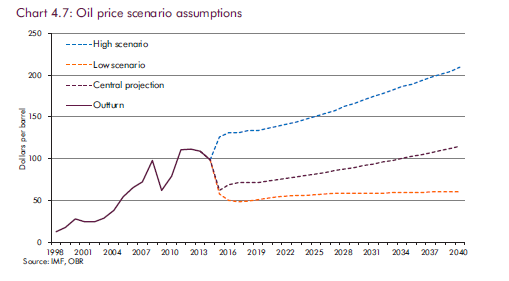
Its a brave person or organization that attempts to predict future oil and gas prices.  One such body is the Office for budget responsibility (OBR).  Set up by the last Tory led coalition as a political wheeze, its proving quite useful criticising the current government of the UK when it feels its necessary.  As its name implies it makes budget predictions and as part of these it must consider oil and gas prices and hence revenues from UK oil and gas production (mostly but no entirely in the North Sea).  Until recently the tax income from this was an important source of tax revenue.  No longer.  Oil production hit a peak in 1999 and will never recover.  This and the falling oil price have decimated revenues (see below).  However,  what is of interest is the OBR in their latest report do not see any quick recovery in oil or gas prices (see graph below).  They also do not see any recovery in UK oil and gas production (also shown in the graphs below using OBR data).

oil and gas price projections

See this graph below lifted from the OBR report below which shows long term projections for the oil price.

obr oil price forcast 2015

The lower oil and gas prices and falling production has had a calamitous effect on revenues.  Between now and 2020/1-2040/1 the tax revenue from the North Sea could be as little as £2 billion or even -£5 billion.  This last last figure raises an important problem.  As the rigs come to the end of their life they need decommissioning.  The exact cost is unknown, but very high.  One estimate is as much as £32 billion.  It looks like the North Sea is entering a phase of making a huge loss.

Neil

Posted in energy costs, One thing we have learnt this week, Peak oil | Tagged | Leave a comment

Going fossil free (in 100 years)

954838_204501379701698_1765426126_nThe G7 have committed to going fossil free at the latest G7 conference (in 100 years).  Opinions are divided on whether the G7 is any longer a good idea and also whether the fossil free pledge is good idea.  I agree with Larry Elliot that the whole idea of the G7 is outdated (have you noticed that no protests take place around it anymore).  And whilst I can see the idea of the fossil free pledge sends a message, it in my view it suffers from the following rather obvious flaws;

  • The fossil free time frame is too long.  100 years is a vague concept to most people and all the current political leaders are likely to be dead.  This is the whole  problem with climate change its too far ahead for most of us to cope with and this makes it worse
  • The fossil free pledge is too vague.  Do what specifically by when in the intervening period?
  • The fossil free pledge is too late.  By 2115 we will by fried on current rates of progress.
  • By 2115 there won’t be any fossil fuels left to speak of anyway.

One positive is that the idea of going fossil free has promoted some discussion.  Professor Catherine Mitchell Professor of energy policy at Exeter University on the radio identified the main problems with going fossil free that we did in our book.  That is materials and transport (although we would add renewable heat too).  Lets face it this fossil free pledge doesn’t add up to a row of beans and we need some serious pledges before Paris.

Neil

Posted in climate change, Peak oil, Politics | Tagged , , | Leave a comment

One thing we have learnt this week- Saudi oil

saudi gas productionThe New York times has discovered something very interesting this week about Saudi oil and global energy prices.  One of the big mysteries about the current low oil price is why the Saudis keep pumping the stuff.  After all they have never behaved this way before, always wanting since 1973 to cut production to maintain higher prices.  Even when oil hit an all time high in 2008 they didn’t really make serious production cuts.  It even more surprising when analysts have needed the Saudis need much higher oil prices than than they are at the moment.  Whilst much of Saudi oil from mature fields is very cheap to produce (probably less than $10/barrel) the Saudi economy is reliant on high prices.

Various theories have been doing the rounds for this reluctance to cut production I’ve reported on these and advanced a few of my own.  It looks like the NYT may have come up with the answer.  Its not Saudi oil, but gas that is the reason.  Outside the peak oil community there has been little attention given to the fact that the Saudis are using much more of the oil they produce themselves.  Their population has grown and with it their affluence.  The Saudis use oil and in particular gas for much of their electricity generation.  According to the BP statistical review of world energy they use all the gas they produce (graph above).  This gas which as in so many fields overlies the oil.  Its difficult to produce one without the other and in this case the Saudis are stuck- locked into a fossil fuel dependence they have done so much to create.

Neil

Posted in energy costs, oil prices, One thing we have learnt this week, Peak oil | Tagged , , | Leave a comment

Church divestment

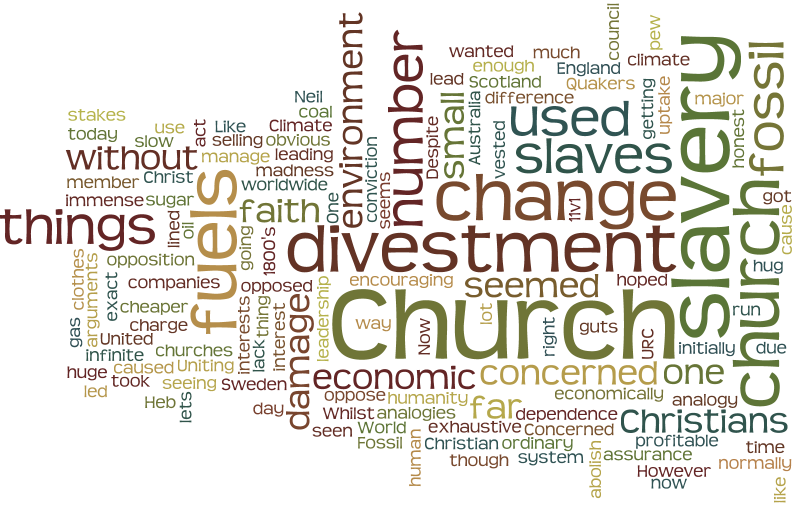
church divestmentOne of the most encouraging things going on as far as climate change is concerned is church divestment from fossil fuels.  Despite the lack of interest of the ordinary member in the pew in the environment (and lets be honest there isn’t much), church leadership worldwide is getting more concerned.  Concerned enough to lead to church divestment by selling their (normally very profitable) stakes in oil, gas and coal companies.

There are analogies here to slavery.  Whilst they are not exact, they are there.  Like slavery the church has been both slow on the uptake and leading the charge.  A small number of Christians (initially) wanted to abolish slavery seeing the immense human damage it caused.  Again there are a small number of Christians who have led the way on the environment.  Climate change will cause huge damage to humanity.  However, as with slavery there are huge vested interests lined against change.  Those who opposed change used the same arguments of economic dependence used today.  We couldn’t manage economically without slaves and we cannot without fossil fuels.  Those in the 1800’s had got used to cheaper clothes and sugar due to the use of slaves.  The analogy is obvious.  It took a lot of guts to oppose the economic system then and it does now.

Church divestment in fossil fuels seems to me an act of faith as was Christian opposition to slavery.  It seemed like madness at the time but was the right thing to do.  There is one major difference though, the number of slaves seemed infinite.   Fossil fuels will run out one day.

Neil

Now faith is the assurance of things hoped for, the conviction of things not seen.” Heb 11v1

Church divestment so far (not exhaustive).

Church of Sweden
Church of England
World council of churches
URC Scotland
Uniting Church in Australia
United Church of Christ
Quakers

Posted in climate change, Faith | Tagged | Leave a comment

One thing we have learnt this week -Indian Energy

800px-സൌരോർജ്ജ‍ഫലകങ്ങൾThere was a very interesting article in the Guardian this week looking at Indian energy.  More particularly the Indian governments attitude to coal power and solar energy.  The whole article shows the tension between good intentions and development in the lead up to Paris.  The new Indian Prime minister Narendra Modi has promised everyone in India access to electricity I believe by 2019.  Since a third of the population have no access to the grid (including many who suffer the direct pollution of old coal fired power stations) this is given India’s population quite a challenge.  Indian energy policy has made the news mainly because Modi has announced a huge increase in solar energy from 3 GWp today to 100GWp in seven years (at the moment total generating capacity for all forms is about 200GWp).  But at the same time a whole heap of new coal plants (very efficient and clean) are being built which would mean Indian energy (electricity) was made up of 55% coal in 2030.  At the moment the slow down in the economy means there is an excess of generating capacity but if the economy picks up there could be a shortage of electricity by 2017.  And there are still power cuts.

All India’s energy plans are very ambitious.  Solar would have to go in at a rate not seen anywhere else so far.  However, as we have seen elsewhere solar constantly exceeds expectations.  It also has a huge advantage of matching India’s energy demand, when air-con needs are highest solar output at a maximum.  A whole heap of entrepreneurs are selling solar systems as back up  power systems as an alternative to expensive noisy smelly diesel system when there are power cuts.  In addition due to the good solar resource PV electricity is only very slightly more expensive than coal powered electricity.  Finally whilst it takes nearly a decade to build coal fired power stations solar can go in months.

The Indian government thinks it should be able to develop and unlike China make no carbon cutting commitments.  Is this fair especially when India’s historical emissions are high?  Should Indian energy policy take account of climate change or should we cut more so the developing world can develop?

The whole article can be seen here.

Neil

Posted in coal, One thing we have learnt this week, Renewables | Tagged , , , , , | Leave a comment

James Watt’s Steam engine

Engine_watt.svgIts approximately 250 years (last week) since James Watt’s Steam engine was invented and with it the industrial revolution.  James Watt’s Steam engine had a huge advantage that it used a separate condenser.  Up until then the existing engines had one cylinder in which the water was heated up until steam which escaped to power a drive shaft.  The heat exited and then the whole thing had to be heated up again.  This made the whole process very ineffective.  James Watt (out walking) came up with the more efficient process in his head.  Apart from the above modification when the steam exited the separate condenser it produced a partial vacuum as the condenser cooled.  This could be used to pull a piston into the condenser meaning this part of the process could also provide energy.  In total the whole process was three times more efficient meaning coal went three times as far.  James Watt’s Steam engine led to the industrial revolution which started in the UK.

Obviously the industrial revolution has had mixed effects.  The plus sides don’t need to be spelled out, least of all since you can read this blog!  The minus sides include climate change, excessive materialism and and an unhealthy addiction to fossil fuels.

Andy described the problem we face very well in our book.

One of the problems with using alternative energy sources is that most of them suffer a comparative disadvantage in energy density when measured against our current, very energy-rich sources of power. Only a few centuries ago, humankind was burning only
wood and dung for energy, and using hand-labour and draught animals to do work (and of course in many parts of the world people are still doing this). As populations increased, agriculture and demand for firewood cleared the forests and the resulting shortage of wood led to people burning coal. As development continued, the immense energy needs of industrialisation and urbanisation were met by the use of more and more coal, then oil, and more recently gas and nuclear fuel. Each change of energy supply has been to a more concentrated energy source, with the carbon and nuclear fuels we currently use having a very high energy density.


Posted in Uncategorized | Leave a comment

One thing we have learnt this week- nuclear is more expensive than we thought!

Nuclear is more expensive than we thought? That’s the lesson this week as the private consortium tasked with cleaning up the UK’s “magnox” reactors is laying off 1600 workers.  There is a suspicion that this could be a prelude to the private consortium demanding more government money.  The reason being given that the task is much more complex than anticipated.  A completely separate contract for the clean-up of Sellafield involving a different group of companies has been ended due to problems.

Nuclear is more expensive than we thought, tell me something I was not expecting!  The reason nuclear is more expensive than we thought?  No thought went into how to dismantle these reactors when they were designed.  You also wonder how much is going into decommissioning with new reactor designs?  One problem is its unlikely the designers will be alive when any decommissioning takes place.  Just think how difficult it is to communicate complex ideas in writing for someone who have not met 40-50 years in the future?  Especially on something like a nuclear power station.  It doesn’t matter does it anyway its some else’s mess.

Meanwhile negotiations on Hinkley C continue with lots of construction jobs being cut there.  As reported on this site over the last few years this new nuclear power station hangs in the balance.  (And by extension all the other proposed ones in the UK).  It still seems unlikely to go ahead and its therefore less surprising that the government has been pressing ahead with plans for 3-4 new interconnectors.  In the meanwhile renewables (in particular solar is leaping ahead) and the plans were confirmed this week for another large offshore wind farm.  Nuclear is looking increasingly out of kilter as yesterdays technology.

Neil

Posted in Nuclear, One thing we have learnt this week, Renewables, Uncategorized | Tagged | Leave a comment