One thing we have learnt this week

cropped PVAnother warning from OFGEM  about energy security warning that the lights might go out has hit the news over the last 24 hours.  What we wrote in the first paragraph of our book does not seem so far fetched now.


The modern world is not perfect, but if you were born in a developed country sometime in the last sixty years, it is likely that you have experienced a rising standard of living, with increasing comfort and convenience. Yet we only need to look back a few generations to see how much has changed, and how much we take for granted. We flick a switch, assuming that electricity will be there to light up the bulb. We expect to be able to travel long distances quickly, in comfort and at reasonable cost. We think nothing of sitting down to a meal whose ingredients have been transported across the globe to our table. These things and many more besides have become basic expectations for most in the developed world – and as Christians living within a modern, developed country we share them. While we may bow our heads and give thanks for God’s provision at the start of a meal, in most other ways we take the conveniences of modern life for granted.

Why this is happening is because almost all the coal and nuclear plants will be closed by 2016.  How likely is it?  Difficult to say, the press is saying that the government will pay intensive energy users (industry) to shut-down and National grid would be given powers to bring mothballed plant on-line.

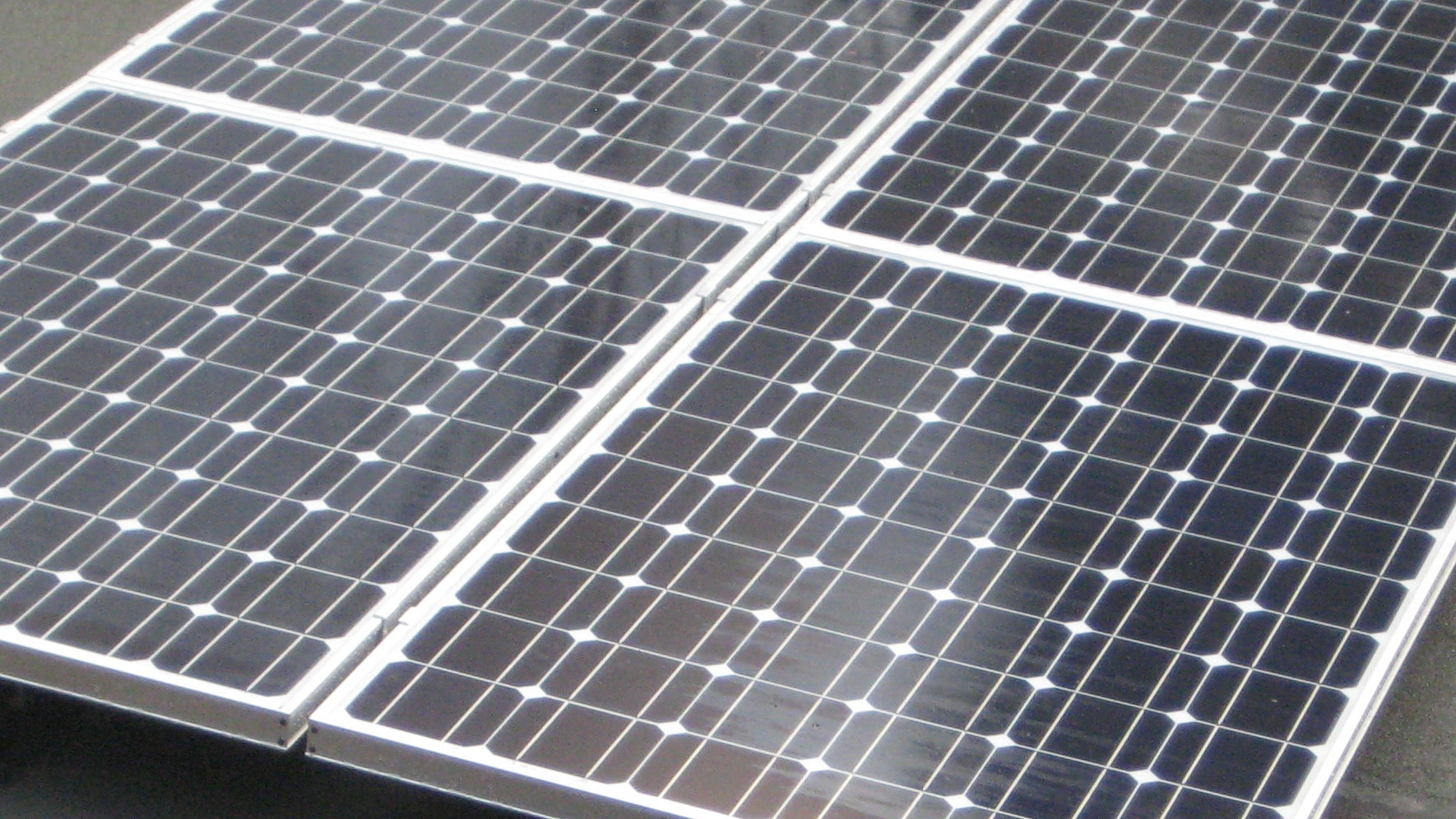
How can you help?  Move into an energy conservation mode.  For example LED’s are expensive but cost effective and the light is now just like an incandescent bulb.  Consider not only saving energy  but “producing” your own using PV’s, wind (in the country) or hydro (if you are really lucky and have access to water).  Finally as a warning to American readers of this blog.  Don’t get complacent about your own energy supplies from shale.  We did with the North sea.  In energy terms its here one minute and gone the next.  The days of cheap energy are over, this will affect Christians and churches as much as anyone else.  Further details can be found in our book.

Further details can be found about OFGEM’s concerns here.

Neil

Posted in One thing we have learnt this week | Leave a comment

BP a look at fossil fuels

As I mentioned in the previous blog post the annual BP statistical energy review is out for 2013 (of course its most recent data is for 2012).  So what do we learn about fossil fuels?

Gas

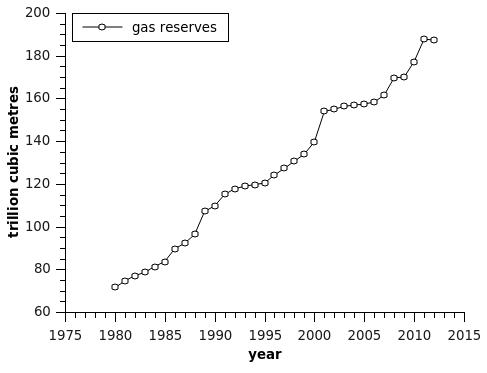
This makes up 23.9% of primary energy production worldwide.  Consumption grew by 2.2%, below its historical average and production by 1.9%.  But the real shock is that the gas reserves fell, as you can see from the graph below this is the first time this has ever happened.  In the days when unconventional gas is a “game changer”, this is very surprising.

gas reserves graph

gas reserves graph (source BP statistical energy review (2013)

This is not highlighted anywhere on the main BP energy review website whatsoever or in the pdf of the report.  It is mentioned in one of the gas webpages on their site.  The reason given is reserve revisions in the former soviet union countries.

Oil

Still makes up 33.1% of primary energy, although this is the lowest value in the reviews history.  Consumption grew by just under 900,000 barrels a day (below the historical average).   Production grew 1.9 million barrels a day partly due to a recovery in Libya but also a large increase in the US.  Consumption fell in the US though by 2.8%.  As this blog has covered American driving may have peaked.  How long the shale oil story will play in the US is extremely questionable as we covered in our blog in the past.

Coal

Output was 2% higher as demand apparently weakened.  Demand was 2.5% and coal is that fastest growing fossil fuel although this figure was less than the average for the last 10 years which is 4.4%.  Coal prices are also given, these have risen dramatically since the millennium but have fallen back a bit over the last year or so.  Reserve values although the highest of any fossil fuel just keep falling.

coal data from BP

Coal reserve data (source BP)

Nuclear

As predicted on this blog there has been another big drop in nuclear output of 6.9% for the second year running.  Nuclear powers’ days are over.  In the next blog I will examine the renewable energy data.

Neil

Posted in Peak oil | Leave a comment

One thing we have learnt this week

I’m not sure about “we have learnt” should be the title this week of this regular post.  Perhaps “I have learnt” would be a more appropriate title.

I have been reminded of how much energy it takes to boil a small amount of water.  A friends husband at our homegroup barbecue got us to demonstrate this by means of heating it by pedal power.  He and some friends had built a home-made pedal powered heater.  Bits of bike attached to dynamo with a heating element in an insulated box.  It took 5 of us with about 2 minutes pedalling each to get the cup of water boiling.  And yet we flick the switch on a kettle without thinking about it.  A picture can be seen on our Facebook page (link on the RHS).

Neil


Posted in One thing we have learnt this week, Practical low carbon living | Leave a comment

There are some reasons for hope…

Two new reports are just out.  The International Energy Agency (IEA) has produced a report called “Redrawing the energy-climate map” and the annual BP review of world energy is also out.

There is both good and bad news in the IEA report.

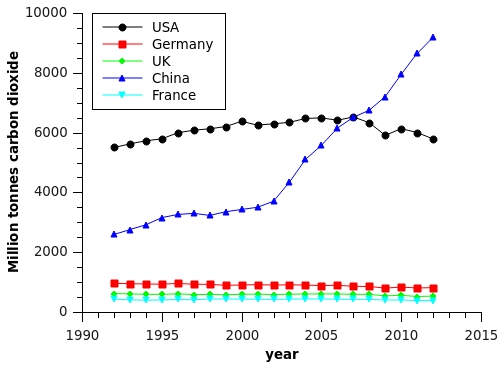
The good news is that in both the US and China switches to renewables and possibly gas are driving either a fall in emissions (US) or a continuing fall in the rate of emissions increase (China).  The EU also had a fall in emissions partly due to an increase renewables output.  In China the electricity output increase of just over 5% in 2012 was met by increased renewables output.  The CO2 intensity of Chinese electricity is also plunging, although its still much higher than here.  Energy efficiency in Japan was not enough to prevent an increase of 70Mt of carbon emissions due to nuclear shut-down.

The bad news is according to the IEA (who it should be stated are not climate sceptics) that we are still heading for a 2.8-4.5 increase in temperature on current trends.  The IEA states that to prevent this we need to have emissions on a downward trend by 2020.  Can we do this?  Yes, but its tough.  The IEA say four things have to happen.

  • Making our buildings and transport much more efficient.
  • Phasing out fossil fuel subsides.
  • Minimise greenhouse gas emissions from  oil and gas production.
  • Limit coal power.

So at last the US and China are making huge strides in the right direction, hopefully not too late.  Some of the bulleted points you can take action on and your church could lobby on others.  The BP energy review will be covered in another post.

Neil

Posted in climate change, Peak oil, Renewables | Leave a comment

One thing we have learnt this week

I was going to lead this week with something completely different, but I have just heard the US supreme court has rejected the idea that human genes can be patented.  Apparently they could not see how something that was a “product of nature” could be protected in this way.  This has implications across biology.  Up until now both US and EU patent law allow patenting of genes in plants (and presumably other organisms) if the the gene was sufficiently “isolated” from the organism.  There was an extraordinary case of Monsanto taking a Canadian farmer to court after they noticed he was using “roundup” resistant canola.  [It fell into his field by mistake and he noticed it survived roundup so he collected the seed and used it the next year. Astonishingly Monsanto came round and tested the canola in the area to use if anyone was using GM canola without paying and took him to court.  They won and this helped confirm that genes could be patented].  What’s the difference in law between a plant gene and a human gene?

As we posted on our Facebook page a week or so ago there is a concern that large agro companies will patent more plants and genomes.  There is a move to sequence many plant genomes on crops much used in the developing world and publish the sequences so that they cannot be patented.  This does not just relate to GM.  Genome sequencing is so easy now products of conventional plant breeding can be sequenced to look for useful traits, speeding up the conventional plant breeding process.  With food supplies under pressure as never before we do want farmers anywhere paying for a limited numbers of varieties under the control of the likes of Monsanto. In addition many bacteria could have useful genes to make limited (see our book) quantities of bio-derived materials.

As a biologist this ruling seems logical and just.  It does preclude companies making money from the innovations around the gene(s), just they cannot own the genes.  Its time for another look at the law concerning plant genes.

Neil

Posted in One thing we have learnt this week | Leave a comment

Review

Another good review for “No oil in the lamp” this time by Green Christian magazine.

The first thing that made me sit up was the review that read “Neil and
Andy have set out the background to the issue of Peak Oil and exposed
some of the consequences of an energy-constrained future”, this by the
Chief Executive of Scottish and Southern Energy!”

Neil

Posted in Book, Reviews | Leave a comment

One thing we have learnt this week

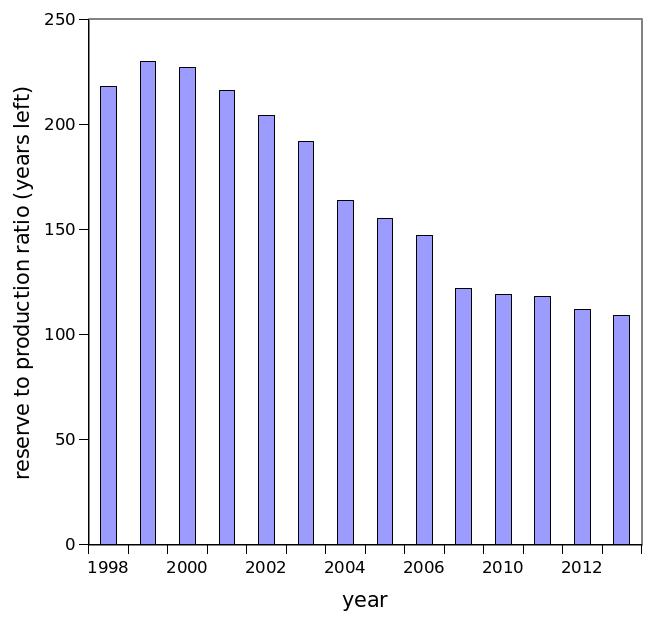
Governments don’t get the need for de-carbonisation.  This week a policy to make all power generation zero carbon by 2030 was defeated in the UK.  Instead there is a danger we will be locked into higher prices due to natural gas price increases. Of the four conventional energy sources we examined in our book, gas appears to have the best reserves, although these reserves, particularly unconventional ones, may be exaggerated.  However, even large gas reserves will not delay a crisis if oil peaks soon, since the gas price is linked to that of oil for the reasons given above.  It therefore seems likely that gas prices are going to keep rising, this is particularly true in Western Europe where there could be actual shortages of supply due to depletion of indigenous reserves.  This is a disaster if we stick with our current course for everyone but particularly the poorest in our societies.

Neil

Posted in One thing we have learnt this week | Leave a comment

Can GM feed the world?

One of the claims made every-time you hear a proponent of genetically modified plants talk is that GM plants are required to feed the world because we are facing a global food security crisis.  Whilst I would agree we are facing a crisis, is this true?  Are they the technological leap forward agriculture has had in the past and can they overcome many of the climate and peak oil issues we face with growing enough food in the future?

There a number of reasons why GM may not be the solution.  Some of these are commercial, some how our agricultural system works and some are due to the current scientific limitations of GM technology.  Taking each of these points in turn.

Historically GM has aimed at modifications that do not directly benefit the consumer but apparently only the big agro companies or possibly the farmer.  In 2002 almost all GM crops in production were modified for herbicide resistance, insect resistance or virus resistance.  A few modification traits were in production for improved shelf life (Scragg, Environmental biotechnology 2005).  Although I heard on the news in 2012 that some GM drought resistant maize had saved what was left of the US maize crop that year, this does not seem to be the case.  Some new conventionally bred varieties were sold in 2011 with these traits.  Currently an internet search suggests not much has changed and all the GM crops in production cover the same traits mentioned above.  Its the cosy link between agro companies selling you a crop that is resistant to a herbicide they produce that is a large part of the reason that GM is so controversial, in my view.  Their claim that using GM herbicide resistant crops means the farmer will use less herbicide is not logical.  In addition many of the staple crops that people rely on the developing world are left out of any technological developments.  To be fair in a few years this is going to change with the introduction of “golden rice”, rice with vitamin A engineered in.  This rice has had charitable and biotech company development input.

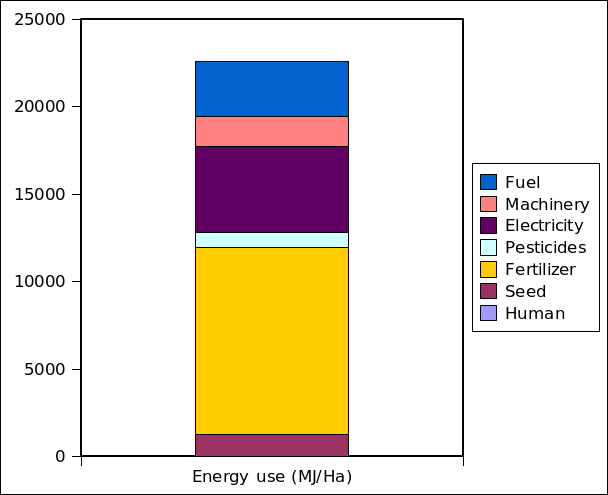
The second major limitation of GM is it does not overcome the huge oil dependency of agriculture.  The graph below is a good illustration of this ( taken from “Global food waste not, want not”. IME 2013)

The energy use in growing one Hectare of wheat.

The energy use in growing one Hectare of wheat.


As you can see the amount of energy due to human effort doesn’t show up on the graph (its just 6MJ!) and the energy due to other fossil fuel dependent factors are huge.  Even if you could remove the fertilizer component (see below) this would still leave over half the energy to be replaced with non-fossil fuel based sources.

Leaving aside ethical considerations GM has a number of biological limitations.   The first is where the foreign DNA ends up in the plant genome. For one gene this probably doesn’t matter. Cells where the introduced gene has ended up in the middle of another critical existing plant gene probably won’t grow. But in another cell in the same culture it may have ended up somewhere else within the plant genome and these viable cells are selected then grown on into plants. Its when you want to put multiple genes in plants this would become more of a problem. The other obvious limitation is the fact that you can only transfer a few genes (golden rice is 3). Many of traits large agro-companies or charitable organisations would like to engineer into plants involve large families of genes.

The “holy grail” of plants with a large gene transfer requirement is that of legumes. These plants which include beans, peas, soya, peanuts and some trees have symbiotic relationships with bacteria in their roots. These bacteria fix nitrogen from the atmosphere into the soil. The argument goes putting this capacity in plants that require large amounts of fertilizer (e.g. cereals) would save both money and the declining resource used to make it (e.g. natural gas). However, the relationship between the plant and bacteria is an extraordinarily complex one and involves major changes in the structure of both parties. These changes involve large numbers of genes. In the case of the plant the number is in excess of 40. For the bacteria its around 20. Currently nothing like this number of genes can be transferred into plants.  However, the complexity is not just the shear number of genes required that may make the plant non-viable by ending up slicing through vital genes. The other difficulty is that a whole series of other DNA sequences are required to switch the genes on/off have to go with them, possibly in other parts of a particular chromosome or even different ones if translocated.  In addition these genes operate as groups and have to be able to interact with one another.   Lastly considering climate change we may need to engineer plants with both drought and flood resistance.   Again this would take multiple gene transfers into the same plant. This is not possible at present and probably involves synthetic biology.

Neil

Posted in climate change, Food, Peak oil | Leave a comment

Should Christians be allowed to park for free on Sundays?

I was very surprised to read today that some councils offer free car parking to Christian church-goers on Sundays in city centres.  In fact the council most in the news (Woking), offers free parking to all faith groups.  Woking west of London is mentioned in our book since the council has built its own electricity micro-grid and offers its residents and businesses access to cheaper power*.  The council did this to cut its carbon emissions, which it has done significantly.  Its therefore surprising that they encourage people to drive.  Its also surprising that anywhere in the UK offers free city centre parking!  I have been to France recently and even in a major city we visited the parking was free on a Saturday in a city centre car park.  This is inconceivable in the UK.  Certainly in Edinburgh members of the city centre church I attend have not been offered free parking.  Exactly the opposite, currently you can park on a Sunday for free if you can find a residents permit parking space, everywhere else you pay.  These are limited in number and with more and more shopping  and cars in the city centre it has been getting harder and harder to park.   However, the council is currently consulting on charging for even residents permit parking spaces on Sundays.  In addition (and for us that is part of the problem) they are free for everyone, not just church-goers.  Its such a hassle I refuse to go in the car and cycle (as I wrote in the previous but one post, that’s not the only reason).

The council gave the reasons for this policy as follows;

The policy applies to all faiths, not just church-goers. The council considers that places of worship, and the faith communities that they serve, play an important role, both in society in general and Woking in particular.

They encourage people to participate in society, thereby promoting social inclusion. In addition, considerable voluntary work is organised by faith communities, often for the benefit of the more disadvantaged members of our society … In furtherance of this aim, the council allows members of a faith community to park free of charge.

This is encouraging and I would hope true, but I cannot agree with it.  In days when we need to cut carbon emissions and change our lifestyles Christians should be at the forefront of environmental change.  There are good reasons not to use the car to go to church and good reasons to get people out of their cars in general.  Our church undoubtedly gums up the streets around it with cars making it more difficult for residents and another church does the same in my street.  Congestion and pollution is a big problem in any city where the car is king.  Parking charges are not only a revenue stream for local government but a way of getting people pay for some of the external effects of internal combustion.

Of course this car parking exemption is being challenged by the “National secular society”.  Normally I don’t have much time I don’t have much sympathy with this bunch, who should get a life.  But this time I do, although not the idea of making parking free for everyone which is one idea they are suggesting as an alternative.

Neil

* The power sources are fuel cells and photovoltaics.

Posted in climate change, Peak oil, Practical low carbon living, Transport | Leave a comment

One thing we have learnt this week

Food banks have been in the news this week in the UK.  This may surprise our US readers but they are relatively new here.  A combination of high energy prices (feeding through to higher food prices), the global economic crash and no rise in median incomes for around 10 years has meant that people are struggling to make ends meet.  What is surprising is how many working families are using food banks.

Following on from an article earlier in the week in the Guardian on the fact that food banks are booming there are a number of letters bemoaning their existence in today’s print edition.  This includes one from a Quaker congregation saying they will not be donating food.  Again it may surprise US readers but we like our social security system here.  Its under strain and attack but is still relatively intact.  It has its faults but is a reasonably efficient way of distributing money to those in need (which is not say it does not require reform and simplification).  What concerns people here is a return to the pre-war mix of charities and local government schemes which didn’t work (my parents teeth being one good example of pre NHS dentistry).  I have other concerns as well.  Giving people food rather than money means they are more limited in their food intake and are not taking responsibility for their diet.  In addition this oil based processed food which apart from not being great for our health is not sustainable in the long term.

The biggest food bank in the UK is run by Christians so this makes it a difficult issue for many of us here who are Christians with doubts.  Whilst I understand the concerns of the Quakers I have to say if I see a need I should meet it.  I’m a reluctant giver though on this one.  With still high and increasing oil prices this problem is only going to get worse and I think food banks are here to stay.  It would be nice to see some gardening projects as part of the food bank approach though…

Neil

Posted in One thing we have learnt this week | Leave a comment