Smart power revolution

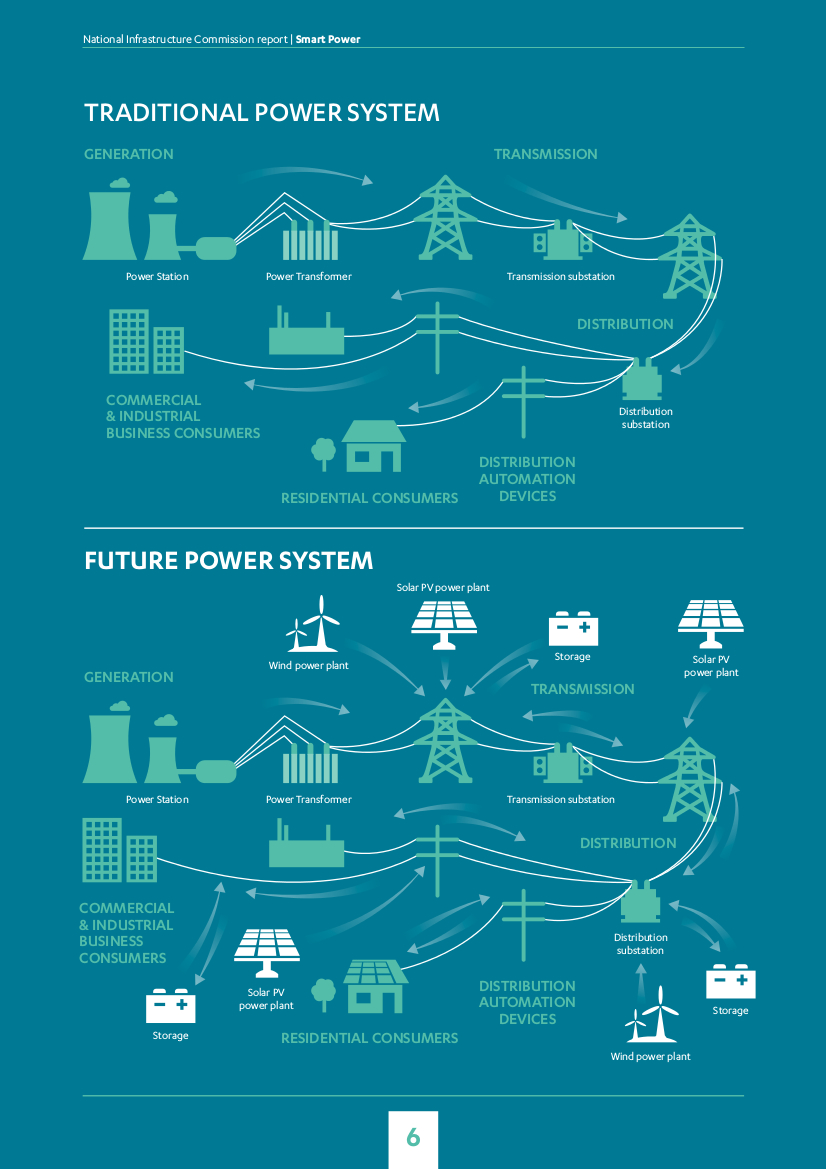
IC_Energy_Report_webThe smart power revolution is on its way, that seems to be the message from two reports in the last week.  The first was from Energy UK.  The second is from the national infrastructure commission.  This latter body was set up by the chancellor to give political cover to controversial infrastructure projects such as nuclear power stations and airport expansion.  I’m not sure this report is what he was after.

As “Smart Power” says we face a number of challenges.  We need to cut CO2 emissions by 80% by 2050.  At the same time we are closing a a whole heap of coal and nuclear power plants.  The only types of generation the power companies want to invest in appear to renewable sources (mainly solar and wind).  The cost of these are now close or at competing with traditional sources of energy.  It looks like the traditional model of power generation is now dead (that of large central mostly fossil fuel powered power stations).  These new sources of power are however more difficult to manage their power output being both variable and diffuse (so you need lots of them).  A final challenge is that the UK grid was never designed for distributed generation and in any case needs renewal.

The answers lie in what this report calls smart power.  The characteristics of which are according to them;

Interconnection – sharing our power with our neighbours so that peaks and troughs in renewable production can be ironed out.

Storage – storing power- there are a variety of technologies not just lithium batteries.  Again ironing out variability in production.

Demand flexibility – this includes such things as smart devices at a domestic scale which switch on when power is cheap and plentiful and demand management for big users.  Also smart meters which allow consumers to maximise power use when demand is low.

By doing all the above we can largely negate the need to build large power stations.  So far so good and largely we agree having covered a lot of the above in our book.  The report comes up with some rather vague recommendations to take this forward none of which involve the government spending money.  However I have some concerns and caveats.

The first is that interconnections should not be used as an excuse not to build up our own generating capacity.  By doing so we would and have indeed have become more dependent on our neighbours for our electricity.  We have largely import through the French and Netherlands connectors although the Irish connector is largely used for export.  In addition one of the interconnectors suggested is Scotland-Iceland.  At the moment as this report admits the Iceland has little excess generation capacity, so would not be worth building.  I would also add that the distances and therefore resistance power losses would be huge as would the cost.

I have no problems with storage at the grid level.  As Energy UK say this is the next big revolution.  I have suggested before at the domestic level storage will not make the grid easier to manage without smart meters.

I do some concerns about smart meters and domestic demand management.  I don’t have any problem with the concept of smart meters but wonder whether their implementation as it is planned at the moment can make them easy to hack.  The second concern is over smart devices.  Do you really want an internet of things with all the risks over security and hacking?  In addition getting people to use their white goods at night maybe risky, disturb neighbours and downright difficult.  However, I’d by and large recommend the report which says we could save £8 billion a year if we go down this route which maybe not in precisely this form, is the future of our energy system.

Neil

Posted in energy conservation, other, Renewables, Uncategorized | Tagged , | Leave a comment

One thing we have learnt this week UK energy lobby group changes direction

2013-07-13 19.28.08In what could be a very significant move the main energy lobby group in the UK (UK Energy) has changed direction on its renewables stance.  Up until now the lobby group which represents all the “big six” suppliers has been regarded as a bit of a dinosaur with its defence of big fossil fuel powered central generation.  A sort of “you leave generating electricity to us” stance.  However its just produced a report that embraces renewables.

The new head Lawrence Slade said “It would be quite a sensible thing to have an Energiewende [Germany’s plan to move to a majority of renewable energy sources] but the emphasis would have to be on our own version not a direct cut and paste.”

The lobby group also see energy storage as being vital, solar PV and other distributed forms of generation being massive.  Energy UK see PV being at grid parity (at least up the garden path) in a few years.  They see demand management using energy efficiency and smart grids as a means of managing the peaks and troughs of renewables production.  they support the phase out of coal fired power stations and the lobby group also has concerns over the cuts to renewables support since the election.  The lobby group also thinks energy storage from batteries is going to be enormous, the only debate on being how soon do the economics add up.  What a turn around and bizarrely that leaves the government and almost everyone else going in different directions.

Neil

Posted in climate change, One thing we have learnt this week, Renewables | Tagged , , , | Leave a comment

Peak stuff updated

As lent is underway it seems appropriate to write about “peak stuff”.   Have we in the west reached peak stuff?  There have been some comments in the last few weeks from business people suggesting we might have reached “peak stuff”, the point where people have have had enough with consumerism, in the sense that we have enough and don’t buy anymore.  A businessmen recently said at a Guardian discussion day.

In the West, we’ve probably hit peak stuff. We talk about peak oil. I’d say we’ve hit peak red meat, peak sugar, peak home furnishings.

The office for national statistics has just released some data suggesting that the UK is consuming far less stuff, backing up the peak stuff hypothesis.   The crude data suggests we use about 10 tonnes per annum (2013) rather than 15 tonnes (2001).  The argument then starts on imported goods but despite this it does look like the peak stuff theory is holding up.  One pro argument for this is that if you think about almost anything we buy is smaller and made more efficiently.  Our oil and gas use is also dropping.

There is no record of Jesus owning anything (something the health and wealth brigade ignore).  However, since traditionally he was a carpenter (in actual fact this is one translation of his father’s profession -earthly father’s profession!) and didn’t start his ministry until he was thirty(ish), logically he must have owned something.  Be this at it may Jesus condemned excessive consumerism in both parables and comments to those he met.  For example Mat 6v19;

Do not store up for yourselves treasures on earth, where moth and rust destroy, and where thieves break in and steal.

Or the parables of the rich young ruler or the farmer who built the bigger barns, or the story of Lazarus… You get the idea.  I personally don’t think Jesus expects to live without any pleasure or comfort in our lives (there are other verses that suggest this), but certainly not to run after stuff and make it our god, which for many people in the West it has become.  Or at least it has up until now?

The question is has our demand for stuff peaked?  We looked at this a bit in our book under green economics.  The data plotted in the figure below at least in part is due to Chris Goodall a former green MEP and it is that we discussed in our book.

peak stuffDomestic material consumption (DMC) is the weight of resources used within the UK, including imports and excluding exports and total material consumption (TMR), the total weight of goods consumed in the UK plus all the resources used to produce them, domestically and overseas.

The interesting thing is the trend and when it starts.  Well before the financial crash.  Of course the data is out of date and at least on cars has been surpassed.  However even this is not necessarily a negative.  People have been generally buying more fuel efficient vehicles, often smaller.  This fits in with falling oil demand in the West.

There is no doubt economic growth has slowed in the Western world.  There are number of possible reasons for this being put forward.  Firstly, developing economies develop and this raises growth.  Second, inequality which rising everywhere within countries slows economic growth.  Third, there is a theory that all the main innovations and inventions have been made.  Fourth there is the classical reason that economists use to explain weak  growth, weak demand.  Lastly but one that rarely gets a mention since it contradicts current economic thinking- is perhaps we don’t want as much stuff.  All the data suggests it doesn’t beyond a certain point material goods don’t make us any happier.  Something that fits in with Christianity.

Neil

Another look at this here.

Posted in Uncategorized | Tagged | Leave a comment

One thing we have learnt this week -solar wars

DSCN1669“Solar wars” are breaking out all over the world.  What are being described as solar wars are taxes or charges on individuals or businesses that have solar panels fitted on their properties.  In Spain the government has introduced a tax on all electricity produced by solar panels even if the power doesn’t go to the grid.  To be fair systems under 10kWp are excluded.  However systems of 100kWp have to donate their power for free to the grid and huge fines and inspections are there for those who try to not declare their systems.

The solar wars in the US are taking the shape of fines on people with solar panels.  The latest is in Nevada but as you will see in that link solar is under pressure in most US states.  Most have utilities that have tried to charge owners of such systems.  In some cases the monthly charges are quite substantial, wiping out the savings from the solar system.

The reasoning behind both what is happening in the US and Spain (or at least the excuse) is that people have to pay for their systems’ contribution to the grid.  Their argument is that using the grid as a battery has to be paid for.  But is this really true.  The evidence is mixed.  Studies years ago here suggested high penetration of microgen would lessen the strain on the grid.  Part of this is due to fact that fewer large power stations are needed.  That said the distribution network owner in south west England and Wales has banned all new microgen recently on the basis that the grid is under strain.  However, many of us think the real reasons are different.  In the immortal words of Corporal Jones in a very different context “they don’t like it up them, they don’t like it up them at all”.  The decentralised model threatens the utilities and they are trying to fight back.   We already pay for the grid maintenance in our bills and will continue to do so but the charges in the link above are excessive.  Yes the grids were not designed for decentralised energy but the kind of charges being made cannot be justified.  The time is near when solar will not need subsidy and when that time comes the mother of all fights will be on.  There are two reasons why the utilities cannot win this one, the first is energy storage.  The Spanish tax obviously has this in its sights as well.   The second is very large scale roll out means that there will be millions of angry people who are voters.  Eventually the energy companies will have to embrace the new reality, becoming energy service companies rather than just energy production companies.

Neil

Posted in energy costs, One thing we have learnt this week, solar, Uncategorized | Tagged | 1 Comment

Hinkley C falters

It is looking like Hinkley C is finally dead.  With a lot of other stuff in the news such as the EU referendum the subject of EDF’s decision to delay the process for 3 more years has not been covered as it should be.  Officially EDF have merely “postponed” the start of construction until 2019.  This will make the reactor a mere 13 or so years late and that is at the start of construction!  That is also looking very tight on the 2030 cut-off date at which the UK government can cancel the whole thing without paying EDF.  The reason EDF are not going ahead they cannot raise the money.  EDF is under intense financial pressure.  The reactors its building in France are way over budget and behind schedule.  There is a problem with the pressure vessel at at Flamanville in France, where it contains too much carbon.  This may render it unsafe and could even sink the project.  The same problem seems to have happened in China with two reactors of the same design which are also delayed.  In addition at least €100 billion needs spending on the existing fleet of nuclear reactors in France.  EDF has spent £2 billion on the Hinkley C project so far and is supposed to be trying to get this money back.

The question is what this means for UK energy policy, most of which has been scrapped since the general election.  As I wrote about a few weeks ago the contracts for difference is not yielding any new plants, old coal fired plants are closing fast and there is no sign of any fracking.  The only kit the energy companies are interested in building is off shore wind, with the largest plant in the world being announced the other week.  Hitachi seems to be moving ahead to a certain extent with its reactor project in Wales.  One possibility being floated is the Chinese buying the EDF stake in the Hinkley C project in this way EDF getting its money back.  Then the Chinese would build their reactor design.  This would mean further delays since this design would need licensing.  It does look to me that Nuclear in the UK and therefore the West is dead.   Would the Chinese really want to take the risk with this project and the others they are supposed to be considering?  Hinkley C was supposed to be the flagship.  And all the time renewables are getting cheaper than nuclear.

Finally I must say our book came for a lot of criticism from someone at the world nuclear association.  You can see the review on our books Amazon page.  I see no reason to alter our view about nuclear power in the least, in fact exactly the opposite.  I repeat a reactor that is 13 years late before construction starts!

Neil

Posted in climate change, Nuclear, Uncategorized | Tagged , | Leave a comment

One thing we have learnt this week – eco town

1024px-Masdar_PRT_(3)_croppedMasdar an eco town?  I was going to write about the ongoing Hinkley C saga but found this story again, something I’d forgotten about.  Is Masdar an eco town or an eco ghost town?  When UAE decided to build this in 2006 it was supposed to be the worlds first eco town or even city with 50,000 residents and 40,000 people commuting in.  Greenhouse gas emissions were supposed to be zero and world famous architects such as Richard Foster were brought in to design eco friendly buildings and layout.  The project was Abu Dhabi’s (very successful) attempt to diversify out of oil.

10 years on though only 5% has been built.  Very few businesses have any kind of real presence there (only the Internal Renewable Energy agency and Siemens) and the town is a long way off being self sufficient in energy and may never be.   The electric transport system of electric podcars running on rails (above) seems to have been largely scrapped and apparently only 300 students actually live in the place.

What’s gone wrong and can we learn any lessons here?  Part of the problem with Masdar to be fair is the 2008 global crash.  The UK government is planning more than one eco town in England.  The first issue is putting something new where there is no employment is always difficult.  New towns were built after the war in England and Scotland and possibly only the much derided Milton Keynes has been a success in terms of balancing employment and residents.  Even there I can think of no major industries or employers.  Cumbernauld in Scotland is probably more of a commuter town for Glasgow.  The second tension is do you build the infrastructure first or after demand has appeared when people and businesses arrive?  It makes sense to build it first, but it can look stupid when demand does not materialise.

The proposed eco town s in England are a way of building on green field sites so as to minimise opposition.  The problem of where people work and how they get there will be a very difficult one to solve.  They will probably be no more “eco” than Masdar, but people will at least liver there.

Neil

Posted in One thing we have learnt this week, Renewables | Tagged | Leave a comment

Lent starts

lent wordleWith Lent having started people are expressing ideas of what to give up. In recent years the idea of a carbon fast has emerged. The oil lamp is going to throw its hat in the ring and make a few suggestions under a number of different headings.  We have written a lent study guide to help based around our book.  This can downloaded from the bottom of the post.

The problem with modern Western life is we are addicted to oil and more generally energy. This use is causing rises in temperature, environmental damage and an addiction which sooner or later (and we would argue sooner) is going to have to end.  Cutting this energy use is very difficult because the addiction we have goes beyond energy use into materials.  However,  there are some simple things you can do to make a start at getting it under control this lent covered under a number of different headings…

Energy

  • Start by monitoring your use on a weekly basis, you may be surprised by how much you use.  Read your electricity and gas (if you use it) at roughly the same time on the same day each week.  Having done this we turn to ways to save a bit of energy.
  • One suggestion that has been made is to remove a bulb from a prominent light during lent.  There is a danger in our house that if we do that someone will merely leave another light on to replace it.  A better idea if this is a danger is to replace the bulb with a lower energy alternative.  As we have covered on this blog LED’s are now a viable alternative.  Despite their high up front cost they pay for themselves in 1-2 years (at European electricity rates).  I’ve been adding LED bulbs and recently bought a few more.  I did a blog post on LED’s here.  We put some more LED’s last lent and have been adding more since.  Our electricity use has fallen over the last year.
  • Other simple ideas include turning the thermostat down a few degrees or even more radically switching the heating off when its mild.  Don’t switch your heating on an off throughout the day (letting the system cool in between).  The warm-up each time uses a lot of energy.
  • Only fill the kettle with the water you need when you need it.
  • Consider putting in more insulation.  Loft insulation is the easiest and most cost effective to do, but don’t forgot to insulate the loft hatch itself.

Driving

  • Drive less!  Don’t use the car for short journeys. Why not walk and pray at the same time starting over lent.  Cycle.  If you do wear a helmet.
  • If you drive make sure your tyres are fully inflated and cut down on the use of air conditioning.
  • Drive carefully and don’t accelerate or brake wildly.

Stuff

Everything we use either has oil embedded in it in some way either because its derived from oil (plastics) or has been transported long distances.  Stuff and food (see below) are responsible for a lot of carbon emissions.

  • During lent cut down on what you buy.
  • Our homegroup has had several swap, share and donate sessions over the years (here is a short blog entry about it).  These fit in well with lent.
  • Recycle as much as possible.

Food

The modern food system has been described as a means of turning oil into food.  It takes a lot of energy to keep the industrial food system going.

  • The number one “No oil in the lamp” tip is grow your own.  Whilst during lent its probably impossible to bring something to the cropping stage you can plant stuff to harvest over the summer.  If you don’t have any land this is no excuse.  Did you know you can grow Strawberries and potatoes in containers?  Grow lettuce and herbs in window-boxes.
  • Make your own bread (the subject of another blog entry), in fact try to cook everything fresh.
  • Don’t throw food away.
  • Buy local if possible.
  • Cut down on the meat this lent, its better for you and the environment.  Be careful about buying fish though, many species are getting fished out.  This is the big change my family has made starting last lent.  We are about 90% veggie now.

This is a quick run through of some ideas and our book has more and in more detail as does our lent study guide.  Most of all have fun doing this and remember what lent is about.  The lent study guide is here No oil in the lamp lent guide.

Neil

PS this is an updated post from last year.

Posted in Book, energy costs, Faith, Food, One thing we have learnt this week, Practical low carbon living | Tagged , , , , | Leave a comment

Peak stuff?

As lent is almost open us it seems appropriate to write about “peak stuff”.   Have we in the west reached peak stuff?  There have been some comments in the last few weeks from business people suggesting we might have reached “peak stuff”, the point where people have have had enough with consumerism, in the sense that we have enough and don’t buy anymore.  A businessmen recently said at a Guardian discussion day.

In the West, we’ve probably hit peak stuff. We talk about peak oil. I’d say we’ve hit peak red meat, peak sugar, peak home furnishings.

There is no record of Jesus owning anything (something the health and wealth brigade ignore).  However, since traditionally he was a carpenter (in actual fact this is one translation of his father’s profession -earthly father’s profession!) and didn’t start his ministry until he was thirty(ish), logically he must have owned something.  Be this at it may Jesus condemned excessive consumerism in both parables and comments to those he met.  For example Mat 6v19;

Do not store up for yourselves treasures on earth, where moth and rust destroy, and where thieves break in and steal.

Or the parables of the rich young ruler or the farmer who built the bigger barns, or the story of Lazarus… You get the idea.  I personally don’t think Jesus expects to live without any pleasure or comfort in our lives (there are other verses that suggest this), but certainly not to run after stuff and make it our god, which for many people in the West it has become.  Or at least it has up until now?

The question is has our demand for stuff peaked?  We looked at this a bit in our book under green economics.  The data plotted in the figure below at least in part is due to Chris Goodall a former green MEP and it is that we discussed in our book.

peak stuffDomestic material consumption (DMC) is the weight of resources used within the UK, including imports and excluding exports and total material consumption (TMR), the total weight of goods consumed in the UK plus all the resources used to produce them, domestically and overseas.

The interesting thing is the trend and when it starts.  Well before the financial crash.  Of course the data is out of date and at least on cars has been surpassed.  However even this is not necessarily a negative.  People have been generally buying more fuel efficient vehicles, often smaller.  This fits in with falling oil demand in the West.

There is no doubt economic growth has slowed in the Western world.  There are number of possible reasons for this being put forward.  Firstly, developing economies develop and this raises growth.  Second, inequality which rising everywhere within countries slows economic growth.  Third, there is a theory that all the main innovations and inventions have been made.  Fourth there is the classical reason that economists use to explain weak  growth, weak demand.  Lastly but one that rarely gets a mention since it contradicts current economic thinking is perhaps we don’t want as much stuff.  All the data suggests it doesn’t beyond a certain point material goods don’t make us any happier.  Something that fits in with Christianity.

Neil

Posted in Faith, Intentional living, Lifestyle, materials, other, Practical low carbon living, Uncategorized | Leave a comment

One thing we have learnt this week -charity begins at home

00002Once again a charity is under the spotlight.  In recent months charities in the UK have been under intense scrutiny.  It been building for some years firstly over chuggers and more recently of begging letters.  After an old lady in Bristol committed suicide after so many letters asking for donations arrived on her doorstep an enquiry was launched.  (In actual fact her family later said that the reason she committed suicide was not due to charity pressure).

Nevertheless some reputational damage has been done, which is unfortunate.  Now comes news of another alleged scandal this time involving one of the “big six” energy companies Eon.  As this blog has reported on over the last few years the increase in prices has has hit the poorest hardest and a variety of people and organisations have started to try to negotiate deals, or in the case of an increasing number of local authorities start their own energy supply companies.  In the case of the charity “Age Concern” or “Age UK” its done a deal with Eon for elderly people to get a reduction.  People are raising concerns on two counts.  Firstly, the deal is not as good as it seems to be and elderly people can do far better elsewhere.  Second, that Eon is allegedly paying quite a low of money for each customer they sign up to the charity.

I don’t know whether they are true, although the press reports that Age UK’s accounts suggest very large payments from energy deals.  Interestingly the charity commission cannot investigate this but OFGEM can and is.  My advice is to shop around, unfortunately this often involves the use of computers.  Get someone else to do it with you who has online access if you do not.

Neil

Posted in energy costs, One thing we have learnt this week, Uncategorized | Tagged | Leave a comment

TV chief goes solar

last subsistance lunchTV chief goes solar.  For those of you don’t know Delia Smith is one of our top TV chiefs.  She is also a Christian.  Its just come to light that she has installed solar panels at her house in the county.  In the renewable energy and climate sceptic Daily Mail no less that put a pro solar video on its webpage below the story.

Delia is its fair to say one of the older TV chiefs.  She has been on TV since the 1970’s but for middle class people her recipe books are almost like the bible.  In our household we use one of them all the time.

As to why she has done it she said.

It may seem a drop in the ocean – but then the ocean is made up of little drops, and we would encourage anyone who can to do the same.

I think anyone who really reflects on the problem would want to play a part and do anything they could to avoid the inevitable catastrophes ahead. Certainly the only effective way to do this is if everyone is together.

Could it be that this very influential TV chief will cause a solar panel boom as she has for various bits of kitchen equipment and foodstuffs?  Maybe this won’t change the world but at the moment seems a a modest good news story.

Full story here.

Neil

Posted in Renewables, Uncategorized | Tagged , , | Leave a comment