One thing we have learnt this week – are we facing power cuts?

800px-Shelby_Farms_Solar_Farm_Memphis_TN_2013-02-02_008Is the UK facing power cuts in another decade?  Perhaps the biggest story of this week has almost gone unnoticed.  There could be capacity supply gap of up to 55% in 10 years which will certainly mean power cuts.

A bit of history first.  At one time the electricity system in the UK was state owned.   In those days the majority of the power came from coal with some hydro.  Then in 1956 the world’s first nuclear power station was built.  By the 70’s nuclear power made a sizeable contribution (around a third), with a bit of gas.  In the 70’s natural gas arrived from the North sea.  The first energy crisis hit in 1973 and the miners went on strike at the same time.  I remember the power cuts as a child and sitting in the dark and its made me concerned about energy issues ever since.

After the miners strike there was a wholesale switch to gas (I remember this at school) we used to play on the pile of coal and get chased off by the janitor- then one day it wasn’t there…  Mrs Thatcher swept to power in 1979, took on the miners and privatised the electricity industry.  In the 90’s there was a dash to gas powered generation, this cut carbon emissions, but made us dependent on the stuff.  At the same time the first wind farms started appearing.  Around 2000 the oil price started its increase towards its 2008 peak and a heap of subsidies for renewables started appearing including in 2010 the feed in tariff.  At the same time as offshore and onshore wind started appearing, older plants (coal/gas/nuclear) started closing.  We had record capacity supply surplus in 2003 but its been dropping ever since and is now about 1%.  North sea gas went into decline and imports were more expensive.  Electricity and gas prices soared.  In 2013 the Tory led government introduced an energy act.  This has two parts “Contracts for difference” this a sort of market led auction of low carbon generation and “Capacity Market” which is the same type of thing but auctioning off future and current generation.

The challenges we face are these.

  • The Capacity Market isn’t working.  Even very large future power prices are insufficient to incentivise new capacity.
  • The whole structure of the grid has changed.  There is now around 10Gwp of solar and at least 9Gwp of wind on the system which was never designed to cope with decentralised electricity.  The distribution system is overloaded in parts of the country and needs upgrade.
  • The government has cut carbon capture and storage support and announced all coal fired power stations will close by 2025.
  • New nuclear stands on the brink of collapse but in any case could not be built in time.

What to do to avoid power cuts?

A dash for gas?

Difficult, we would need to build 3 gas fired power stations a year.  We would also end up importing the gas.  For all the hype about fracking there is too much opposition and gas prices are too low to justify it economically.  Also in Poland it didn’t technically work, so we cannot be sure we can actually recover any.

Energy efficiency?

Again this is a big ask.  In principle we have 10 years but of course this a process not an event.  5.5% a year of a fall in electricity demand is possible but bigger than most falls in recent years.  This is one area where history is on our side the trend on energy use is down.  However if electric car sales carry on increasing as I wrote last week this will reverse.

Renewables?

We could put enough generating capacity in place easily to cover the shortfall (notationally).  However without energy storage is would lead to problems.  Luckily it looks battery prices are set to plunge over this period, although I don’t think we should just use this technology.  Whilst offshore wind is expensive costs are falling and its a order of magnitude  cheaper than the money offered in the auctions according to rumours.  Solar farms are going ahead despite the complete cut in subsidy.  This also against the direction the government is going in.

Interconnecters

A lot more of these are planned but not enough to make up the shortfall.  Will help though.

Nuclear

Cannot be built in time.

Conclusions

Writing this makes it seem a bit less scary.  With a bit more gas, using less energy and renewables with energy storage and the use of interconnectors we can close the gap and avoid power cuts.  However, time is not on our side and the government seems complacent and that is most worrying of all…  Most of all don’t expect much of a cut in electricity prices but sizeable increases.

Neil

Posted in energy costs, One thing we have learnt this week, Renewables | Tagged | Leave a comment

Electric car sales soar

Nissan_Leaf_002Electric car sales soared in 2015 (albeit from a very low level).  This was in the news the other day.  Why have electric car sales soared as the oil price has plunged?  Not sure but it must have something to do with environmental concerns rather than economics.  As we wrote in our book even with higher oil prices the economics weren’t that great.  That said what we wrote is as we predicted slightly out of date.  The range of the cars is increasing and the costs of purchase falling.  This will improve the economics dramatically and make up for some of the fall in oil prices.  The number of charging points is also increasing.

The government has not cut the UK’s grant scheme for electric cars unlike it has every other green scheme.  Indeed electric cars are to be allowed to use bus lanes.  This maybe because of the problem of air quality in our cities which has already been a major issue this year.  There are many that think that electric cars are not the answer to urban pollution.  I disagree with their findings.  A simple calculation taking the increased efficiency of the vehicles over fossil fuel versions into account shows this.  The urban pollution problem has got so bad in so many cities that even using polluting power plants elsewhere has got to be better (although there could be a problem for those immediately around) and its largely caused by diesel vehicles.    Besides there is a huge shift to renewables going on.  However, the other criticisms I agree with.  We made these and others in our book.  If electric car sales keep increasing at this rate they will be a major part of the market in a few years.  Something that is to be welcomed at least in part.

Neil

Posted in other, Renewables, Transport, Uncategorized | Tagged , , | Leave a comment

One thing we have learnt this week – Fuel poverty

IMG_0761Is fuel poverty why one elderly person is dying every 7 minutes in the UK?  The latest figures for England and Wales suggest 120,000 people have died of cold weather over the last 4 winters.  Taking the average deaths in the summer and winter months and taking the difference suggests an excess of winter deaths.  The interesting thing is the further north you go the lower this excess is.  So in Spain and Portugal the winter death rate is far higher than the UK whilst Norway is a lot lower and Finland has no difference in winter death rates at all.

Age UK think the problem is fuel poverty.  The problem is energy costs particularly of gas have soared.  In 2002 I was paying 1.1p a kWh for gas now I’m paying over 5p.  And our energy costs are still not the most expensive in Europe.  Elderly people cannot afford to heat their houses to the minimum of 16°C for all rooms at 18-21°C for living rooms.   In Nordic countries buildings are very well insulated.  The labour government had several initiatives to tackle this problem, one of which was the warmfront scheme.  This seems to have been pretty successful, having insulated 2.3 million homes.  They also introduced the winter fuel payment, an extra amount of money given to all pensioners to help with their fuel bills.  The coalition government did away with the first scheme introducing the “green deal”, a market based scheme which involved taking out loans.  This bombed with an uptake rate of less than 20,000 homes.  Its been scrapped by the new Tory government, but nothing has yet replaced it.  Although the energy companies still offer free insulation etc. to those who want it.  The problem is considerable with 4.5 million people still living in fuel poverty in the UK.

The question is what to do about it?  Short of Tradable Energy Quotas and a citizens income, both of which I support but are not on the political radar then the problem needs attacking at both ends.  We need to raise people’s incomes and insulate their homes.  On the raising incomes pensioners have been well treated by governments in recent years and its hard to see pensions rising significantly enough to deal with the problem.  This leaves somehow richer bill payers subsidising poorer bill payers in some way.  This happens to a certain extent in some ways already.  The energy company I’m signed up with makes everyone pay the same so there is no direct debit discount or higher rates for those on pre-paid meters.  The free energy efficiency measures provided by the energy companies are also subsidised by everyone- which in effect means those who are better off.  This cross subsidy idea whilst attractive to me would be on a more formal basis difficult to administer and has civil liberties implications.

The other necessity is for energy efficiency measures.  The problem here is that even with the rise in energy prices most energy efficiency measures still take a very long time to payback.  This is one reason why the green deal failed (that the interest rates on the loans).  Double glazing is likely to almost at the stage of paying for itself if the lifetime is taken at 20 years but really the only form of heat based energy efficiency measure that pays its money back in next to no time is loft insulation.  This leaves us with a problem that a market based scheme is not going to work.  The measures need some subsidy and the best way of doing that is by the energy companies.  Its looks like we should go back to warmfront.

Neil

Posted in energy conservation, energy costs, One thing we have learnt this week, Practical low carbon living, Uncategorized | Tagged , , | Leave a comment

Oil price – how low can it go?

How low can the oil price go?  This is the question on many peoples lips at the moment.  After an extraordinary 15 year upward trend interrupted only by the financial crisis the oil price has been falling for over a year and currently shows no signs of stopping.  An oil price of $10/barrel looks quite possible.  A price at which almost no oil can be removed from the ground at a profit.  Is peak oil dead or merely sleeping?

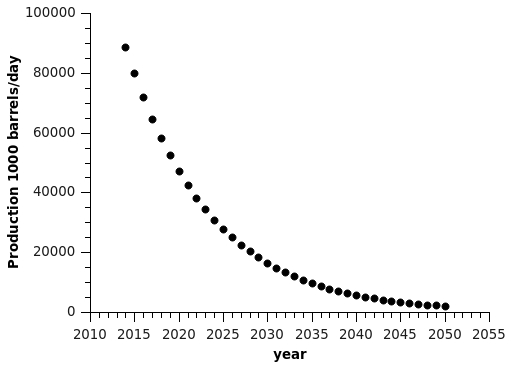
I heard Sir Ian Wood of the Wood group interviewed on BBC radio 4 today programme.  He was quite hawkish on the oil price.  What he said was something we tend to forget (I had) and that is masked by the current production glut.  That is underlying production is falling at 10% a year.  The graph shows what this would mean going forward from 2014 production.

oil declineOf course that assumes absolutely no increases in production, which is unrealistic, nevertheless it does show us the challenge of replacement.   Last year only non-OPEC and OECD countries (excluding Europe) managed significant increases in production, all other regions were in decline or production increases were minimal.  The overall global increase in production was 2.3%.  Rarely (if ever) has global oil production achieved a 10% in a year .  Of course at the moment shale oil has arrived on the scene and there is plenty of oil swilling around.  Going forward though there are plus and minuses on the oil price which make it difficult to call.

On the doveish side…

  • Oil and gas demand is falling in OECD countries and may have peaked in China.
  • The global economy and particularly the Chinese economy looks terrible.
  • A climate change agreement was reached in Paris which should cut demand over the medium term.
  • Electric car sales are soaring – albeit from very low levels.
  • Iran is increasing production
  • There are huge stocks of oil building up.  Even if there is a crisis in production its effects will be lessened by these stocks.

On the hawkish side…

  • Apart from OPEC conventional oil fields and regions are almost all in decline.
  • Demand in some parts of the world is still increasing (or would be if the global economy wasn’t tanking).  Watch out for Africa and India as they get wealthier.  China’s car demand cannot have peaked.
  • There have to be questions over OPEC reserves.
  • US shale oil production is set to peak in 2018.

Where is the oil price going, who knows? but peak oil is only sleeping since there are obviously geological limits to production.

Neil

Posted in climate change, energy costs, Peak oil, Uncategorized | Tagged , , , | Leave a comment

One thing we have learnt this week – Aramco float

Is an Aramco float on the cards?  According to its website it is.  As we have reported on several times over the last year on this blog the Saudis have a problem.   The oil price fall has hit their economy very hard. In addition they are fighting a messy proxy war with Iran in Yemen which they show no signs of winning.  Finally due to the execution of Saudi cleric Nimr Baqr al-Nimr recently tensions with Iran have burst into the open.

What to do?  They have started cutting public spending and government subsidies hard but show no sign of limiting production of oil for reasons we have outlined before.  An Aramco float could be a way of raising very large amounts of money.  Potentially trillions of dollars.

There is a problem though.  For a number of decades many people don’t think that many OPEC countries have been entirely truthful about their reserves.  Look at these reserve figures in the figure shown below from our book.  In the mid eighties many OPEC countries miraculously “found” vast reserves.

chapter1 figure 3If Saudi Arabia is serious about an Aramco float even of 5%, as is rumoured they are going to be transparent about how much is left.  Its been thought for some years that they maybe have a lot less oil left in the ground than is officially claimed.

Neil

Posted in energy costs, One thing we have learnt this week, Peak oil, Uncategorized | Leave a comment

Ground mounted solar

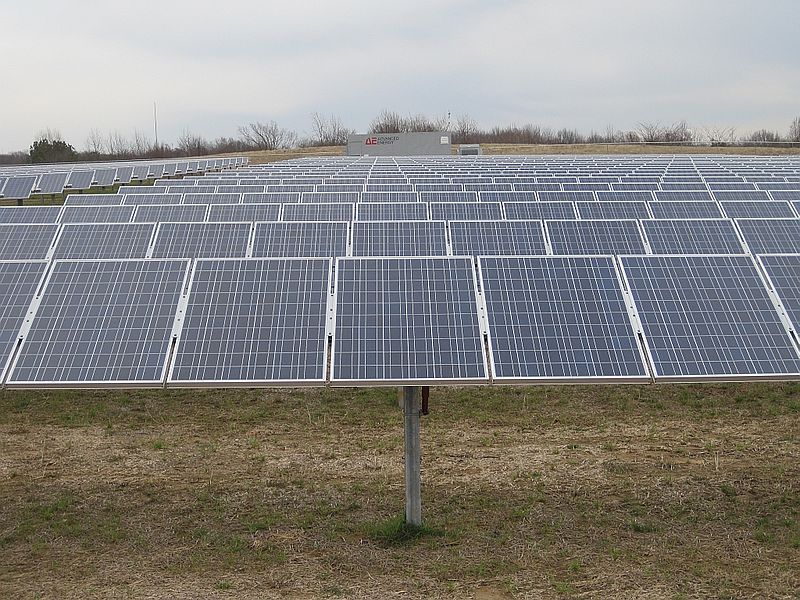
800px-Shelby_Farms_Solar_Farm_Memphis_TN_2013-02-02_008Don’t let the the title “Ground mounted solar” put you off.  Sometimes you find the weirdest most improbable story out there you have to run it.  This is one and as a disclaimer I should add I didn’t find the story but my brother did somehow.  I know Americans read my blog, I apologise but these stories only seem to come out of the US.

A small town (Woodland) in North Carolina US has recently rejected a Ground mounted solar farm.  Nothing unusual there but its the apparent reasons at a public meeting to oppose them given that have made the story go viral.

They include;

” the solar farms would suck up all the energy from the sun and businesses would not come to Woodland”

“that photosynthesis, which depends upon sunlight, would not happen and would keep the vegetation from growing.”

“no one could tell her that solar panels didn’t cause cancer”

Some people have written more charitable explanations of what was said but on the face of it it does seem to show the most incredible ignorance.  I do have some issues with ground mounted solar, but not all of them are expressed in the links above.

Firstly, there have to be concerns over the aesthetics of filling green areas with large numbers of panels.  This is one of the main arguments used against ground mounted solar and I share some of these concerns.  There are developments that find a way round these problems.  The use of wasteland, old quarries or old airfields have been made in the UK without any loss of amenity.  Putting solar farms in areas surrounded by trees so they are invisible to those around is another option.

Another potential drawback is we are setting up another competition in land between fuel and food.  Its not possible to use land for solar farms to grow crops unlike with wind farms.  It is possible to graze sheep or keep poultry around solar panels.  We need to watch this.

If solar is in large farms then there will be resistance losses getting the power to where its needed which by and large is not going to be where its generated.  Its not a “deal breaker”, but is worth bearing in mind.

One criticism I don’t accept is that of cancer.  The actual panels in their finished state are not going to cause cancer.  However, I do accept the argument over their manufacture in the link above.  There are two counter arguments to this.  Firstly, worker protection is important and suppliers of panels here along with us who buy them should ensure those making them are treated safely and fairly.  This not an argument against solar PV but for workers rights.  Second people who make this criticism don’t mention that PV’s are semiconductors.  We are surrounded by droves of semiconductors, I’m writing this using many now.  I hear little concern over semiconductors in phones, computers and just about every other device going.

In my view the best place for PV (which I love and have fitted on my house) is on a roof.  Aesthetically its better and the power ends up where its needed most.  However I’m torn, there is no doubt we need to get off fossil fuels as fast as possible for peak oil and climate change reasons and ground mounted solar has helped bring the price of solar down.  There are drawbacks and silliness can sometimes help see these.  It looks like even the UK ground mounted solar is now at grid parity so this problem is not going to go way.

Neil


Posted in climate change, Community energy, Practical low carbon living, Renewables, Uncategorized | Tagged , , , , | Leave a comment

New years predictions

New years predictionsPredicting the future is a mugs game, as Andy wrote in our book, but here it goes with new years predictions as is customary at this time of year….

Energy supply

  • There will be no power cuts in the UK this year, although it will tight.
  • EDF will not sign a deal to go ahead with Hinkley C this year, although it will still be theoretically on the cards at the end of this year. Whilst the supposed deal was supposed to have been signed and sealed and looked likely to go ahead with work according to EDF starting in November. However, nothing has happened and the same has been said every year since 2008.
  • Little will happen on the fracking front in the UK this year, the economics are terrible and the agro too great.
  • Electricity and gas prices will not fall this year, strange how the price of electricity has not come down since the wholesale gas price has fallen. My gas prices have come down a bit, but at the moment I’m not expecting more.

Renewables

  • The government will not quite kill renewables stone dead. It looks like ground mounted PV maybe viable subsidy free and the domestic roof PV might just be worth going with since the cuts to the FIT weren’t as bad as was feared. The government are battling Brussels over the EU’s ridiculous insistence on a sales tax rate of 20% rather than 5%. This it seems to me is more important but is more likely to be a battle that is lost.
  • Amber Rudd was threatening the off-shore wind industry a few weeks ago but they seem quite optimistic in the paper the other day with some very large investments still going to go ahead.

Oil prices

  • Now sanctions are over with Iran they are looking to double their output over the next 6 months. This will add to the oversupply and should depress prices. As will more signs of an economic slowdown in China. However, in recent days there has been big trouble between Iran and Saudi Arabia. The big Sunni/Shiite split is getting worse by the day. If more than the current proxy wars break out then all bets are off with very high prices certain. The problem with predicting the oil price is that there so many factors pulling in opposite directions.

Transport

  • Electric cars will continue to increase in sales dramatically, but from a very low level. The UK government interestingly have not cut their very large subsidy for electric cars.

Climate change

  • More signs that climate change is upon us will become apparent this year. 2015 was the warmest year since records began and 2016 looks likely to beat it. Once in 100 year floods are now happening every year and its a pretty safe prediction they will happen in 2016.

Economics

  • No global crash this year (although early signs have not been encouraging), we are storing that up for another year since the banks have not really been sorted out.

Christians and the environment

  • Safe bet on here. Most Christians will not take any more interest in the environment, energy or climate and it will remain a minority pursuit in most churches. After all Paris had it sorted didn’t it? Goodness knows what it will take to shift this outlook.

Incidentally I’ve had a look at my new year resolutions from a year ago and managed to do something on every area.

Happy new year

Neil

Posted in climate change, Creation, energy costs, Fracking, oil prices, Peak oil, Uncategorized | Tagged | Leave a comment

Obama and Bear Grylls

Bear_Grylls_2I was going to write about something else but in my last post before Christmas had to write about Obama and Bear Grylls.  It was with some amazement I learned this programme with the two of them was being made, more amazement that Obama had requested it to be made and with even more amazement that I watched it last Sunday.  I agree with the Guardian reviewer its one of the strangest pieces of TV I have seen in a long time.  One thing you could not say about Obama and Bear Grylls together in Alaska is they were boring.  The weirdness came from the concept and its optional extras about bear sex (that’s large brown creatures not Grylls) and drinking your own urine.  Apparently but logically from a biological perspective you should only do this if you are not dehydrated, which defeats the purpose.

The bit where Bear pulled a half eaten Salmon out of his bag and suggested they cook it was classic (a bear had taken all the good bits already).  The secret service must have been having kittens.  But to be fair they let Obama eat it and he’s still alive to the best of my knowledge.

The programme was made to promote action on climate change and this was the overwhelming theme raised throughout the programme.  The pair walked to a valley which had been filled with a glacier in 2008 when Obama had been inaugurated.  Its retreat since then was huge.  It was great to see Bear taking this issue seriously and I think I heard him say his house is powered by wind and solar, but heh it is an island off Wales (I’ve actually sailed around it).

Both pledged action on climate change and Bear asked Obama about his Christian faith.  I don’t know whether Bear does it with everyone but he prayed with Obama at the end.  Bear is the new face of relaunched Alpha course next year.

No oil rating – 9/10 for weird entertainment value, loses 1/10 for no overnight camping.

Neil

Posted in climate change, Creation, Lifestyle, Reviews | Leave a comment

One thing we have learnt this week – volunteering

DSC_1305_optI heard a very interesting programme on volunteering this week.  This is something I have been mulling over for sometime and this programme covered much of what I have been mulling over.  Bank of England Chief Economist Andy Haldane who made the programme looked at the economics of volunteering but  interstingly did not major on this.  He felt it was curious though that elements of the black economy such as drug dealing and prostitution are included in UK economic figures, but not volunteering.

In the UK 15 million people volunteer in a regular basis and this is worth an estimated 50-100 billion to the economy.  The people who take part in volunteering come from every age, race and class.  I am one of these people.  There a number of questions that I would want to ask about volunteering.  Does it remove economic activity from other parts of the economy? i.e. do we replace something else?  Does it replicate state activity (i.e. replace it), so it is it a way of cutting public expenditure back?  How do you manage volunteers?  And what motives do we have for doing it -this is of particular interest to Christians.  Looking at my volunteering experience I will attempt to look at these questions some of which were raised in the programme above.

I have volunteered in the past for a growing project on unused land (picture above).  Many of those involved those with this project had mental problems.  (Much research suggests that gardening is very good for those with poor mental health.)  I currently volunteer with our churches homelessness project.   On the replacement question the answer must be in some cases yes.  But this by and large does not bother me.  The garden project ended up running a couple of cafés and I think a shop, so in this case people using these and purchasing food where not buying it somewhere else from a more commercial operator.  So what- in macroeconomic terms this will make little difference.  It might however affect the micro-economy.  The opposite is true for our homelessness project.  We are not replacing anything, we offer a meal on a Saturday night which almost no one else was and do so we purchase more food than would otherwise be bought.  A few years ago the church eco group thought of setting up a project where we would insulate peoples roofs.  In the end for various reasons it did not go ahead.  Some of us did have a concern we were putting people of of work.  Of course there is one other aspect of this, by volunteering we are not doing something more economically useful?  Very difficult to quantify.

The second charge of replacing cut services with volunteers is a much more serious charge.  This was raised in the programme and the unions have obvious concerns.  I would oppose volunteers taking over public services; partly since you are putting people out of jobs, partly since its unlikely that we can run them to the same scale as the state or as well.  In 2010 David Cameron raised the idea of volunteering and called it the big society.  Even his own voters treated it with extreme suspicion for the same reasons as above.  Where I see volunteering and the state is the volunteers doing thing the state cannot.  Such as our homeless meal.

The question of how do you manage volunteers is an interesting one, but not to me in my situation.  The beauty of my leading the cooking on the homeless meal is how fantastic my fellow volunteers are.  They require very little in the way of management.

The final question was interestingly raised in the programme.  As a Christian I have pondered this.  When I am in charge of the cooking at home time and later I feel a great sense of pride and satisfaction of having catered for 120 guests and 30 volunteers.  Less so when I help and others are leaving.  Am I wrong to feel this?  Should I recognise this as being down to God?  Does it affect me wanting to do the volunteering?  These are still questions I am working through but in the meantime I see volunteering as having a role in any society.  Its also a good reason for a citizen’s income.

One in the occasional series on alternative economics.

Neil

Posted in Economics, One thing we have learnt this week, other, Uncategorized | Tagged | Leave a comment

Pelerins du climat part 3

In the last of my pelerins posts I will reflect on a mixture of what we did in Paris, what we may have helped in a very small way to achieve, what I have learnt from the experience and what we can all learn.

The first lesson we can learn from COP21 is that religions are taking climate change more seriously.  There were a number of events we attended over the weekend from a Christian/multifaith perspective.  The first of these was a gathering on the the Friday night for us and other pelerins.  Some Tearfund supporters had walked from London but many had made much longer journeys than all of us.  One couple had cycled from Vietnam.  Whilst most of this event had to be trashed due to translation into 2 other languages than english taking a lot longer than was thought, we did get to pray and sing.  We also had to present a song based on our trip, a snatch can be heard here on BBC radio 4 Sunday programme.

2015-11-27 18.02.01On our second day in Paris we went to a multifaith event at St Denis cathedral followed by a presentation of our petitions to the chair of the conference Christiana Figueres.  Ms Figueres burst into tears.  This second event was high impact.  As Ms Figueres turned up (to our surprise), the world’s press was there.

2015-11-28 13.43.212015-11-28 13.05.21On the Sunday we went to the protest planned to link arms near Place de la République.  Despite being unofficial the police allowed this to go ahead.  Tearfund banned their people from going, but we decided to take the risk.  The event was entirely peaceful with a wide range of people young and old present.  We were right opposite the Bataclan theatre.  After this we looked the memorials (almost unbearable) and went to the Place de la République.  To get there we passed though lines of CRS (riot police) and it was obvious anarchists we spoiling for a fight.  This was starting to remind me of my time in China in 1989.  Later we saw the trouble and teargas from a distance.  Our final act as pelerins was to go to a Tearfund organised church service in which we prayed for Paris and the COP.

Whilst the religious involvement concern for climate change is growing we should not exaggerate.  As a group we went to 8 different churches.  Of these none had taken much interest in environmental issues.  The same was true of others we met from round the world.  If climate change and peak oil are the defining issues of our time they have little traction in most branches of Christianity (and I suspect other religions too).   At the same time I must say there is some interest in evangelical circles.  We were staying in a Christian centre, (wonderfully) hosted by a group from the Lausanne movement from the US and other US evangelicals then joined us.

I am aware that this blog series has been from my perspective- albeit with lots of “we”.  Like Chaucer’s pilgrims we were a mix of people and that inevitably leads to tensions.  Nevertheless we were a team most of the time.  We could not have done without our brilliant guide Chris and his bike mounted GPS system (so invaluable in urban areas).  Caroline from Climate Stewards also helped lead and organise accommodation.  Mark brought a huge collection of postcard petitions from school children and wrote a blog for children.  The two Clare’s largely wrote our song (with contributions from others).  I attempted to play whistle on the song.  Geoff suggested the chorus should repeat so our audience could join in and made sure they did so, the contributions go on and on…

My final thoughts of this blog series turn to what has been achieved.  What have I learnt?  What has COP21 (more importantly) brought about?  They say that what you learn from a pilgrimage is what you bring back.  I’m still trying to process this in spiritual terms, but in human terms I feel a great sense of satisfaction.  Firstly having physically survived and second having made a microscopic contribution to something so important.  And what about the outcome.  Better than I could have possibly hoped for with mention of 1.5C.  Yes its not perfect, yes its not binding (at least not the whole treaty).  But its still a miracle.  195 countries agreed this is a huge problem and pledged to do something about it.  This in of itself knocks the sceptics arguments on its head.  We have made a start, set a direction of travel and it seems likely will end up as humans taking a very different direction than we would otherwise have done.  As one of the team of pelerins that makes the whole thing worthwhile.

Neil

Posted in climate change, Creation, Cycling, pilgrimage | Tagged , , | 1 Comment