Eco-Holiday

eurostar trainEco-Holiday.

After reading Neil and Andy’s book, my wife and I were challenged to rethink some of the consumer decisions we make and the impact they have on God’s world. One suggestion in particular that the book made which was especially challenging to us was the idea to give up/severely reduce travel by plane. We have both flown extensively, for work and leisure trips, and we would automatically consider flying as the only way to travel when planning a trip. So to think about changing that seemed like a major sacrifice at the time! However we decided to give it a go, and planned our most recent holiday from the UK to Belgium with the goal to forego flying and travel by much less energy intensive means.

After doing some research into the options available to us, we ended up planning to travel by train from Edinburgh to Brussels, Belgium, which included a leg of the journey on the Eurostar high-speed line from London to Brussels. In doing the planning for a trip, we saw that many of the things the book points out as benefits to train travel were indeed true. Our train would arrive in the Brussels city centre, allowing us to connect to local transport quickly and easily to arrive at our hotel (on the other hand, the budget airline airport for “Brussels” would have put us over an hour away from the actual city centre!). The cost of travel by train was comparable to the cost of flights into Brussels. And the overall time of the trip by train was not much more than flying, when travel to/from the airport, arriving early for the flight, long queues when going through security, and so on was taken into account.

Assuming that many people reading this have travelled by train before, I will speak mostly to our experience of travelling on the Eurostar high speed train specifically. Due to travel between the UK and the EU, we did end up going through a security and passport checkpoint in the train station. I found that the experience there was much better laid out than in many airports and the process went quickly even with a large volume of other travellers. In reading about the train ride itself, I saw that we would reach a top speed of 186 mph during our journey to Brussels. With our train travelling at such high speeds on land, I was nervous that we would be in for a bumpy and uncomfortable ride at times. However the train journey was surprisingly smooth and very comfortable, and it was hardly noticeable that we were moving as fast as we were. Both my wife and I felt much more relaxed and our bodies less stressed afterwards than they normally do after a flight. And of course being able to look out the window and take in the beautiful French and Belgian countryside provided for a much more enjoyable view than what you normally get looking out of an airplane window.

Overall we had a great experience and got over our fear of “not flying” when travelling. Rather than feeling that we were making sacrifices for the sake of using less energy, we found ourselves actually preferring the benefits of train travel over flying. We are excited to plan future trips using train travel and to learn more about making choices that reduce our dependence on fossil fuels.

Guest blog by Tim

Posted in Book, Guest Blogs, Transport, travel | 1 Comment

One thing we have learnt this week – German Energiewende

The German Energiewende or transition to renewables is controversial both at home and abroad.  This blog has detailed some of the issues about what to do with the excess power, although the problems put about by prominent climate sceptics seem to have been exaggerated.  There have not been wide spread power outages.  Another area of controversy has been over the German Energiewende and coal use.  Many critics say that the closure of nuclear power has led to the production of much more electricity by coal, increasing CO2 emissions.  The latest figures suggest this is not true.

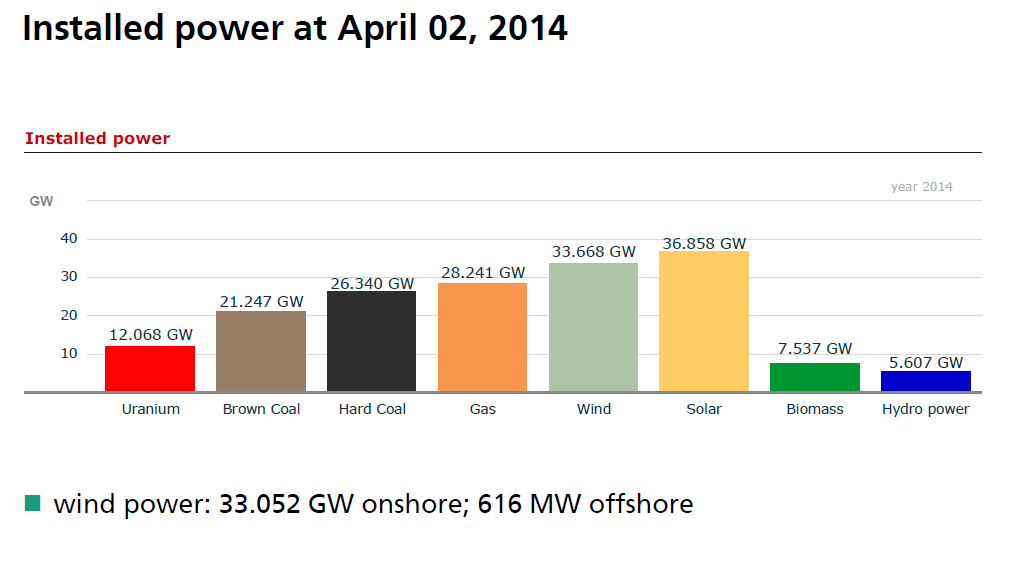
The first graphic shows Germany’s installed generation capacity.

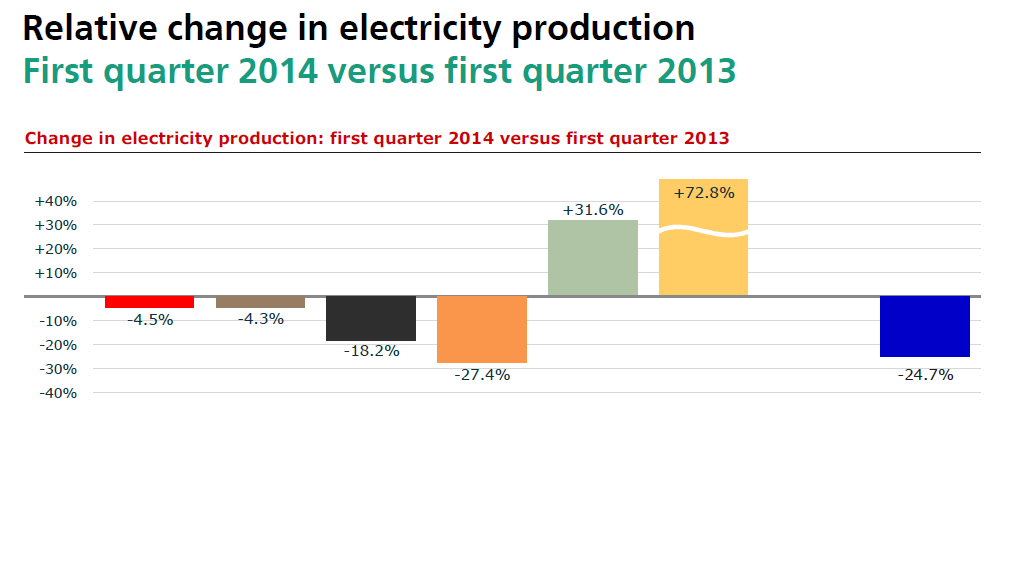
German installed generation capacityThe second shows the change in power output between Q1 2013 and Q1 2014.  Both figures from the Fraunhofer Institute.

.

German output by type Of course the data is only for two quarters and the winter was mild and more conducive to solar and wind output.  It does nevertheless suggest the German Energiewende is not necessarily leading to more coal use.

Another criticism of the German Energiewende is that Germany is importing fossil fuel or nuclear generated electricity from elsewhere in Europe.  Again the latest data suggests this is not the case.  Germany continued to export power in Q1 2014.  It was 4.6TWh, the lowest ever, but its still positive.

The Germans should be congratulated on their Energiewende.  They are leading where the rest of us must follow and we can learn from them.  The UK is fast catching up in terms of wind and solar with over 1GWp of solar alone installed in the first quarter of this year.  Therefore some of the excess power issues are going to show this summer or the year after.  Some more details about the German Energiewende data can be seen here.

Neil

Any problems with posting comments please post to our FB page…

Posted in climate change, Renewables, Uncategorized | Leave a comment

That’s Incredible that is!

breathe-picJoanna Dobson introduces Incredible Edible, the local food movement that’s spreading across the world.

Ezekiel lay on his side for 430 days; Hosea took an unfaithful wife, and in the west Yorkshire town of Todmorden, Mary Clear ripped out her rose bushes and replaced them with vegetables and a sign saying ‘Help Yourself’.

Sometimes when you urgently need to get people’s attention, it’s better to act than talk. And you don’t have to inhabit the Hebrew scriptures to be a prophet.

Not that Mary Clear, mother of four, grandmother of twelve and co-founder of the Incredible Edible movement, would ever call herself that. But in keeping with the best prophetic tradition, this simple act of planting food for a whole community to share has given people a new way of looking at the world and brought hope to places where it was often in short supply.

Incredible Edible Todmorden was born when a few local residents got fed up with waiting for the powers that be to do something about the challenges facing their town – challenges it shares with many places up and down the country, such as a shortage of jobs, dwindling community spirit, and independent producers struggling to survive in a supermarket culture.

This was originally posted on Breathe where you can see the rest.

Posted in Faith, Food, Guest Blogs, Practical low carbon living, Uncategorized | Leave a comment

One thing we have learnt this week- algae

00001_optThis week I was going to blog about peak oil after I found an surprise article on it on a financial website, but then I found yet another one on algae.  We’ve seen it growing, the green, brown or red slimy stuff.   Algae is family of micro-organisms which like plants mostly use photosynthesis to grow.  Could these tiny organisms be the answer to the world’s energy problems?  Or at least those relating to transport.  This is some of what we wrote about it in our book.

Some forms of algae use photosynthesis to produce an oil-like substance, and a huge amount of research is going on in this area to develop a commercial process for harvesting the algal oil and producing usable fuel. In theory algae has significant advantages over other sources of oil for production of biodiesel. Being photosynthetic, its carbon source for growth is carbon dioxide and its energy source is light. It therefore doesn’t require any valuable crop or energy input for its growth stage. The process of production is to some extent established, having been used on a small scale for many years.

The fact that the energy comes from light for the production process and importantly it requires no input of nitrogen fertilizer or carbon are huge advantages, as are its productivity compared to other biofuels.  Some very impressive figures are quoted in the article on algae linked to above.  You could also grow it (in theory) on marginal land where its not possible to grow food, eliminating the eat-travel dilemma.  If you could replace all the world fuels with algal based fuel you could capture and store at any one time a very large amount of CO2, which we may need to do to tackle climate change.

But the issues we raised in our book still stand.  Do you grow algae in open ponds where the optimised strains can be contaminated by wild strains?  Or in tanks?  Building and maintaining algae in tanks in sufficient quantity to replace even part of the world’s transport fuels is an enormous undertaking (and will take very large amounts of energy).  The issue of where also crops up.  Algae will do so much better in the tropics than temperate regions.  Deserts or out at sea are mooted but transport, water and storms are all issues that would have to faced.  In deserts seawater could be used but would have to be pumped to the algae if they were grown inland, taking energy. In many ways I would be delighted if algae could solve even some of our peak oil and climate problems, but until some of these practical issues are faced it looks like a pipe dream.

Neil

If you want to post about this blog post and struggle to post then let us know via facebook.


Posted in Book, Food, One thing we have learnt this week, Peak oil, Renewables | Leave a comment

Cycling to work

trusty steadI have just started cycling to work again since I now have found a part time job.  We mention cycling in our book.

Try taking up cycling, not just for leisure purposes but as a regular means of transport. If you are a reader in Germany, Holland or Denmark you will likely live in cities where cycling is very common
or even the predominant mode of transport. This applies to some cities in the UK such as York and Cambridge, and Portland in the US. We strongly recommend that you don’t just buy a bike, jump on
it and set off into traffic. In many towns and cities there are groups set up that will take you out and show you how to ride safely in an urban environment.

I have posted before that cycling is not the answer to peak oil.  Or at least the magic bullet, but then we think there is no magic bullet.

I cycle to church every week but have not cycled to work for some years, principally since I have not had work to cycle to.  When I cycled to the university where I did my doctorate I cycled along a canal 90% of the way.  So it is more years than I remember than I fought my way through Edinburgh’s traffic at rush hour.  Ironically in a previous job I cycled almost half my current route.  This gives me an opportunity to compare traffic and cycling conditions and see how much they have changed.

Almost all my route is on road, some of this is on road cycle lanes- but these are little help.  I use one off road stretch which is a short cut.  There are couple of other short stretches of off road lanes, one of which is useless and the other, essentially pavement, takes me round a a roundabout under the bypass.  This letter very useful stretch is a cycle lane (though not marked as one) since there is a twocan.  As far as cycling provision very little has changed since I first cycled out this way.  There are advanced markings at all the junctions, but I’m pretty certain they were (just) there when I last cycled out this way.

The big change cycling to work is in the volume of traffic.  Remember I was partly cycling to work this way before.  I’m not doing a scientific survey but my overwhelming impression is that road traffic has fallen dramatically.  I’m cycling out of town against the main volume of traffic but this makes it easier to see how many cars are going into town.  Since I last cycled to work this way the oil price has soared and along with it the price of petrol and diesel.  People in my view must be using their cars less.  I’ve been trying to decide whether our road (one of the main routes into town) is quieter since 2008 and I think it must be.  Another indication of change is that I’ve seen little change in the volume of traffic in the school holidays.  There used to be a huge drop when the schools, especially the private schools were off.  Less traffic makes cycling to work a far more pleasurable experience.  The motorists for the most part seem more bike aware than in previous years.

Since I’m going out of town the number of other cyclists I see going my way are few.  I know traffic surveys have shown that the number of people cycling to work is growing in Edinburgh, but its nothing like the increase in London.  The way I go I see few other cyclists.  Usually their backside as they burn past me.  The only incident so far I have had was a collision with another cyclist (my fault).  Lastly, in the last kilometre there is a very short stretch of downhill road with a radar gun and a speed indicator.  When there are no cars (which there usually aren’t) I try to beat my record.  So far 31mph with the LED flashing at me!

Neil

PS. Any of you that run a blog know about the battle with spam comments.  I have installed a new anti-spam plugin to count how much of our visits are genuine.  It seems the great majority so far, which is good.  Its extremely effective at blocking.  If you cannot comment though let me know via the books FB page (link on the right).

Posted in Cycling, Peak oil, Practical low carbon living | Leave a comment

Passover meal

Wordle: Untitled


The original Easter story took place against the backdrop of the passover festival, with much of the central part of this happening at a passover meal.

On the first day of the Festival of Unleavened Bread, the disciples went to Jesus and said, “Where do you want us to make preparations for you to eat the Passover meal?”   He said, “Go to a certain man in the city and say to him, ‘The Teacher says, “My time is near. I will celebrate the Passover with my disciples at your house.”’ So the disciples did as Jesus had directed them, and they prepared the Passover meal.   When evening came, Jesus was sitting at the table with the twelve.   While they were eating, he said, “Truly I tell you, one of you is going to betray me.”   Feeling deeply distressed, each one began to say to him, “Surely I am not the one, Lord?”   He replied, “The man who has dipped his hand into the bowl with me will betray me. The Son of Man is going away, just as it has been written about him, but how terrible it will be for that man by whom the Son of Man is betrayed! It would have been better for him if he had never been born.”    Then Judas, who was going to betray him, said, “Rabbi, I’m not the one, am I?” Jesus said to him, “You have said so.” While they were eating, Jesus took a loaf of bread and blessed it. Then he broke it in pieces and handed it to the disciples, saying, “Take this and eat it. This is my body.”    Then he took a cup, gave thanks, and gave it to them, saying, “Drink from it, all of you.   For this is my blood of the new covenant that is being poured out for many people for the forgiveness of sins. I tell you, I will never again drink the product of the vine until that day when I drink it new with you in my Father’s kingdom.

With this in mind last night our church held a passover meal as a preparation for Easter. This blog entry covers a brief account of what we did and thoughts and lessons we can learn from the passover*. The passover of course is recounted in Ex 12v5-14. In this passage God tells the Israelites to mark their door frames with lambs blood and eat the lamb along with bitter herbs to protect them from God’s wrath when he killed the first born Egyptians.

We started the Seder with the lighting of a candle done by the most senior woman on our table and a prayer thanking God who gives us life and sustains us. We then moved onto the Kiddush (cup of sanctification). Wine is a big part of passover and this is the first of four prayers of giving thanks to God for the fruit of the vine. We drank one glass of wine (actually grape juice).

Next was the Karpas. This is was a prayer of thanks for springtime and its bounty and involved eating parsley dipped in salt. The prayer we prayed was a specific remainder that God is the creator and we rely on him for our food.

Passover is a festival of remembrance of deliverance from slavery. In the next section the Maggid the story is recounted and the youngest member reads out a series of questions about the symbols and an elder answers each one. We thanked God for the unleavened bread the Israelites took in their hurray to leave Egypt and prayed for the hungry and oppressed. We then poured another glass of wine.

Moving on, in the “Hallel: cup of redemption” we first thanked God for his rescue from Egypt and asked him to allow plenty more passover meals in peace. We then thanked God for the fruit of the vine again and drank the second glass of wine.

Passover is of course a meal and before every meal you should wash your hands (Mat 26v23). We did this in water with lemon in it. Jesus washed his disciples feet showing his humility (Jn 13v2-17), we didn’t go that far. A prayer of blessing was prayed (Rachatz) followed by the Motzi Matzoh the blessing of the bread and prayer to remind us that its God who gives “bread from the earth”.

We kept some bread back for the Morar (the blessing of the bitter herbs). In this section we dipped our bread in sweet Charoses made of apples and nuts meant to symbolise the mortar with which the the Israelite slaves built the pyramids with.  Followed then by horseradish to represent the bitterness of slavery. This ended with a prayer and a reading of Luke 22v15-19 which is an account of Jesus’ celebration of the passover.

The next thing to do was actually eat (Shulhan Orekah). The church had laid on a fantastic meal of lamb with couscous. At this point my table did drink some real wine (we didn’t feel we could manage to down four glasses and stay sober). For the first time we could talk and we aptly discussed what we had or hadn’t given up for lent, a wedding and the merits of vegetarianism as well as holidays. At the passover you give thanks at the end for the food (Borekh), this took the form of a three part prayer and response thanking God, the food and fellowship, being able to celebrate passover and for God’s mercy. We then thanked God a third time for wine and drank again!

The passover meal, service?? started to come to a close with a Hallel psalm of praise (Ps 116) and another blessing for the fruit of the vine. This time we only drank half the glass keeping half for the Nirtzeh when we brought Christ into the final thanks for the fruit of the vine.

There is so much resonant symbolism in the passover meal for Christians. We see Christ as the unblemished lamb who saves us from our sins. There are also echoes of the unleavened bread in 1 Cor 5v6-8, a passage we were encouraged to read on our table. Paul sees it as a symbol of throwing off the old and embracing the new, which is Jesus. Roman 8v38-39 we also read, talks of coping with bitterness and suffering, something the bitter herbs reminded us of. This I regard as all true and the passover meal was a moving reminder of my need for Christ.

But there was more to the passover meal than I expected. The issue of food security and God’s place in it came up several times in the prayers we prayed. I have written a blog post on this subject this very week. We in the rich west have lost our link with the land almost completely and we seem to think we are immune from food insecurity. This is increasingly untrue. Long supply lines, oil dependency and climate change means feeding ourselves in the future will be expensive and challenging. The passover meal also reminds us that eating is an act of celebration and community. A last ironic thought. The passover meal we celebrated had no vegetarian option. But eating meat at the time of the patriarchs would have been rare, unlike today. Perhaps only in such festivals as the passover. This could be the future for us too.

Have a happy Easter.

Neil

*How authentically Jewish this is I’m not sure. As far as I am concerned its a Christianised version and not meant to offend. I do have some distant Jewish ancestry.


Posted in climate change, Creation, Faith, Food, One thing we have learnt this week, other, Peak oil, Practical low carbon living, Slow living | Leave a comment

oil and food

DSC_1305_optWhen you sit down for your next meal try to imagine you are eating oil.  Its a fairly disgusting thought, but that is literally what you are doing.  We tend not to think about how much energy is used in growing, transporting and storing food.  A helpful start is think about how much it takes grow a hectare of wheat.  Data provided by the Institute of Mechanical Engineers suggests it takes on average 22566MJ of energy in total.  Just 6MJ of this is due to human effort (presumably operating the tractor).  To put it into perspective, for every calorie you eat, it takes an average of 8 calories of energy to get it into your mouth.  Much more than that if its meat.

There are two main reasons for this.  When my grandparents were young, before the first world war, the great majority of the food they ate was local and seasonal.  Nowadays the food we buy can come from anywhere any time.  Seasonal, forget it.  About the only thing I can think of that’s still seasonal is sprouts!  These very long supply lines often from different continents, rely on vast amounts of cheap energy and that’s just for the transport.  There is also another issue that has links to just before the first world war.  Returning to our field of wheat, the fertilizer used to grow our wheat takes 10,651MJ/Ha, almost half the energy required.   Fertilizers are not solely composed of nitrogen, but its the most important element within them.  Why is this?

Nitrogen is a vital component of amino-acids which form the building blocks of proteins, its also used to make the nucleotide bases used in DNA and RNA.  There’s plenty of it around, the atmosphere is nearly 80% nitrogen.  There’s a problem though.  Nitrogen does not like being alone.  It bonds very happily with other atoms such as oxygen or hydrogen to form compounds, but not as happily as to itself.   Nitrogen in the atmosphere is a gas formed of two nitrogen atoms bound together by a very strong triple bond.  Nitrogen gas is therefore very inert, stable and not bioavailable.  This takes a lot of energy to break nitrogen the compound into individual nitrogen atoms, giving them a chance to combine with something else.  In nature lightening can do it, the nitrogen combining with either one or two oxygen atoms.  The resulting nitrogen oxides dissolve in rain water to form weak nitrous acids.  These end up in the soil where plants can acquire the nitrogen.  Another route for nitrogen to enter plants and the soil is via bacteria.  Some bacteria can use enzymes to break the triple bond.  Leguminous plants have evolved to be able use bacteria to “fix” nitrogen in forms they can utilise.  You might ask why over millions of years all the nitrogen has not ended up in plants and the soil?  The reason being other bacteria convert nitrates back to nitrogen gas.

Till the 1840’s crop rotation using legumes and rain were the main sources of nitrogen fertilizers for plants.  Then mineral nitrates and guano (mineralised bird poo) came on the scene.  These were finite.  Just as it looked like there could be a food crisis in 1909 Haber and Bosch invented the Haber process.  This as you will remember from school chemistry lessons uses lots of  heat, pressure and an iron catalyst to break the triple bond combining hydrogen and nitrogen to make ammonia.  Ammonia when combined with nitrates are forms of nitrogen that plants can easily assimilate.  Crisis solved, loads of nitrogen and lots of food for everyone.  There’s a problem however and its energy again.  The Haber process is reliant on fossil fuels both for the hydrogen and the heat to drive the process.  So much so that an astonishing 3-5% of the worlds natural gas alone is used to make fertilizer.

Our current food system has given us much that is good, we have more food than ever before and more choice of what to eat.  It also given us ecological damage and an obesity crisis.  Our reliance on oil and gas make us vulnerable when they start to deplete.  We are in the foothills of this now.  Since 2000 the percentage income we spend on food has doubled.

So what are we to do?  GM crops obviously won’t totally break the link with oil.  The solutions lie in growing as much food as close to us as we can, organically.  Even in the middle of cities.  Also using a diversified agriculture with rotation using legumes, rather than monoculture.  By eating less meat and less food in general.  Can it be done?  The experience of Cuba suggests its possible.  After the break up of the USSR they lost their cheap oil and survived by doing the above.

Neil

This post is being entered for a science writing prize (very speculatively), more info on the link between oil and food can be found in our book.

Posted in Uncategorized | Leave a comment

UK energy data

A while ago I promised a blog on the recent release of the UK energy data.  This blog covers some of it.  The energy data I’ve obtained is really very comprehensive and goes back to 1970.  It covers almost very aspect of domestic energy use and patterns in the UK.  Whilst this data is UK centric the broad trends are probably the same in most Western countries.

Looking first at heat use from the UK energy data we can see from the left hand graph that decades of falling heat loss from UK houses has spectacularly reversed in the last three years of data.  The right hand graph shows that the average temperature people heat their houses to has showed a consistent upward trend even as the average outside temperature has increased.

graph1At first sight there is no obvious explanation for this recent pattern, although 2010 was on of the cold winters we have had, so was 2009.    However, the overall data is broken down into individual components (walls. Windows, roof etc.)  Only the heat loss through walls has shown a continuing fall.  The heat loss though windows and by ventilation has increased dramatically with other areas such as roofs showing minor increases.  It looks like the recent run of colder winters has had households opening their windows more frequently to combat mould and damp.  This a live issue of debate in our household, is it better to air the house and let cold air in and hopefully damp along with heat out?  Or does make the whole place colder and therefore damper?  There is a solution to this that is a mechanical heat recovery system which removes stale air passes it through a heat exchanger and sends 90% of it back into the house.  However these are disruptive and expensive to retro fit.

The second set of graphs show long term energy price trends.  The left hand graph shows the actual price and the second right hand graph shows the prices relative to 2011 prices (2011=100).

graph2Again this data shows some surprising trends. Whilst there has obviously been a very high upward trend in recent years the price some types of energy are not at all time highs.  The data ends at 2011 and it should be noted that prices have gone up more since.  Also gas and oil prices have been higher in the past.  The gas price data is explained by the fact that it was higher when there was no north sea gas and we used town gas.  This cheap north sea gas explains the gas and electricity price falls in the late nineties, not privatisation of the gas and electricity companies which piggy backed on the back of that cheap resource.  But as the gas has started to run out and the oil price leapt, that trend has gone into reverse with a vengeance.  Oil prices (used for heating) were also higher in the past.  This is also surprising to me.  Not even the record price of oil in 2008 could undo the 1979/80 price.

The effect of these recent price increases can be seen in the next set of graphs showing on the left the % of households in England in fuel poverty and on the right the % income spent by all UK households in different fuels.

graph3

What can we conclude from this UK energy data?  Despite energy price increases we are still very wasteful with energy and for many of us its still too cheap.  There are a large minority however, who are struggling since for them ironically energy prices are far too high.

All UK energy data sourced from DECC.

Posted in climate change, energy costs, gas, Lifestyle, Peak oil, Practical low carbon living, Renewables | Leave a comment

One thing we have learnt this week- climate change and food security

One thing we have learnt this week is we need to worry about food security due to climate change.   The Intergovernmental Panel on Climate Change (IPCC) 5th assessment report covers a wide range of issues relating to climate change, but knowing readers of this blog are interested in food I have just decided to cover this one aspect.

One of the arguments that climate sceptics have made is that increased carbon dioxide levels will increase plant growth.  One right wing think tank in the US even produced a video claiming something along the lines “they called pollution we call it fertilizer”. This belief which, to be fair, many climate scientists hoped might be true is presumably based on the overall photosynthetic reaction shown below.

photosynthesis

For any scientists reading this yes I’m aware its not balanced, its just to keep it very simple.  In crude chemistry terms if you increase the concentration one of the reactants on the left hand side then more product should be produced to bring the reaction back into a new state of chemical equilibrium.  This is known as the law of mass action.  The problem is that plant biochemistry is much more complicated than that indicated by the simple reaction above.  For starters the reaction above is split up, water is broken down to hydrogen ions, electrons and oxygen in a plant organ known as the chloroplast and this process requires light.  Carbon dioxide is captured to form sugars in light independent reactions (known as the Calvin cycle) by an enzyme called ribulose bisphosphate carboxylase oxygenase (RuBisCO.  This protein is probably the most abundant enzyme on earth!  Under dry conditions plants will attempt to save water by shutting pores called stomata.  This means the carbon dioxide levels fall and the reaction above starts to go into reverse (so maintaining the chemical equilibrium).  Various plants have adapted mechanisms to concentrate carbon dioxide and therefore maximise their growth.  For example some tropical plants (such as maize) use a an additional chemical pathway called the C4 pathway to chemically “fix” the carbon dioxide making photosynthesis in these plants more effective.

This last fact could be important to food security. Originally scientists thought plants would grow faster and bigger everywhere as CO2 levels rose.  Measurements have not borne this out.  Current thinking suggests that the plants in the tropics will suffer and plants in the northern hemisphere will do better.  Could it be that in the tropics plants are as efficient as they can be due to pathways like C4?  Whatever the reason plants in the tropics don’t benefit from increased CO2.

This is what the 5th assessment says;

Based on these studies, there is medium confidence that climate trends have negatively
affected wheat and maize production for many regions (Figure 7-2) (medium evidence, high agreement). Since many of these regional studies are for major producers, and a global study (Lobell et al. 2011) estimated negative impacts on these crops, there is also medium confidence for negative impacts on global aggregate production of wheat and
maize. Effects on rice and soybean yields have been small in major production regions and globally (Figure 7-2) (medium evidence, high agreement). There is also high confidence that warming has benefitted crop production in some high-latitude regions, such as Northeast China or the United Kingdom Jaggard et al., 2007, Supit et al., 2010;
Chen et al., 2010; Gregory and Marshall, 2012).”

If this was it then food security would be increased in temperate regions and decreased in the tropics.   Which would be bad enough.  The problem is this leaves out one huge elephant in the room – the weather.  Different plants are adapted to different levels of sun and moisture (and humans are responsible for much of that adaptation).  So for example rice likes growing in water, whereas maize will cope with much drier conditions.  The 5th assessment does not reach definite conclusions on this weather related food security  issue.  In fact it states crop yields and weather are even more complicated and localised than the above might imply.

“The overall relationship between weather and yields is often crop and region specific, depending on differences in baseline climate, management and soil, and the duration and timing of crop exposure to various conditions. For example, rice yields in China have been found to be positively correlated with temperature in some regions and negatively correlated in others (Zhang et al., 2010). The trade-offs that occur in determining yield are therefore region-specific. This difference may be due to positive correlation between temperature and solar radiation in the former case, and negative correlation between temperature and water stress in the latter case. Similarly, although studies consistently show spikelet sterility in rice for daytime temperatures exceeding 33°C (Jadadish et al., 2007; Wassmann et al., 2009), some statistical studies find a positive effect of daytime warming on yields because these extremes are not reached frequently enough to affect yields (Welch et al., 2010). Responses to temperature may vary according whether yields are limited by low or high temperatures. However, there is evidence that high temperatures will limit future yields even in cool environments (Semenov et al., 2012; Teixeira et al., 2013).

In other words on food security, the official view is we are guessing.  Common sense has to come into play here though. As a keen non-professional gardener, since the late 90’s I’ve seen the weather become increasingly erratic.  I also know that almost everything I grow needs benign weather.  Not to much rain or sun, just the right amount.  The crazy weather we have been getting does not bode well in that regard.  There are also other issues such as rising demand, population increase and peak oil that must be factored in.  Food security looks like being an increasing challenge over the next couple of decades and going forward.  We all have a responsibility to stop this happening, as the writer of proverbs says;

A good man leaves an inheritance to his children’s children, but the sinner’s wealth is laid up for the righteous.  The fallow ground of the poor would yield much food,
but it is swept away through injustice.” Proverbs 13v22-3

Neil

This passage will form the basis of part of a new book we are working on and is a very crude first draft.

Posted in climate change, Food | 1 Comment

In praise of trees

apple tree_optI don’t know whether everyone has a favourite plant, but mine I have decided are trees. I like almost any trees, but my favourite ones are fruit trees.  The other week when we were doing some voluntary I was talking with some of our homegroup about my having a go at tree grafting.  At least one member had never heard of this.  So I thought I would blog on trees!


It doesn’t take long for the bible to mention trees.  Genesis 1v11 says;


“And God said,“Let the earth sprout vegetation, plants yielding seed, and fruit trees bearing fruit in which is their seed, each according to its kind, on the earth.” And it was so”


Whether you take Genesis literally or metaphorically, humankind was in Genesis 2 commanded to look after the garden which included trees and the bible moves forward from there mentioning trees too many times for this blog to list. Often trees are used as a metaphor as in Proverbs 11v30.


“The fruit of the righteous is a tree of life, and whoever captures souls is wise.”


Or Psalm 1


“He is like a tree planted by streams of water that yields its fruit in its season,
and its leaf does not wither.  In all that he does, he prospers.”


All this leads me to think that GOD loves trees and so should we and they can also be used by God to teach us about him.

One of the slight environmental success stories of recent years is a slow down in deforestation, although there is no room for complacency.  I live in one the countries with the lowest tree cover in the whole of Europe.  Trees were chopped down to build ships, smelt iron and in the enclosures and clearances put sheep on the land.   There are national forest planting schemes in Scotland and England but progress is slow.  I would like to tell readers to support tree planting charities, but I’m slightly cynical.  Last year I went walking on the Isle of Skye with friends.  We walked through an area where rock stars had planted trees partly as a carbon offset (a scheme so famous I had heard of it).  At least that’s what a sign said but there were precious few trees to see.  They had been damaged and destroyed.

However, if you have sufficient land I would urge you to plant a tree or trees and given the remit of the blog, a fruit tree.  Peak oil being a real food challenge we will need to grow as much as we can ourselves.  There is no doubt that most fruit trees are highly space efficient.  2013 was a great year for my fruit trees, we had vast numbers of plums and apples.  We gave the fruit away, ate vast amounts of stewed and fresh fruit everyday for months, but also made large amounts of jam and cider.  To preserve my liver I also had a go at bottling apple juice, which has been extremely successful.  This year and last year I have planted three new apple trees and a Damson, all on small rootstocks.

This brings me neatly to the original reason for this blog -grafting, an ancient idea described by Pliny in his “Natural History“.  Almost fruit trees you would buy are made up of two components the rootstock and the scion.  The rootstock gives the tree its size characteristics.  The scion determines which variety of fruit a tree will bear i.e. a cox.  These two are brought together by grafting, using the natural healing properties of the tree to join two slightly wounded trees together.  When you buy a tree you will usually see a sign of this by a bulge low down the trunk of the tree.  This should be planted above the level of the soil otherwise the tree will from a sprout from the rootstock and put its energies into producing what will likely be useless fruit. Trees come on different rootstocks most developed by the East Malling research station in Kent.  The nomenclature is a bit confusing but you should buy one appropriate to your size needs.  There are lots of different ways of grafting trees.  I had a go at whip grafting at the garden project I do some volunteering for.  This is the time of year to carry it out.  How successful it will be only time will tell.  Anyway why not plant a tree!

Neil

Posted in Creation, Food, other | Leave a comment