
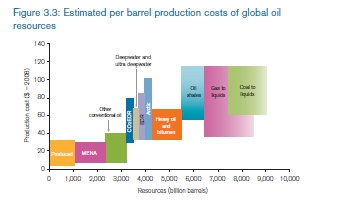
The days of cheap energy are over see this graph from “Resources futures” from Chatham house (see last but one post below).
Neil
The days of cheap energy are over see this graph from “Resources futures” from Chatham house (see last but one post below).
Neil
See Make Wealth history’s review of books of the year.
Chatham House have recently brought out a report “Resources Futures”. In it they look at the future of resources over the next few decades. This blog has covered some of the energy implications of this report here. The report is important enough to merit a blog post summarising the reports main findings on the other resources mentioned.
Background
For most of the last 150 years the global story has been about the rise and rise of the Western economies. They have had the worlds largest economies and dominated the worlds resources. This is particularly true since the second World War. However, after the collapse of communism this started to change, the G7 group of countries expanded to include Russia. More recently even this group of countries has been insufficient to “solve” the worlds problems and after the 2008 financial crash was expanded to be the G20. This includes the so called “BRIC countries” (Brazil, India and China). But even this grouping maybe out of date. A whole host of other countries are undergoing rapid economic growth such as Turkey, Botswana, Kenya, Turkey and Bolivia. As these countries develop they consume more energy, water, metals and food as their citizens become wealthier. Hence we have a problem. At the same time population is growing putting more pressure on resources, the estimate for the global population before it peaks is in the range of 8.1 to 9.7 billion in 2040, increasing from about 7 billion today.
Expectations of resource demand increases
The Chatham house authors warn that some of the data used to make projections are in short supply.
Food. By 2020 the projected demand for cereals is likely to increase by about 15%, for vegetable oil seeds, protein (used as feed) and meat by 20%. Meanwhile demand for sugar, vegetable oils and fresh dairy produce surges by roughly 25%. Cereal demand is expected to reach 2.7 billion tonnes by 2030 up from 1.9 billion tonnes in 2000. Much of this increase is due to biofuels. In 2010 fisheries produced 128 million tonnes of fish products this will need to increase by an additional 14 million tonnes by 2020 (27 million in 2030). Almost all of this increase in fish consumption comes from developing countries. Meat consumption increases at 1.7% a year (mainly poultry).
Metals. OECD data suggests a 250% increase on 2005 demand by 2030. Aluminium and steel lead. Due to space considerations we were not able to write more than a very brief amount on non-energy resources in our book, but one thing to note is the energy used to mine and extract metals is rising fast because the ore strengths are falling. Like oil and gas all the easy to extract stuff has been mined first. The report gives little indication of when metal supply crunches are going to occur but other people have made some guesses and for some metals its not good…
Fertilizers. Nitrogen fertilizers are fossil fuel dependent (due to the energy used in the Haber process) whereas potash and phosphate are mined (but still somewhat fossil fuel dependent). Chatham house state “Annual demand for nitrogen, phosphate and potash will grow by 1.7%, 1.9% and 3.1% respectively to 2015”. Other problems mentioned are lower yields due to climate change, soil degradation and water shortages. The authors describe the problem thus;
“In sum, agriculture must be radically reformed if production is to keep pace with demand, remain resilient to climate change and stay within environmental limits relating to the use of land, water and fertilizers. There are, however, significant opportunities to improve farm practices and improve water management and fertilizer application.”
Wood. Traditionally used as a biomass fuel (for cooking) in the developing world, demand is rising due its use in the developed world as biomass fuel (for electricity production). No figures are given on future projected demand.
The implications
As Chatham house put it “volatility as the new normal”. Price volatility is the highest its ever been overall for metals, food and fuel. Price volatility isn’t great for consumers or producers and political problems can occur in areas where reliance on low prices is highest, such as food and oil. We saw this with the Arab spring and other countries such as Mexico where food riots occurred. The question is how much can technology help? Can technical innovation cope to overcome demand constraints and environmental problems? The report is open minded. It depends on a number of factors, finance to fund innovation, policy drivers such as feed-in-tariffs and resource supplies.
Governments have tended to react to the threats of a resource crunch in the following ways. Resource nationalism (keeping more of their production of a particular resource at home), formation of cartels to maintain high prices, trying to increase production at home, increasing strategic stockpiles of materials and most controversially of all the purchase of land by sovereign wealth funds. All of these policy drivers have disadvantages, for example resource nationalism can lead to lack of foreign investment and therefore a drop in production.
Chatham house suggest a number of more positive policies to overcome the above. These include better efficiency and use of resources, more recycling particularly of metals, substitution of different materials and a move towards a circular economy (this last point is going to be the subject of a another blog post). The authors also suggest a new politics with better intervention to prevent food price increases. A number of mechanisms are considered including a global virtual reserve in which countries would intervene in global futures markets to forestall price rises and also buy foodstuffs from biofuel producers. (Would it not be easier to limit trading in food as a commodity as used to be the case?). The report also recommends increased environmental protection since we are dependent on the environment for so much of our resources. Finally we should be investing in producing countries to give better government and environmental resilience as well as better transparency and data on resources.
This is a well written and researched report which is beginning to think beyond technofixs and business as per usual. Its a great pity not many Christians have even thought about these issues since we will have to face them over the next decade or so. As Rebekah Simon-Peter wrote in “Green Church”;
“For example, have you ever tried to make lunch without drawing upon the bounty of the earth? It cannot be done. Even if you are having a plastic sandwich, neon chips and a diet pop from the corner store, your lunch still finds its source in the earth. There is no life for humanity without a healthy creation.”
For more information see here.
Neil
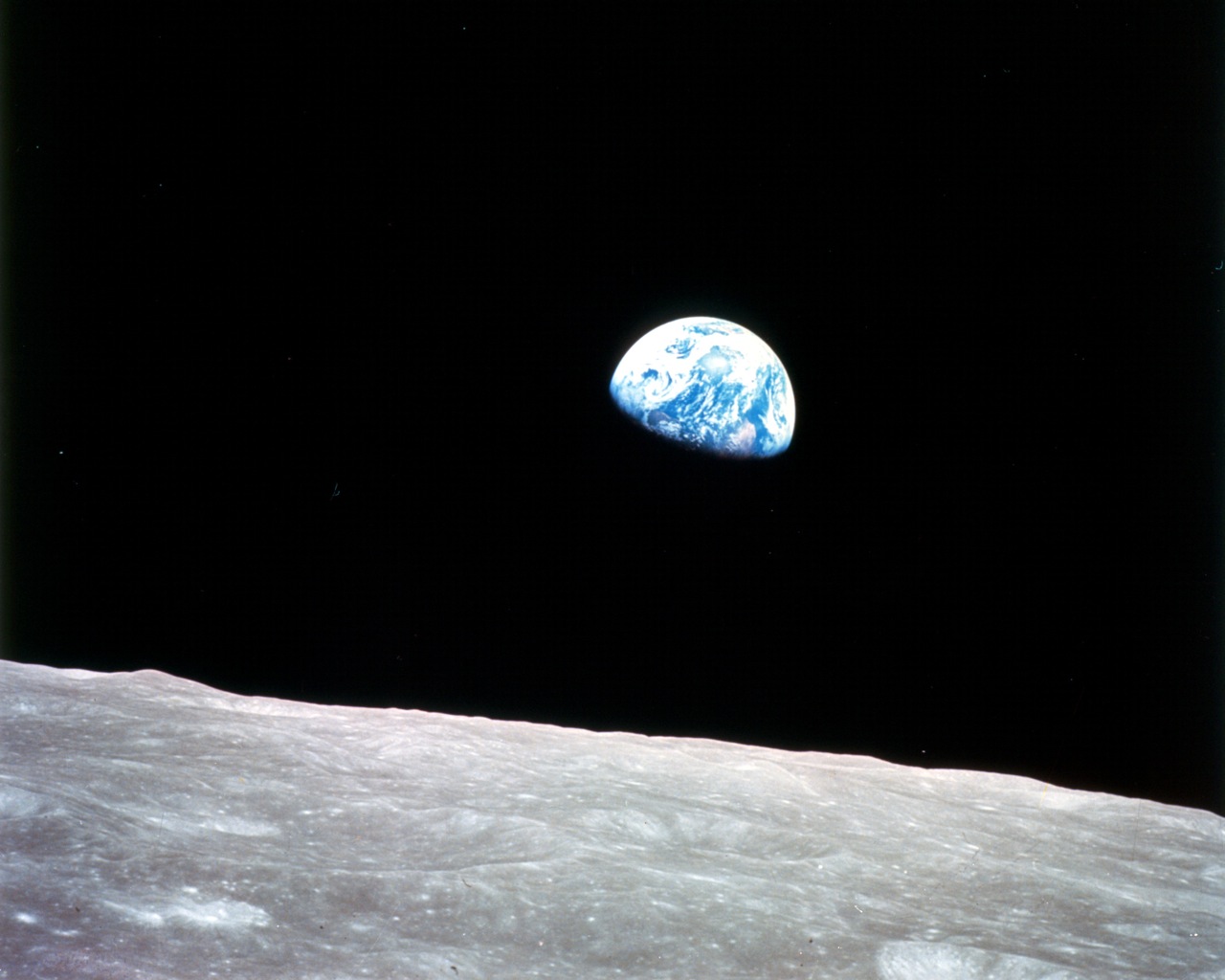
Earthrise from the moon. This and “Silent Spring” by Rachel Carson did more launch the modern environmental movement than anything else.
There have been a number of attempts by writers to get Christians to take the environment seriously as an issue. “Creation in Crisis” by Alex McDonald, “Jesus and the Earth” by James Jones, more recently “Cherish the Earth” by Margot and Martin Hodson and “Christianity,Climate Change and Sustainable Living” by Nick Spencer and Robert White to name but a few have covered the environment and faith from a variety of angles. The two former titles are more general and theological and the other two both theological and practical. Jones and McDonald don’t really mention climate change at all, whereas the other two titles concentrate heavily on it. An internet search throws up a long list of Christian titles on “Creation care”. It is into this crowded field that Rebekah Simon-Peter has in the couple of years entered with “Green Church: Reduce, Reuse, Recycle, Rejoice!”.
Cleverly the book is structured around the well known expression “Reduce, Reuse, Recycle”, but with “Repent” and “Rejoice” added. Theologically the book is centred around Genesis although with reference to lots of other passages in both the new and old testaments. Simon-Peter takes the reader through the creation story particularly in the first chapter “Repent” but keeps returning to the first few chapters of Genesis throughout the book.
There is no doubt that in many Christians minds the debate about “dominion” versus “stewardship” is at the heart of the environmental issue. Green Church tackles this head on in the “reclaim” chapter by arguing we are live in relationship with the creation. This is so obviously true since we are dependent on the natural world. Simon-Peter expresses this beautifully;
“This is as true today as it was then. For example, have you ever tried to make lunch without drawing upon the bounty of the earth? It cannot be done. Even if you are having a plastic sandwich, neon chips and a diet pop from the corner store, your lunch still finds its source in the earth. There is no life for humanity without a healthy creation.”
It never ceases to amaze me just how many Christians don’t apparently recognise this and what seems to me basic self interest (if nothing else). Each chapter ends on a practical note and Green church correctly diagnoses one reason for the ecological crisis. We are out of touch with nature. The remedy – get outside and enjoy it!
Perhaps because her Jewish background Simon-Peter is keen on the Sabbath (although due to modern day practicalities this is expressed as one day a week rather than necessarily a Sunday). Green church turns this into a day of rest for the earth (“Reduce”). Particularly from that American obsession, driving to church. However, this is a huge problem all over the West. I belong to a gathered church. In fact our family use a variety of ways to travel the mile and a half to our fellowship. Cycling, walking, bus and car (sometimes to the same service). Green Church gives some figures for potential CO2 savings (although based on US car consumption figures) and they make sobering reading. We have raised transport to and from church meetings as an issue in “No oil in the lamp”. There are no easy answers but this is one area of oil dependency which is not going to be easy to solve and it maybe that churches move or amalgamate.
Upcycling (in the “Recycle” chapter) is an expression which has passed me by until now, but since I read Green Church I’ve heard an article about it on the radio. As a European I’m surprised that kerbside collection is not more advanced in Wyoming. Much of what the author suggests you need to take somewhere to be recycled we have collected on a two weekly basis (and the UK is one of the worst for recycling in Europe). However, the plastic recycling facts given do make sobering reading. Recycling plastic means its being turned in lower grade material and is eventually unusable. I have felt too comfortable about this up until now. As a family we need to reduce our plastic consumption.
However bad things seem environmentally (and there is much to be pessimistic about lets face it) we should never despair. Green Church ends on a positive note (“Rejoice”) with a short section on Earthrise and examples from churches. It ends with a call to action;
“Somehow, God is using us to free the creation from the bondage of decay. Let the joy of that promise pull you, and the creation, forward into God’s good future”.
Green Church is a good general text for those Christians who have not thought about their faith and environmental care before. Its well written, challenging, easy to read, well referenced and thoroughly researched with lots of scriptural backing. There are boxes with challenging questions and facts (such as the oil dependency of paper) throughout every chapter. Its slightly short on practical action compared to our book, but there are companion publications to take it further. One or two of these practical ideas are simple but not ones I’d thought of which shows anyone can learn something from this book and not just newbies. Finally whilst it only mentions resource depletion in general terms this leaves an opportunity for books like ours…
Disclaimer. I paid for the book and have no financial reward from its sale.
“Green Church: Reduce, Reuse, Recycle, Rejoice!” is published by Abingdon press.
Neil
The Suffragan Bishop of Europe David Hamid has given our book a good review. This can be seen on his blog here.
Lord, help us to see in the groaning of creation not death throes but birth pangs;
Help us to see in suffering a promise for the future, because it is a cry against the inhumanity of the present.
Help us to glimpse in protest the dawn of justice;
In the cross, the pathway to resurrection;
And in suffering, the seeds of joy.
– Ruben Alves, 1987
Its not only fossil fuels that are being depleted, but also other things such as metals or in this case a gas – helium. Andy and I heard a programme on materials depletion on BBC Radio 4 and much to my amazement helium is mined, mainly in Texas. The problem is it has important uses (apart from in balloons) and as such one scientist has asked for its use to be banned in balloons. I seem to remember from the programme there’s about 20 years supply left at current rates of usage. Once it leaks out into the atmosphere being so light it sloughs off into space. The link to the full article can be seen on our Facebook page.
Neil
Background
Our very first post on this blog was aptly (in a way) a response to George Monbiot having decided on the basis of one report there was plenty of oil. (This can be seen here ). I was intending to follow this up with any new information at some point. However, over the summer and Autumn there have been a plethora of articles in the mainstream press and blogs suggesting there is no such thing as peak oil. This has turned into a torrent in November after the release of the latest International Energy Agency “World Energy Outlook” report, forcing a more detailed response. Before we get to that though there have been two reports published by the IMF on the future oil supply (which in itself is interesting) and a brand new one by Chatham house on general resource depletion and we need to consider the historical oil production data.
The IMF papers
Both the IMF papers are primarily economic rather than geological. However, the first paper “The Future of Oil: Geology versus Technology” by Benes et al., has an interesting premise, why not combine economic and geological views of the future oil supply. In the introduction they site a number of economists and what is astonishing is their view of the oil supply is merely governed by economics not geology. If the price is high enough then new sources of oil will be found with no apparent limits on production. The clear impression given in this paper is that the idea of looking at future oil supplies from both points of view is something new, which is very surprising. The paper then combines Hubbert linearisation and economics equations to make some forecasts but not before having a look at historical geological predications of the oil supply and how these have turned out. These historical inputs come from two extremes Colin Campbell (too pessimistic) and the US Energy agency (way too optimistic). The equations used in the forecasts are way too complicated for non-economists (including this blogger) to understand, but the implications are relatively straightforward. Historically oil supplies have risen at rate of 1.5-2% per annum. The authors predict a maximum growth rate of 0.9% in oil supplies up until 2021, well below the long term historical average. The lower limit they come up with is no growth on oil supply with a variety of predictions in between. The authors conclude by stating the future could be difficult because GDP growth appears to correlate linearly with oil supply and a doubling of the oil price in the next 10 years (which is what they predict) will have serious effects on economic growth. They do not regard much oil use to be easily substitutable. These are both something many of us with an interest in this field could have told them.
In the second paper “Oil and the World Economy: Some Possible Futures” Kumhof and Muir look at four possible oil supply scenarios and their effects on economics. In the first oil supply declines by 1% a year. This leads to a 200% price rise in the oil price over 20 years with much lower economic growth rates in oil importing countries. In the second scenario the world adapts better to a life without oil. Economic growth is better under this scenario in all countries. The authors decline to predict an oil price. In the third scenario a declining oil supply is not substitutable and the oil price rises 300% over 20 years. The last scenario is basically the first but with oil being much more necessary to our lifestyle. This is described by the marvellous economic jargon “elasticity of substitution” (see our book for a brief explanation). If this is the case the authors reckon the price increase could be 400% over 20 years with significant economic effects. The IMF are going to revisit this issue.
Chatham house
This report “Resources Futures” published in December 2012 considers a wide variety of resources (metal, oil, gas, water and food commodities). In this blog I’m going to concentrate on oil, although the whole report is worth a future blog entry. Chatham house* predict a supply crunch between 2025-2030 unless widespread carbon pricing and energy efficiency measures are put in place. In other words a peak in global oil production. After 2030 they predict a fall in oil price since demand drops (this seems naïve unless we really have kicked the oil habit).
Current situation
The recent situation is shown in the graph, despite the recent increase in prices from about 2002, production is generally accepted to have stagnated, this is particularly the case since 2005. This has led many to postulate we are at the top of the oil peak, especially as in the 1970’s, post the first oil crisis, Dr Hubbert predicted this was the approximate date of global oil production.
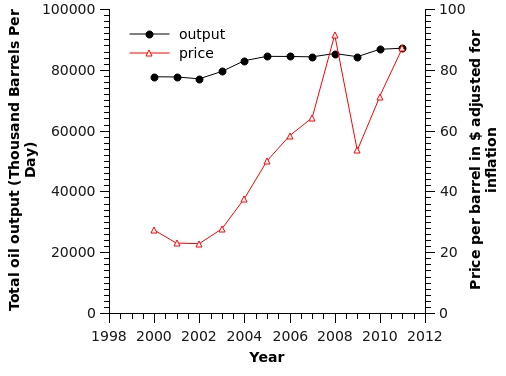
oil price and output since 2000
IEA view
I have to confess I have not read the entire IEA report. I cannot afford to. However, they do publish a short summary of its main conclusions. This is far more nuanced than the headlines have suggested. One finding the press picked up on was that the US would become the worlds largest oil producer. However, even if this is true, this is forecast as being for an extraordinarily short period of time, only for 5 years from 2020-2025. A related finding is that of the US becoming a net oil exporter in 2030. This is predicated on “new fuel-efficiency measures in transport”. As we mentioned in our book this takes no account of the the “Jevon’s paradox” or the “Khazzoom-Brookes postulate”. These economic theories of behaviour named after the economists who postulated them suggest that a bounce-back can occur from energy efficiency. The paradox is that people who buy a more fuel-efficient car, thus saving money, then use it more, thereby wiping out any efficiency gains made. If oil prices do fall due to US oil production then there is a chance that demand will bounce back (at least without peoples patterns of car use permanently changing). Despite any changes that occur in the US as the IEA summary says the oil price is global and US prices are going to reflect this. As the IEA predict
“Oil demand reaches 99.7 mb/d in 2035, up from 87.4 mb/d in 2011, and the average IEA crude oil import price rises to $125/barrel (in year-2011 dollars) in 2035 (over $215/barrel in nominal terms). The transport sector already accounts for over half of global oil consumption, and this share increases as the number of passenger cars doubles to 1.7 billion and demand for road freight rises quickly.”
Interestingly this year on year % increase is roughly that Benes et al., suggest and is below the long term trend. Non-OPEC unconventional oil is seen as a temporary phenomenon and OPEC production is seen as vital. Therefore according to IEA a lot hinges on what happens on what happens in Iraq as “Iraq makes the largest contribution by far to global oil supply growth”. There is little doubt that there is lot of oil in the ground in Iraq. There is also no doubt that like the rest of the middle east OPEC producers Iraq overstated its reserves. Since the 2003 Western invasion Iraq has not been a model of stability although its production has increased in recent years. The IEA predict production over doubling by 2020 and nearly tripling by 2035. If it doesn’t then as the IEA states
“Without this supply growth from Iraq, oil markets would be set for difficult times, characterised by prices that are almost $15/barrel higher than the level in the New Policies Scenario by 2035”.
The IEA are surprisingly (but rightly) cautious about unconventional gas
“… the unconventional gas business is still in its formative years, with uncertainty in many countries about the extent and quality of the resource base.”
The IEA see a huge increase in renewables (especially electricity production), with renewables as the second largest generator behind coal by 2015 and ahead of coal by 2035. Most of this growth comes from solar. The report also takes in a big push on energy efficiency which as it says
“These gains are not based on achieving any major or unexpected technological breakthroughs, but just on taking actions to remove the barriers obstructing the implementation of energy efficiency measures that are economically viable. Successful action to this effect would have a major impact on global energy and climate trends, compared with the New Policies Scenario. The growth in global primary energy demand to 2035 would be halved. Oil demand would peak just before 2020 and would be almost 13 mb/d lower by 2035, a reduction equal to the current production of Russia and combined, easing the pressure for new discoveries and development.”
The last very surprising factor the IEA raise is water. Its obvious though when you think about it. Water is vital for production of biofuels, which as covered on this blog are now unfortunately a “necessary” part of the transport fuel mix. But water is also required for unconventional oil and gas extraction and Iraqi oil production. Could it be that water shortages limit fossil fuel production? How ironic.
Conclusion
All the reports agree on one thing, the days of cheap energy are behind us. Even the IEA sees a doubling of the oil price over the next 20 years or so. Peak oil is not just about the end of oil, but the end of cheap oil. This rising oil price will obviously have severe knock on effects on the world economy through the costs of oil dependent goods and services, such as food and transport etc. Its surprising that with rising oil price since the year 2002 the level of production (especially since 2005) has been minimal. This does suggest we are at the top of the oil peak. How wide the top of the peak will be depends on how much unconventional oil and gas can be extracted. The IMF reports do take into account unconventional oil and gas and indeed all the reports cited here are cautious on this point. One factor no one seems to take into account is the energy return on energy invested. For all the unconventional energy sources its very low indeed. You are therefore using more and more conventional fossil fuel sources to extract unconventional sources hence speeding up depletion. Which brings us to the final point. How secure are these conventional resources? We know OPEC has overstated their reserves. If the Saudi fields go into decline by 2015 as has been suggested by amount others Wikileaks then no amount of unconventional oil is going to make up the shortfall.
I don’t see anything to alter my view we are at the top of the peak. Oil production may rise a bit buts its hard to see it increasing like the IEA suggest, there are too many imponderables. It just that the top of the peak maybe wider and longer than we had thought. There is a clear danger here that hype sets policy making. This has just happened in the UK over energy policy regarding natural gas. Fracking is unbanned and a new dash for gas will take place locking us into a declining and expensive resource. The same could happen with oil and airport expansion. It makes those who set policy make the wrong decisions. It is vital that proponents of peak oil and climate change combine arguments to combat the hype, as encouragingly is happening over fracking in the UK.
* its a think tank in London.
Neil
This is an interesting (as my own church is stepping up its role in this area) but depressing programme on foodbanks and faith. Interestingly the non Christians seem to be offering more interesting fresh food. We’ve been hit by a triple whammy of financial collapse, rising energy prices and allied to this rising food prices. This looks set to continue…
To those who find it after 6 days after this date I think the BBC archive everything for ever now.
Neil
“What gave them power, and made them able finally to dominate and reshape our society, was the growth of technology for the production and use of fossil fuel energy. This energy could be made available to empower such unprecedented social change because it was “cheap.” But we were able to consider it “cheap” only by a kind of moral simplicity: the assumption that we had a “right” to as much of it as we could use. This was a “right” made solely by might. Because fossil fuels, however abundant they once were, were nevertheless limited in quantity and not renewable, they obviously did not “belong” to one generation more than another. We ignored the claims of posterity simply because we could, the living being stronger than the unborn, and so worked the “miracle” of industrial progress by the theft of energy from (among others) our children. That is the real foundation of our progress and our affluence.”
(Wendell Berry. “Energy and Agriculture.” from the “The Gift of Good Land”, Counterpoint, 1981).