Renewable Olympics

Couldn’t resist a post related to the Olympics. On channel4 news at their spot at the Olympics site a number of vertical axis wind turbines can be seen behind the news anchor whizzing round (for the most part). One wasn’t turning tonight and the others were. Wind turbines in cities really don’t work well. We have one close to us here. There are times when its windy and its not turning and other times when its not very windy and it is. Its all to do with wind direction I think. In some directions the wind’s power is dissipated by obstacles. Apparently they were considering a really big one at London 2012 but dropped the idea. I can understand them not going for PV since they would be stuck with a load of modules you couldn’t sell. Only new kit for feed-in tariff, although this does have the advantage you cannot steal PV modules since there is no second hand market. They have at least made the right choice of vertical axis turbines which are unaffected by wind direction change.

If there was Olympics for renewables deployment Germany would surely get gold. Their renewables output has hit a new record due to PV installation.

A final thought how are we going to have an Olympics without oil? Answers on a postcard please.

Neil

Posted in Renewables | Leave a comment

Big news on climate change

Managed to drag myself away from the Olympics for a few minutes…

No its still real (climate change that is) and carbon dioxide levels in the Atmosphere are not falling.  But there has been some good news.  A group called the Berkeley Earth Surface Temperature project have analysed land temperature records going back 250 years.  Their director Professor Richard Muller is a climate sceptic (one of the few climate scientists who is) and his anaylsis of this data has made him change his mind (also here). In the best traditions of scientific process when the facts don’t fit your theory you come up with a new one, but good on him for being honest enough to admit it. Especially after where he got his money from. Won’t convince many of hard-line sceptics of course.

There’s another story about climate change in today’s guardian more sobering and yet in a way funny this time. Apparently in 1678 the inhabitants of a village in Switzerland fed up with an advancing glacier (Fiesch in the Swiss canton of Valais) inaugurated an annual pilgrimage to get rid of it. Their prayers were answered and then some. In recent years they could see it disappearing and the Bishop of Sion asked the pope to change the liturgy to the opposite effect. Quite why they had to ask permission is beyond me – but then I’m not a Catholic. Anyway the pope who I believe its fair to say has shown some concern about climate change, agreed in the remarkably short period of a year and the first “rebuild the glacier” pilgrimage is taking place tomorrow.


Neil

Posted in climate change | 1 Comment

Being ordinary

My wife is reading a book called “Everyday God” by Paula Gooder.  I’ve only glanced at it so far but I do intend to read it.  Her thesis seems to be that we don’t celebrate the ordinary enough and run around after experiences.  These don’t give any lasting satisfaction so we move onto the next one.

This is something we have written about in our book.  Oil has given us so much choice in life we can chase after so much in the way of consumer goods, experiences and travel.  Its both ephemeral and idolatrous.  This way of life is coming to an end.

As Bruce Cockburn put it

“Got to slow down fast”.

Neil

Posted in Faith, Lifestyle | Tagged | Leave a comment

Politics, energy, wind and hot air

I’ve got to check the proofs of the typeset book before printing so this will be a brief post but I couldn’t let today’s announcement on wind go without comment. It looks like the UK chancellor’s interference in the energy debate has been to an extent seen off, but possibly at some cost in the future.  A cut in onshore wind subsidies was perfectly reasonable – just not 25%.  I look forward to the day when wind/solar etc. requires no subsidy and that day is getting closer.  I have some qualms about onshore wind – not its efficacy but some aspects of sighting.  Nevertheless I’m glad the chancellor has not managed to kill it off.

What is more worrying though is the chancellor’s fixation with gas.  I don’t understand the reasoning behind the ‘if gas stays cheap we should use it to make electricity’ statements that have been apparently been flying around.  Gas has (almost) never been as expensive (here (UK)).  I say almost since the price I paid (along with everyone else’s) went up 30% last year but has come down a bit since.  The reason it went up was not pesky environmental regulations but due to its link with oil price and the fact that we having to buy more gas on world markets (non UK readers can wake up now after ignoring the last point).  If gas is so plentiful why are starting to use unconventional gas?  This takes a lot more effort, energy and therefore cost to extract.  It puts a floor under prices.  If we stay dependent on gas we will face higher heating and electricity bills as we make ourselves dependent on a declining resource.  And we will fail to meet our carbon targets.  Targets we ourselves have made legally binding.  Something that still makes me proud to be British.  It has to be said that the UK is not the only country facing a backlash against renewables from its government the same is happening in Germany.  As some of the other articles on the same website show and as I have blogged about before, fixed price renewables are cutting the price wholesale electricity, since conventional plant is not required.  I thought this government got energy security even if it didn’t get climate change, it seems it may get neither…

Back to checking the book.

Neil

Posted in Politics | 1 Comment

solar PV and seagull poo

On Saturday my new PV system modules had seagull poo on them (nothing else produces that much).  I climbed on the shed roof and cleaned it off.  By Monday they had done even more.  It was due to rain and so I left it.  For once heavy rain was useful -its all gone.  This system is almost horizontal so needs some cleaning.  The old system is at 27 degrees to the horizontal and tends to self clean, although I have got moss growing on the edge of the frames now.  Its difficult to know how much difference poo makes to power output but must make some, although its not the major problem that I heard someone say it was on the radio (the implication being PV wouldn’t work because of bird poo).

Neil

Posted in Renewables | Leave a comment

Energy storage

In a previous posts I have raised the real issue of how to balance renewable electricity from different renewable resources.   One way of doing this, perhaps the best way, is to store electricity.  The ways of doing this directly are very limited (capacitors?).   There are a number of chemical (batteries/hydrogen) and mechanical methods (flywheels/compressed air).  The remaining method is the oldest-that is pumped storage.

This means of “storing” electricity involves pumping water up hill to a reservoir and releasing it when required.  It is then used to generate electricity by means of a hydroelectric turbine.  Strictly speaking this is not renewable energy, or is only as renewable as the electricity used to pump it up hill.  Typically these systems are used during the day and use cheap electricity to replenish their higher reservoir capacity during the night-time when power demand is low.  These pumped storage systems have been traditionally used to balance high demand for example in the mornings when everyone gets up to have breakfast, or the evenings when people get home from work (the highest regular demand period in the UK for electricity).

Recently we were on holiday in Wales and went to visit what is still one of the largest such schemes in the world (as well as the fastest to swing into action when demand rises) at Dinorwig.  What is so impressive about this scheme is that you would hardly know it was there.  Due to its location in Snowdonia the power station was built in the middle of a mountain and its entrance is where a slate quarry was. In addition the transmission lines are buried underground for around 6 miles as cables.  A huge man-made cavern contains the six turbines rated at 300MW each (which act as pumps when required to reverse the flow) and the generating sets.  Whilst these turbines are large they are surprisingly small considering their power output – being only a few metres in diameter. The weights on the valves used to stop flow to the turbines are also very impressive.  All in all well worth a visit-its a superb piece of British Engineering.

The problem is we don’t have enough of these systems (very few countries do apart from perhaps the Japanese and Norwegians).  Whilst these systems have been used to balance out short term demand on the grid their focus will change to balancing out renewable production with demand.   I understand there was a similar scheme proposed for under Dartmoor which was cancelled.  Maybe its time to resurrect it and convert some existing hydro schemes to pumped storage?  Of course it would help if we could find ways to use less electricity…

Of the other types of types of energy storage mentioned above we think the chemical methods will run into resource issues and the mechanical methods are largely untested (with the exception of compressed air in Germany and a small flywheel in the US).   In principle though mechanical methods and pumped storage are the solution.

A couple of final thoughts- it takes more energy to pump water up hill than you get when it flows back down again and as the share of renewable electricity rises the pumped storage systems are getting more renewable.

Neil


Posted in Renewables | 1 Comment

carbon emissions

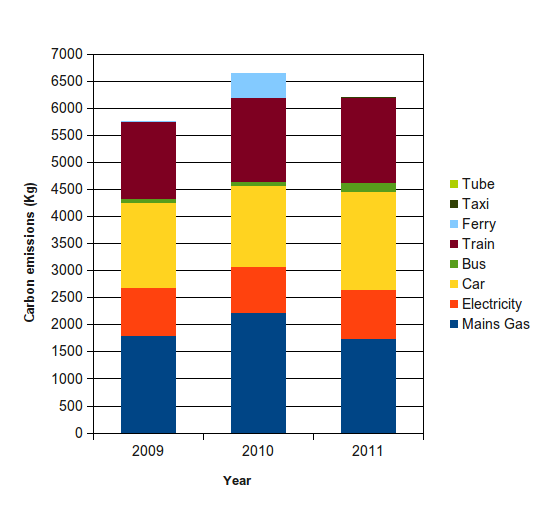
The other day I was working on my Carbon emissions data. Unfortunately one member of my family is flying a long distance this year.  Looking at the data for our energy and transport use we as a family are putting out almost equitable emissions at just over a tonne each (1.2Tonnes), shown in the graph below.

However, this takes no account of what David MacKay calls “stuff” and others call the secondary footprint. That is food and consumer goods. All the things we buy take energy to make and transport and in doing so pumps CO2 into the atmosphere. Some of the figures are shocking- to manufacture an aluminium can takes 600W according to Professor MacKay (I think this is making it from scratch- not if its recycled). Its difficult to arrive at exact figures for these extra emissions for the obvious reason that everyone’s household purchases are slightly different.  Estimates I have come across vary widely from just over a tonne to many tonnes per person. In addition there are 5 of us in the household with very different shopping habits (for example as my wife would tell you I hardly ever buy clothes, one of my daughters goes clothes shopping several times a week).  I did an Internet search and found this site.  Entering the options and trying to make them for all five of us (which involved a degree of compromise) gives a figure of 3.98 tonnes.  If this is for 5 of us I’m reasonably happy, if its per person then its a real challenge.  The implication is that its per person since the pull down options are “I”, however the transport and household tabs are more explicitly per household.  Trying another calculator and adding up the food, health and lifestyle totals gives slightly lower figure of 3.29 and that is per person.  Adding 1.2 onto that for figure we get 4.49 per person – definitely too high and not equitable, albeit less than the UK and other countries average.

Bringing this secondary emissions figure down though is not easy since its only partially in my control.  Whilst I can turn the heating off (and do), grow as much as possible myself (and do), my options over stuff I buy is more limited.  I can try consume less and buy second hand goods (this I do).  I can try to purchase stuff made as locally as possible but its difficult to control the quantity of packaging for example, or whether this packaging can be recycled when I dispose of it. I also need to eat. The lesson of all this in peak oil terms (which is what our book is about), is most energy we use is not within our house but within the wider economy and our world (if its imported).  Bringing this energy use down in line with the downside of the peak will be a major challenge.

This is also a moral issue. Not just because our excessive consumption is damaging to other human beings in other parts of the world whose emissions are far lower, but also other species. We look at the theology in some detail in the book but what is found from the old testament prophets such as Micah and Hosea to the New testament such as James chapter 2 suggests God is concerned not just with mankind’s exploitation of each other, but also with the natural world.  Consider this passage which is Hosea looking forward to the new covenant.

And I will make for them a covenant on that day with the beasts of the field, the birds of the heavens, and the creeping things of the ground.” Hosea 2v18 ESV

Living in a house with teenagers makes cutting your energy use difficult.  Leaving aside the fact that as soon as they hit puberty they are incapable of switching a light off (or any other electrical device- although they don’t leave the hot tap running anymore since they never wash their hands) its difficult for me to stop them spending the money they earn on what they want.  As a start we need to buy more, local organic food (although I don’t accept the carbon emissions are zero for this).  There are still other areas where energy use can be cut back. Looking at the graphs above over half the emissions are from transport much of which has to be regarded as discretionary (although my wife is contracted to have a car for work).  The high train travel over these years is were for urgent family reasons which have changed.  So far in 2012 train emissions are an order of magnitude lower.  Our car use also looks like its going to be lower this year as well.  We have a new PV system so electricity emissions should be lower.  Gas emissions also look like being lower.  Now if it wasn’t for that flying…

Neil

Posted in climate change | Tagged | 5 Comments

Renewable energy data

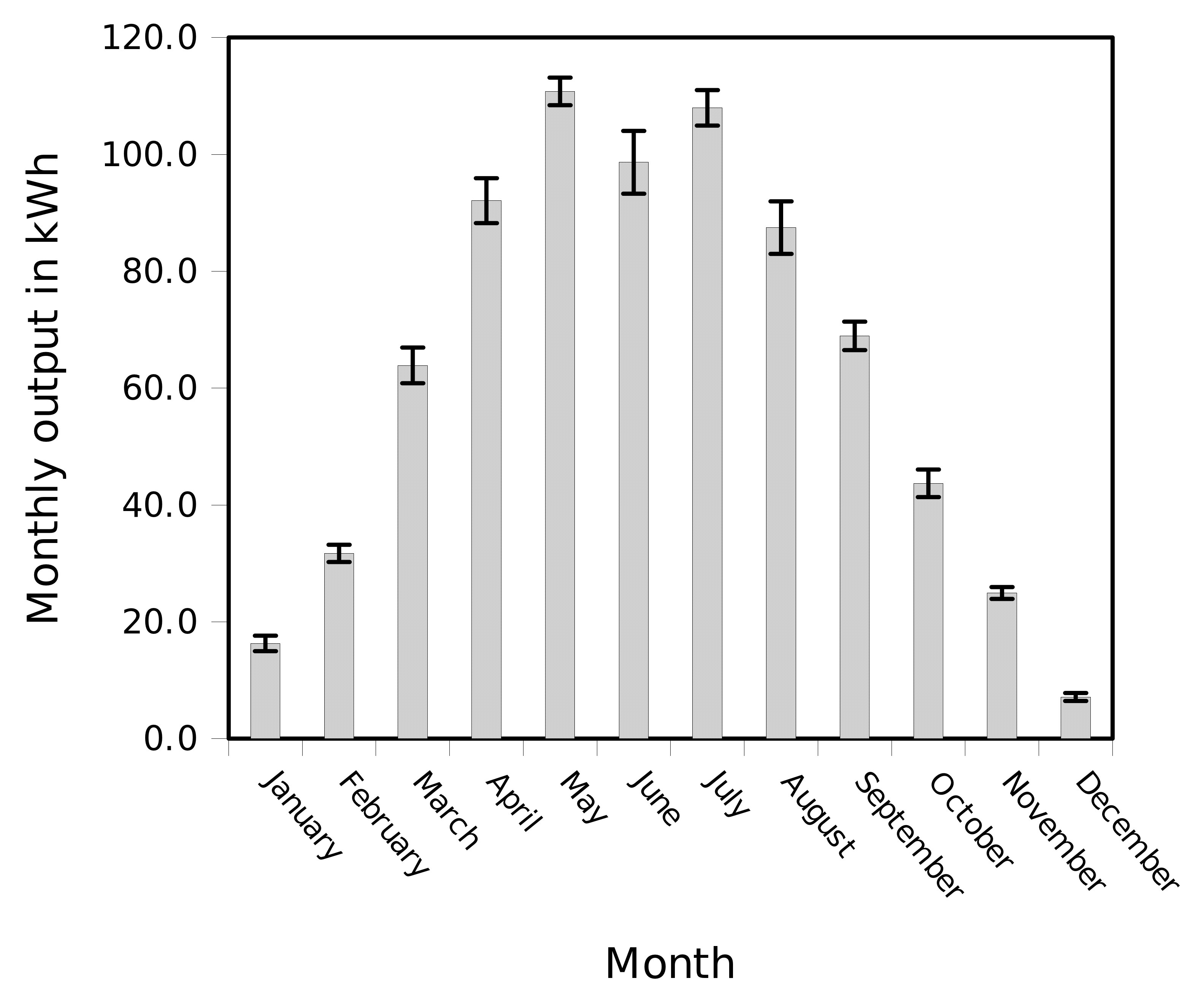
The other day I came across this.  The UK governments quarterly energy data for 2012 has shown record renewable energy production.  There was lots of wind, lots of rain and even solar power shows up with sufficient capacity to be measurable.  This last figure is encouraging with 0.17TWh of electricity generated, especially since the first quarter has relatively low output (see graph of data from my 1kW system).

Another interesting feature was that total primary energy consumption fell by over 1% taking into account weather differences.  This suggests we are slowly learning to use less energy.  However, despite this encouraging news carbon based fuels still dominate, despite gas use for electricity generation having fallen.  We have a long way to go and little time to make the journey…

Neil

Posted in Peak oil, Renewables | Leave a comment

Thoughts on electricity production in the future

The other week we had a small group leaders meal at our house and the weather was actually good enough to sit outside.  Conversation turned to our Solar PV panels that were in view.  I mentioned that on the 28th May Germany managed to provide almost half its power from the sun.  One of the things people wanted to talk about was what happens when the wind isn’t blowing or the sun shining, how do we manage for electricity then?

I talked about Smart meters, the need for conservation and different renewables balancing each other out, for example using HV DC on a continental scale.  No one seemed entirely satisfied with my explanations.  However, a few days later I found this.

Being a follower has its advantages sometimes.  Germany is so far ahead with its solar PV and use of wind that people are pouring over its data.  The above link is one look at the output data.  It shows over different time periods from hours to months the two renewable technologies are balancing each other out.  So as you would expect in winter there is very little solar contribution and the opposite in summer, but the overall contribution from both stays remarkably constant over both long and short time periods.

Other people are starting to look at costs.  As in other countries there are claims that FIT’s raise domestic bills.  Surprisingly a lot of German industry is exempted from paying the FIT. But it seems PV may act to reduce prices, at least in some ways.  In any case the latest FIT’s have been cut to below average German domestic power prices and the FIT will be removed completely when they reach 52GW of installed capacity.  This will be 2016 at current rates of installation.

I could have added to the small group leaders really all the above is the easy bit of peak oil.  Transport, food and chemicals are much more difficult.

Neil

Posted in Renewables | Leave a comment

Is Peak oil a myth?

Peak Oil – Myth or Reality?
Is the world running out of oil or are are we entering a future with a glut of the stuff?  And what are the environmental consequences if we are?  This is the question raised in a recent article by George Monbiot in the Guardian
His views seem to have been altered by a report from Harvard which can be read here.

Firstly, perhaps we should say we agree with George that, from a climate change viewpoint, we need to leave fossil fuels in the ground (we return to this argument later).  We also agree that many people have wrongly predicted peak oil.  It is worth saying at this point that the (wrong) prediction by the first person to study peak oil, M.K.Hubbert which Monbiot references in the article was later revised after the 1970s oil shock.  An interview with Hubbert on this subject can be seen on YouTube.  The sound quality and his accent make it hard to follow but basically he says the peak has been shifted back by about 10 years which takes it to about 2000ish…

The report referred to by George seems to us to be based on the usual mismash of optimistic data put about particularly by the US Geological Survey.  This organisation has a long-standing reputation for being very optimistic about oil (and other resources) which goes all the way back to Hubbert’s 1956 lecture.  The Maugeri report is also very optimistic about Middle Eastern reserves particularly Saudi Arabia.  There is plenty of evidence suggest these countries conflated their reserves in the 1980s, this has been picked up in the wikileaks saga also see and this.

As I (Neil) look at the latest BP statistical review of world energy with country after country showing falling production I’m left wondering can so many regions turn round and start producing more oil?  It’s possible, but seems unlikely.  Can Iraq produce as much oil as is suggested when there is still so much violence?  The IEA World energy output reports in recent years have suggested conventional crude production has peaked in about 2005 (not far from Hubbert’s revised estimate) and that any gap has to be made up from biofuels, new discoveries and unconventional oil.  Why was Fatah Birol their chief economist so pessimistic on ABC’s “The Science Show” (23/4/11)?  His view is that over the next 25 years we need to find 4 Saudi Arabias to just maintain current demand, this report does not suggest this is possible George.  Some of the recent discoveries such as of Brazil seem huge until you divide them by the daily demand, they then last less than a year…

Leonardo Maugeri also ignores another vital aspect of this issue which we cover in some detail in our forthcoming book, that is the energy return on energy invested.  To put it simply it takes energy to make energy (not a scientific way of explaining it, but a practical way).  There is another way of expressing this, as Rob Hopkins puts it, the upside of the peak is not the same as the downside of the peak.  If you imagine an oil production peak as a bell shaped curve then on the way up to its summit you use easy to extract sweet light crude.  On the way down you use harder to extract unconventional oil, this takes more energy to recover and the net energy return is lower.  Hopefully you see where this is going.  We are taking a lot more energy to extract oil, gas and coal (and minerals such as copper) than we were a century ago.  At the beginning of the last century gushers gave   us a ratio of 100:1 return in the 1960/70s this had dropped to around 30:1 and is now at 12-20: (oil from tar sands gives only a marginal return on the energy invested and  unconventional gas and oil are likely to be less than 10:1). The same pattern is seen in coal and gas and arguably uranium.  Thus to stand still we deplete faster.

We’d make two last points; firstly on daily oil production.  You get different figures quoted, but daily conventional production is about 77mbd.  The figure of 93mbd quoted by Monbiot includes unconventional oil, gas, biofuels and shale oil.  BP quote a figure of 83mbd, this excludes liquid fuels from other sources such as biomass and coal derivatives.  Secondly, we return to global warming, whilst it is certainly true there is enough carbon fuels to fry us, (Neil’s) hope is that peak oil would at least raise the prices of all conventional fuels meaning renewables could take up some of the slack and people would use less energy.  Depressing, isn’t it, that to save us from climate change we would have to cope with another major crisis.   Its possible we are wrong but looking at all the evidence we are going to stick our necks out and say we are at the top of the peak for conventional oil production – in fact a plateau from about 2005 to date.  Only time will tell, and we’ll see after 2015.

Neil and Andy

Posted in Peak oil | 2 Comments