One thing we have learnt this week – renewables to dominate by 2040

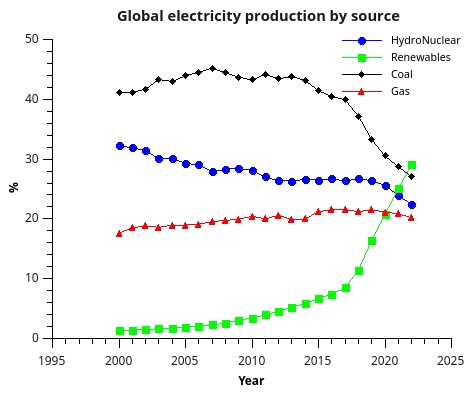
electricity production data 2019Renewables to dominate electricity production by 2040.  That’s the main conclusion in the BP energy outlook 2019.  The graph shows the data provided by BP and replotted by me.  There a number of things to say about this.  Firstly some of this data is historical so in the graph renewables share of the data has doubled 2015-18.  Second, BP persistently underestimate the growth of renewables, so its likely that this latest projection will be an underestimate.  As you you will see from the graph this figure does not include hydro.  Whether big hydro especially in the tropics can be regarded as sustainable is a moat point.  It shows gas staying pretty level, with a huge drop in the use of coal.  Lastly this does include a big increase in electric vehicles, although not as high as other people would see the penetration although much of this is seen as shared rather than owned vehicles.  When this is taken into account the % of journeys is much higher.

Other things to note from the report apart from the renewables to dominate part.  The report talks about the circular economy as far as I am aware for the first time.  It also (surprise surprise) sees oil as the still dominate form of energy but sees much of the demand going forward as coming from need for oil to make plastics.  It warns a ban on single use plastics without an alternative will increase carbon emissions and energy demand.  Precisely why this is not made entirely clear, but one reason given is an increase in food waste.  So some encouragement here we need this transition and we need it fast.  The last thing to say is of course there are lots of other areas to decarbonise apart from electricity.

Neil

Posted in One thing we have learnt this week, Renewables | Tagged | Leave a comment

We need to talk about woodburners

Woodburners come up in the news a lot at the moment.  And not in a good way. They are much maligned as a source of air pollution.  Confession time I have a woodburner which I love, so it was with interest and some trepidation I heard that the the radio 4 programme DSC_2911“More or Less” was covering the issue.  For those of you this programme throws a unbiased eye over statistics in the news.  For example the same programme briefly has a look at the statistic that had been in the news that week that the average length that someone (women) kept new clothes was 5 weeks.  It turns out that is completely untrue and was plucked of thin air.  But I digress…

All combustion produces oxides of nitrogen (NOX), soot and carbon monoxide (a product of incomplete combustion).   Most combustion produces sulphur dioxide as well.  NOX is produced largely since air is nearly 80% nitrogen.  This is present as a molecule made up of two nitrogen molecules joined by a very stable triple bond.   The energy of combustion is enough to break this bond and the nitrogen reacts with any oxygen present.  This is true of central heating, wood burning,  in fact any combustion.  Gas central heating produces soot, NOX and sulpher dioxide since the compound added to give it odour is a sulpher based organic.  After the concern over acid rain in the 1980’s cars in all Western countries had to be fitted with catalytic converters.  In addition NOX is carcinogenic.  Petrol cars have three way cats fitted these remove the NOX, organic hydrocarbons and carbon monoxide.  Diesel cars have two way cats fitted these remove the last two but not the NOX for technical reasons.  Under EU rules new diesels have particulate filters fitted to remove the smallest particles.  These are known as PM2.5’s due to their size (2.5 millionth of a millimetre).  These particles are now known to have a very wide range of health effects, none of them good.  Its been found that 100 µg/m3 increase of PM2.5, the morbidity of residents increased by 12.07% (1).  There has been a clear correlation between some asthma deaths and PM2.5’s.  So its a serious problem.

Now getting back to woodburners.  The UK government states that 38% of all PM2.5’s comes from burning wood (notice the subtle distinction).  Up until now my view as been as the following*;

  • I have been wary of accepting this figure.  One reason for that is the ratio of cars to woodburners is very high.  There are about 2 million woodburners in the UK and over 30 million cars.  To give an example.  I left my woodburner (reluctantly) to give my daughter and her friends a lift on Friday evening to the Theatre (since they were late).  It took me nearly an hour to make a return journey of 3 miles.  The reason was wall to wall cars (mostly diesel).  It seemed to me that my stove and the relatively few others compared to car numbers in my city would have be pushing a lot of filth to compete.
  • My stove has been thoroughly tested and is exempted under the clean air act.  I burn dry wood and regularly check to see what’s coming out the flue.  Usually this is invisible (yes I know PM2.5’s are not going to be visible, but it seems like its a reasonable check on general pollution levels).  When I bought the stove manufacturers were complaining the tests were too onerous and it was taking them 5 years to get a model licenced.
  • We are not sure what people are actually burning.  You can tell its wood but it could be wet wood, open fires (these are not legal), coal etc.

However, as a scientist I have to take peer reviewed scientific data seriously.

So where does this 38% figure come from?  “More or Less” explained.  Apparently according to the programme its from taking all woodburning combustion (from a survey) divided by all PM2.5 emissions for the UK.   This uses an assumption on PM2.5 emissions on cars but I wonder whether this is high enough, since the manufacturers cheated on their emission data?  Anyway the question is what happens when you measure real data?  By measuring particle size and using a mass spectrometer you can tell where particles come from.  One of the much maligned experts has done this and in urban areas found that woodburning makes up 6-9% of PM2.5’s.  This figure is also falling.  Notice the use of that word  woodburning since we still don’t know quite what’s being burned or how.  Also as the programme pointed out air quality is much better than it used to be although the problems it causing are certainly acute particularly regards childhood asthma

The last issue is why are asthma rates rising?  A number of theories have been put forward that are given in that link.  In addition warnings have been made about air quality within increasingly well sealed buildings as well as without which would be interesting to look at.

To conclude.  I’ve felt that woodburners are being blamed unfairly. This seems to be true looking at hard scientific evidence.  Its a lot easier to go after 2 rather than 30 million especially when this involves the motor car.  To really cut PM2.5’s we need to cut road traffic.  I would also point out I mainly burn scrap wood from skips and that saves me a whole lot of greenhouse gas emitting natural gas.  The programme can be heard here.

*they are not worried about the NOX presumably since the contribution is low compared to cars and central heating.

1) Kan HD, Cheng BH. Analysis of exposure-response relationships of air particulate matter and adverse health outcomes in China. Journal of Environment and Health 2002;19:422-4

Neil

Posted in air pollution | Leave a comment

Has something clicked over climate change?

Hockey stock - 21st centuryHas something clicked over climate change?  Over the last year I’ve seen a big change in levels of concern over those I know concerning climate change.  My church has put protecting the planet if not at the heart of its new five year strategy then as an important plank.  This in itself is quite a major change.  In addition most weeks the environment is prayed for and increasingly mentioned in sermons.  We now have an ethical challenge (environmental) in our news sheet every month.  Its not just at church that concern seems to be rising.  My children are increasingly asking how they can cut their emissions.  They may not be ready to give up flying yet, but one has gone to Berlin/Amsterdam by train this week and two are now vegetarian.

What has brought this change about?  In my view it was last summer’s heat wave.  As one comedian put it one the BBC Radio 4 comedy “The News Quiz” last week.  “You can tell climate change is real since I got a tan in Edinburgh last summer”.  I’ve always thought people in the West would only take the issue seriously once the impacts could be seen close to home.  This does seem to be the case now.  Crazy weather is now commonplace and almost expected.  Australia has just had the most amazing drought and record temperatures of almost 50 degrees C followed by huge floods in Queensland over the last few days.  Obviously people have to move from concern to action, but concern is the first step and has to be encouraging.  Has something clicked over climate change?  It looks like it to me.

Neil

Posted in climate change, Faith, Uncategorized | Tagged | Leave a comment

One thing we have learnt this week – electricity from the air

10668295_1133346013348006_545104614_nElectricity from the air sounds too good to be true.  But researchers have announced this week they have found a way of harvesting electricity from the thin air.  Of course its not coming literally from the air but rather from the electromagnetic radiation passing through it.

This while not exactly a waste material is certainly partly going to waste.  We are talking about radio waves mainly.  Signals from Wifi and other radio signals.  What researchers have done is come up with new materials that can harvest the signals and convert it to a small amount of power.  There is nothing new in this and your radio or Wifi works on the same principle using Farady’s theories of electromagnetism .  The radio signal is converted to small amounts of electricity which an amplifier uses to convert to sound (in the case of a domestic radio).  Some mobile phones can be charged without plugging them in (although by a bespoke electromagnetic beam) and there is talk of charging electric cars in the same way.  What’s new is the material can harvest the power and are flexible. One sort of harvester is a sort of table  cloth.

Whilst electricity from the air looks interesting it suffers from a couple of drawbacks.  The amounts of power are very low and come from conventional electricity sources before they hit the air.  It not a free lunch.  Presumably the amounts of power you are removing do not interfere with signal quality.  It raises some issues you could harvest your neighbours Wifi power in fact in most cases there would be little way of telling where it has come from.  But if you think about your Wifi radiates in every direction and most of the time most of its going to waste.

Neil

Posted in One thing we have learnt this week, Uncategorized | Tagged , , | Leave a comment

Feeding the world

pumpkinsFeeding the world in the future has been in the news recently.  The UN Food and Agriculture organisation (FAO) has called for a transformation in global agriculture towards healthy eating and the Lancet medical journal have brought out two reports on eating sustainably.  What is intersting is that the Lancet has linked the global health crisis (obesity and linked health disorders) to the climate crisis.

The Lancets’ recommended diet involves huge cuts in meat production (and therefore consumption) and a huge drop in consumption of sugars.  This general idae ahs been summarised in the past by food writer Micheal Pollen some years ago thus;

” “Eat food, not too much, mostly plants.”

The problem with the Lancets recommendations for every person per person per day on the planet is that quantities are either small (29g chicken) or fractional (one fifth of an egg).  This makes sense scientifically (per year) but is hard to get your head around in practice.

We potentially face huge issues in doing all the above whilst feeding a lot more people whilst not using oil/gas.  Which of course is finite.  Briefly what are the alternatives.

Food waste.  Around 30% of global production is wasted.  In the developing world it tends to be in the field.  In the developed world in the fridge.  Pros.  An obvious solution that would at least buy time.  Cons.  Easy in theory but hard in practice to bring about.  Also the waste could be used for biogas which could be used an energy source.

Conventional “Western” agriculture.  Pros.  Has led to huge increases in food production since WWII.  Has saved whole continents from famine.  Cons.   Relies on farm machinery and fertilizer.  Very energy intensive at every stage, fertilizer uses enormous of gas to produce (covered in our book in more detail).  The use of fertilizer had led to severe soil and water courses.  It had led to many now talking about peak soil as it literally washes away.  Expensive kit.  Huge greenhouse gas emissions.

Organic production.  This makes up only very low percentages of food bought in the US and UK.  Organic producers have to follow a strict set of rules and the use of pesticides and antibiotics is severely limited.   Pros.  Good for the planet.  Cons.  Onerous and controversy rages over productivity and whether there are more nutrients in organic food.  Lots of rules and expensive to register with inspections.  Still uses oil to a certain extent.

Semi-organic.  This the approach that my co-author Andy has been taking.  Exactly as its name suggests using less of the fertilizer/pesticides but being less strict about it.  Pros.  Both these and completely organic producers are more likely to use heritage varieties of animals/plants.  These have advantages with diseases.  Cons.  Still only semi-sustainable.  Still uses oil to a certain extent.

Permaculture.  Hard to describe but involves using the land in a very specific and targeted way (the best use of land that is sunny/shaded/sheltered organically).  Pros.  Potentially sustainable.  Cons.  Quite specialised and more of a way of thinking and culture. Organic but still uses oil to a certain extent.

Biodynamic.  Involves doing things like planting according to the cycles of the moon, organically.  Pros. No hard evidence that its works although its proponents reckon it does.  Cons. Niche. Organic but still uses oil to a certain extent.

Small farms.  About 80% of the world’s food is produced by small farms which make 90% of the 570 million farms worldwide.   Pros.  The FAO sees these farmers as the key to any transition.  Cons.  Many smallholders are loosing land by people stealing it.  Hard to communicate new ideas and many such farmers are resistant to new ideas.  Still uses oil to a certain extent.

Technology.  We have covered this on the blog recently.  Basically uses robots and drones.   Has elements of permaculture to it in that the land is intensively mapped both in terms of topography and soil type, pest monitored using drones/robots.  Pros.  Not organic but allows lower use of pesticides/fertilizer/water.  Cons.  Has to be still pretty energy intensive.  Job losses for those who work on land.  Still uses pesticides/fertilizer.

We face huge issues in feeding the world.  One area of encouragement to leave you with.  There is increasing evidence to suggest global population may peak at a far lower level than had previously been thought.   Fertility rates are plunging.  In most developed countries they are well below replacement levels (including in the UK).  The only continent with vary high fertility rates is Africa but even these are falling.  Falls in population bring other economic challenges but in general terms from a sustainability perspective are to be welcomed.  On that note…

Neil


Posted in Peak oil, Uncategorized | Tagged , , , | Leave a comment

One thing we have learnt this week – fossil fuel subsidies

walney 1 and 2Guess which country in Europe gives the highest fossil fuel subsidies?  No I wasn’t surprised either – its the UK.  Now guess which country subsidises renewables.  This time its easy to guess.  Germany.  The EU commission has produced a report based on the 2016 Eurostat data.  In the UK they reckon that we spent 12 billion Euros on fossil fuel subsidies and 8.3 billion on renewables.  Germany spends 9.5 billion on on fossil fuel subsidies and 27 billion on renewables.

Other countries such as the France the Netherlands, Sweden and Ireland all give more than Germany but less than us.  The fossil fuel subsidies fall into two main parts.  The subsidy of the north sea oil and gas industry (tax breaks) and an indirect subsidy of the low rate of VAT on domestic gas and electricity.  Under EU rules these cannot be cut but members are free to raise them.  A large part of the brexit campaign (interestingly now forgotten) was based around the idea that we should leave so we could VAT further.  Whilst I cannot see anyone cutting VAT on fuel if we leave (and cutting from such a low level would not make that much difference to peoples bills), its even harder to see it being raised either so I guess this subsidy is here to stay.  The North sea subsidies were raised with the drop in the oil price when a large number of fields were found to be uneconomic.  The only way this subsidy is going to fall is as these fields close.  Fracking is so small at the moment that its a very minor component.  The government promised to phase these fossil fuel subsidies out and insists they do not subsidise fossil fuels.  Whilst we should stop this due to climate change don’t hold your breath…

Neil


Posted in climate change, One thing we have learnt this week, Peak oil, Renewables | Leave a comment

Energy policy is collapsing

DSC_4304The government’s energy policy is collapsing.   With Brexit not much attention has been paid to what has happened over the last week.  Its looks like Hitachi has pulled the plug on new nuclear at Wyfla and therefore at Oldbury.  These two stations were expected to supply 7% each of the UK electricity.  This leaves a considerable hole to be plugged and follows on from Toshiba pulling out the Cumbria project.  The deal collapsed due to the UK government asking for a strike price of £7.5/MWh.  This is considerably less than Hinkley Point C at £9.25/MWh.  Hitachi didn’t think it was economic at this price to build either reactor.  They have written off a truly mind boggling £2 billion for this station alone?

The government has put (almost) all its eggs in the nuclear basket.  They have cut onshore wind, tidal/wave and are abolishing the FIT.  The green new deal (admittedly a disaster) was abolished and has not been replaced.  BEIS openly admit nuclear cannot compete with wind/solar and yet have done almost everything they can to destroy them (this continues apace with proposed standing charges on grid connected microgen and alterations to the export regime).   There are a whole heap of interconnectors under construction but both brexit and the size of the hole lead me to think these will not be enough. Energy policy is collapsing, the government needs to rethink on the abolition of the FIT, allow onshore wind through the planning system and invest in tidal and wave.  And come up with a proper energy efficiency scheme.  I have changed my mind on these sources thinking it would be too expansive for too long, but the collapse in the cost of offshore wind generation makes me think that these could undergo very rapid cost reductions as well.

Neil

Posted in Nuclear, ocean energy, Renewables, Uncategorized | Leave a comment

One thing we have learnt this week – right to repair

43788119_1135480189940189_4856292381688856576_nThe EU has introduced a right to repair directive.  One of the most annoying things that happens is that you buy something and it does not last.  Also annoying is that when whatever it is goes wrong repair is either very expensive rendering it uneconomic or impossible.  This in my experience is most prevalent with electronic goods.  We have found this with a Toshiba DVD recorder.  It went wrong.  We bought it online so getting it sent back to Toshiba was difficult.  My to my surprise they actually did repair it and send it back to us.  It then gradually went wrong again with various features stopping working before conking out completely just after its guarantee ran out (about 1 month).  Of course Toshiba did not want to know.  Its not all bad news.  Cars have got much more reliable than when I was young although arguably much more difficult to service and repair.

When I was young there was a whole industry that repaired things.  Everything from clothes to shoes to TV’s.  This infrastructure has disappeared although there are repair shops opening up such as one in Edinburgh where you can take anything or the makers club near me which does iron work (above).  The EU directive should make such initiatives much more viable.  It should also force manufacturers to design recycling in and make their goods more reliable (many of us think built in unreliability is a ploy to get us to buy new stuff).  The right to repair should mean less stuff going to landfill as well.

Neil

Posted in One thing we have learnt this week, other, Practical low carbon living | Leave a comment

Declining renewables output

Something I have been thinking about for a while is declining renewables output.  I said last year that I thought my solar PV output was declining in a previous blog.  I read an article in the Guardians’ weatherwatch in which the author said his PV output was declining in passing although he did not allude to any reasons why.  The other week the same weatherwatch feature also said the planet is becoming less windy.

This latter fact is surprising.  Climate change was expected to make it stormier.  Of course the two are not mutually exclusive.  Average wind speeds could drop with much more violent winds at times.

The wind drop is global.  The Guardian article put forward some theories.  One was that vegetation cover was increasing as are built up areas.  Both tend to slow wind down.  If vegetation cover is increasing then this is good news I thought it was decreasing.  In any case these are not the explanation.  Wind speeds are decreasing in Saudi Arabia which has little of either.

The wind speed decreases are taking place at ground level and its unknown as to whether they will affect wind turbine output.  It does seem likely however.

My solar PV drop does not seem as bad when plotted out (below) or analysed statistically*.  The data is shown for my oldest system.  The newer one shows the same trend but there is less data and not enough to do stats on (and the number of years is odd).  The red line shows the linear trend and the equation at the bottom the trendline equation and the R2 value a measure of how significant the linear regression is.  The answer is not very and the paired test bears this out.  The drop is not statistically significant.

solar PV outputThis surprised me.

The question is if wind and solar output are declining why is it and what can we do about it?  There are several possible solutions to declining renewables output .  We could add more wind and solar capacity to compensate.  We could add better technology.  This is happening anyway with solar cell efficiency hitting 50% rather than that of my cells which is around 20%.  And we can add different technology.  Tidal for the UK seems the obvious answer.  (Wave tends to follow wind output).  In other countries it could be completely different. Its pretty obvious we should be overly reliant on one form of renewables anyway.

Happy new year Neil

*For those interested you can divide a dataset in 2 and do a paired test.  I need an even number to do it.  My new system is an odd number of years.  To remove one year could introduce bias, also for the new system there are too few years to do a normality test first. The data for the old system was divided in 2 and each half was tested for normality.  One set was normal the other was not.  This means you use a non-parametric (non normal) test.  I used Wilcoxon matched pairs in PSPP.  This is an open source version of SPSS which I have used in the past and found to give the same answers as SPSS.

Posted in climate change, Practical low carbon living, Renewables, Uncategorized | Leave a comment

One thing we have learnt this week – Daylight robbery

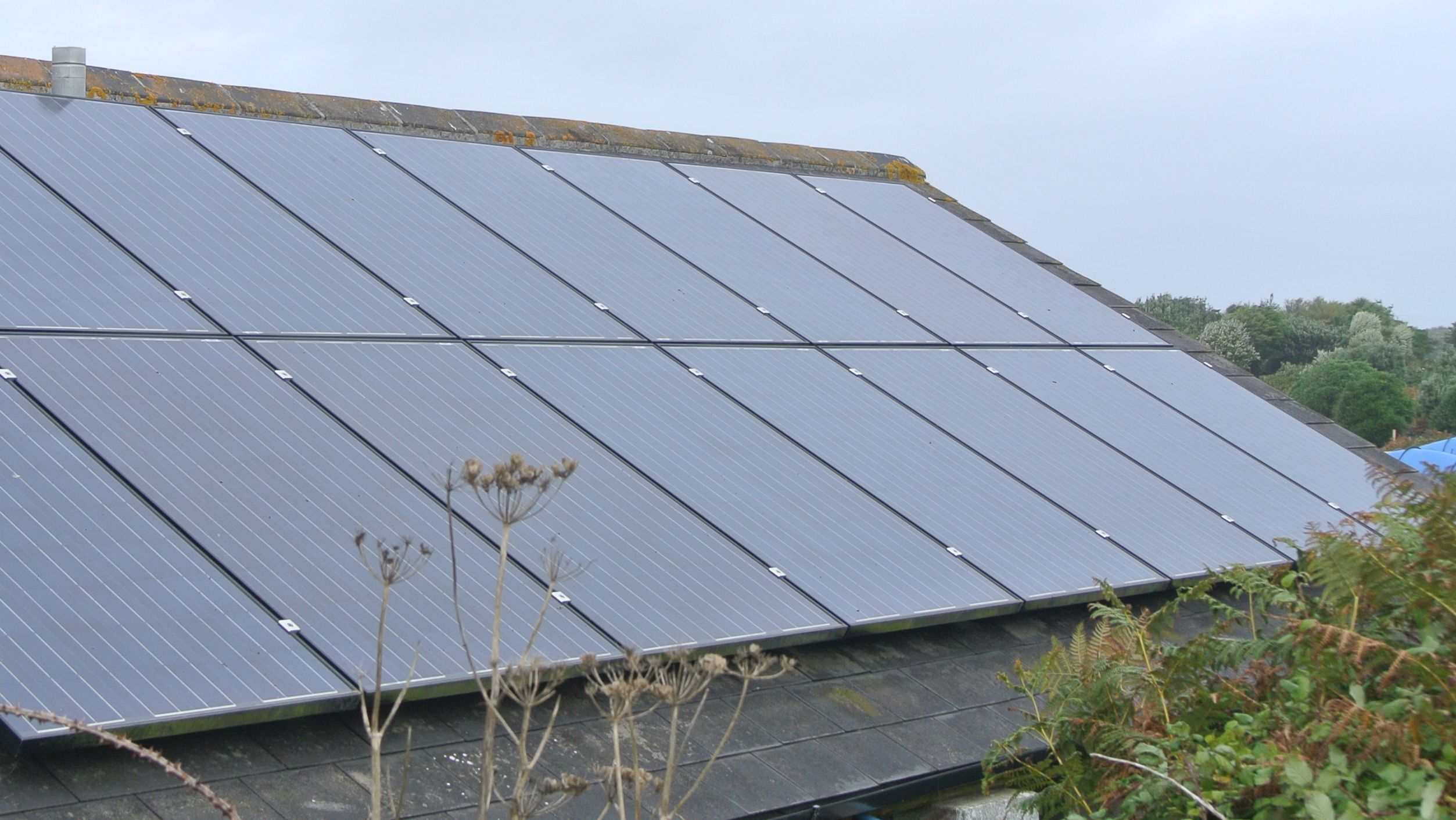
Solar PV on my roofI wasn’t going to do a post until after Christmas but occasionally you come across something so annoying and disturbing that it changes your mind.  If what is planned to happen happens it can only be described as daylight robbery.  In the news over recent week has been the news that when the Feed in Tariff (FIT) ends in March then any installations after that date will not get any money at all.  We knew obviously that when the FIT ends new installers would not get generation money but the assumption was that they would at least get money for the electricity they sent to the grid.  This is not to be the case.  In principle they are giving a lot of electricity away to utilities that are generally quite profitable.  All attempts to stop this have failed (the “consultation” responses were about 95% against apparently).  The export revenue is not huge, for my systems it was about £20 in 2017.  But small amounts add and tip the balance on the payback.  Hopefully (and I expect this to happen) some suppliers particularly at the green end will pay something, but they will not be forced to.  This is clearly daylight robbery.  (One rare bit of good news for existing users is that if you install storage on site you will get the export tariff to your battery system.)

If this is not bad enough another form of daylight robbery is planned and this is retrospective and will affect all renewable micro-gen systems.  OFGEM (the UK energy regulator) is planning to alter the way the network is paid for.   All users pay a small charge in their electricity bill towards the upkeep of the grid.  This is not even itemised on my bill as to where the costs go.   The argument goes that those of us that generate on-site import less and are not paying enough and this is costing other energy users.

At first glance this seems a fair outcome.  Then you start to think about it, its daylight robbery for the following reasons.

1) When the FIT and grant scheme before this was introduced no mention was made of this.  I doubt if those rushing to install systems to beat the current deadline are aware of it either although the idea has been kicking about for a year.  It will seriously affect their payback since the FIT rates are so low.  Retrospective change is dangerous.

2) We were told that installing such systems would reduce the strain on the grid.  Therefore we are saving the grid money.  Many years ago I came across OFGEM or National Grid documents online that stated this would be the case.

3) Not all systems are equal in terms of power output/export etc.  But beyond that the ownership of systems varies.  Many local authorities installed systems on social housing to reduce the energy costs of those on low incomes.  Who is going to pay the increased cost when  many struggle in fuel poverty?  What about rent a roof schemes?

4) This is a total disincentive to energy efficiency.  Why install anything that saves energy?  OFGEM by and large energy demand at the moment is on a downward path.  This is for the simple reason that every-time we replace something it uses less energy than its predecessor. So the network contribution made by all users will fall until electric cars really take off.  Will households who have them pay a surcharge?

5) This is disincentive to invest in renewables when we need more.  It looks like almost all the new nuclear build is going to be cancelled.  We need more renewables not less.

6) Actually those of us who have installed systems are doing everyone a favour.  Not only are tackling climate change and peak oil/energy security.  We are also as pioneers helping to reduce the future prices for others – this has worked.

7)  The type of proposed charge to be levied is unfair.  OFGEM are considering four different types of charges.  A per unit charge (on both generated power and imported power), two types of capacity charge and a fixed charge.   The fairest is a per unit charge since this at least on the import side this gives makes the PV more cost effective and drives efficiency.  Perversely this is why OFGEM seem to be opposed to it for domestic users.  Plus they think you cannot calculate the proportions.  I thought that was what metering was for, particularly smart metering?  A standing charge is the least fair way of charging for energy use and should be abolished for all users, since you cannot conserve.

8) The argument takes no account of the efficiency of microgeneration.  You generate it where you need it and it takes no account of the value of the exported electricity which will go our immediate neighbours.

The cost for me as a low import user and small scale producer as well will about £47-130/year. This is the cost to the domestic user there is  a danger that once business learns about this they will lobby successfully on their behalf and we will pay more.  You got until 2021 if it goes ahead but not as long as that to stop it.

The fairer idea OFGEM is for everyone to do what the French do.  The cost of your electricity is based around capacity.  There are three different levels I believe, you choose your level.  High import capacity users pay the most and low the least.  If you exceed the capacity the power goes off until you cut back.  This would incentivise everyone to conserve.  It means the poorest who usually use less would pay the least.

This idea is unfair to introduce retrospectively (particularly for those just installing now), complicated and sends all the wrong signals.  I’m seriously thinking of setting up a social media group to stop it.  If you have a PV system or any other microgen and are happy to pay the above then fine.  As more me I’m determined to try to stop it.  I think its daylight robbery.  Some more details can be seen here.

Neil


Posted in One thing we have learnt this week, Practical low carbon living, Renewables, solar, solar PV, Uncategorized | Tagged , | Leave a comment