One thing we have learnt this week -ode to meters

metersCarol Ann Duffy the poet laureate is write an ode to gas meters.  As poet laureate her job is to comment on and to celebrate national life.  With conventional meters being phased out she wants to celebrate the demise of the whirring meter which apparently has been with us for 100 years.  The article mentions just gas meters but of course electricity meters are going as well.  All the old meters are supposed to go by 2020 to be replaced by smart-meters (not very long).

Whilst in a way this is a silly story there is a serious point to it.  This blog has written about smart meters a number of times.  It sees them as vital to managing our grid with a increasing amounts of renewable electricity.  It could save grid reinforcement and will certainly make billing easier for the energy companies (whether that will help the customers is a moot point).  My concerns are over the type of communication used to connect to the utilities and remote cut-off with the dangers of hacking which this entails.  There could also be crime issue with hacking as well.

I have a whole heap of different meters having multiple PV systems as well as gas.  Recently I had to have the electricity ones inspected by my energy company.  There were problems with this caused by my energy company which led to discussions on the phone.  They didn’t know that the government has prioritised smart meters for people with PV systems.  When I mentioned this they told something I did know, that current smart meters are not compatible with PV systems!  I’m not sure how many houses in the UK have PV systems fitted, you read different figures, but its certainly greater than 200,000 and even after the cuts increasing all the time.  Two issues arise from this problem.  First what happens if you try to fit a PV system to a house with a smart meter (relatively unlikely) and what happens if you already have a PV system (increasingly likely) and your utility turns up to fit one.  This whole business looks like running and running like a whirring old meter.  Maybe our poet laureate should write a poem about the whole saga.

Neil
Posted in One thing we have learnt this week, Uncategorized | Tagged , | Leave a comment

David MacKay an appreciation of his life

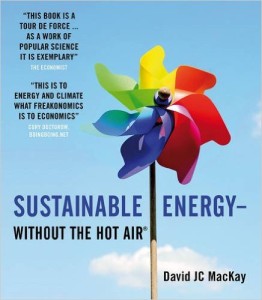
51YM3I8C0ML._SX434_BO1,204,203,200_On a visit to my parents I was surprised to see a copy of “Sustainable Energy – Without the Hot Air” by David MacKay lying around.  My father told me my brother had given him a copy since he had been at Cambridge at the same time as David MacKay.  I had heard of the book and read as much as I could whilst I was there.

Dr David McKay was born in 1967 and studied Natural Sciences and Physics  at Cambridge University.  After carrying out doctoral studies in the States on machine learning he continued his research at Cambridge.  This might have be have been it, a good but obscure career in Science if he had not written “Sustainable Energy – Without the Hot Air”.

In this he had a number of brilliant ideas.  The first was so simple (but like many innovations you wonder why you have not thought of it yourself).  This was to put all our energy use in kWh/day per person (for UK and USA), rather than barrels of oil, or millions of tonnes of oil equivalent etc.  The kWh is a unit that even we cannot define is something we are familiar with in our daily lives.  The second idea was to consider all our energy use for all we do in kWh.  Many books (and I’ve read some of them) simply say we can move over to renewables and that’s it.  The problem is as we tried to express in our book its not as simple as that.  At the moment carbon fuels and to a certain extent nuclear give us an excess of energy which means we do not have to worry about our energy use for material things which make up our total (hidden) energy demand.  Some of the examples he gives are shocking such as newspapers and magazines and aluminium cans (cans need 500W each to make).  He produced overall graphs of energy demand and supply in kWh/day per person.  When we can to write “No oil in the Lamp” he very kindly gave us permission to reproduce one of these without paying royalties.

In 2009 he was appointed as Chief Scientific officer at the Department of Energy and climate change.   Here David McKay came up with another innovation which was an on-line 2050 calculator, free for anyone to use.  In it you could come up with your own electricity system and see if you meet the UK climate targets (mandated under the climate change act).  You could choose all nuclear/solar etc or any combination thereof and see how far it got you.  This was an open source effort written in Ruby that anyone could join in.

Whilst I think David MacKay’s analysis of the problems was spot on, I did not always agree with his solutions.  He did not seem to recognise resource limitations which when you are planning longterm you must do.  He was very pro nuclear and given all that has happened since with Fukishima and the Hinkley C only confirms my anti-nuclear stance.  Indeed in some ways his energy calculator undermined his own arguments.  I had several goes with the 2050 calculator and could meet the 2050 climate target using only renewables*.   He did seem to recognise Uranium resource limitations, but his way round this was to extract it from seawater.  I got hold of one of the papers he cited and in my view he made a mistake in his calculations by a factor of 1000.  Uranium has been extracted from seawater on a minute scale but as the concentrations are in the order of parts per billion its simply impracticable.  Interestingly he was far more cautious about extracting lithium from seawater and this is a 1000 times more concentrated than uranium.

He also underestimated the speed and the fall in cost of solar or batteries (but has every excuse there), but more worryingly the contribution solar could make to the nations electricity supply.   We are now producing whilst not anything like the potential maximum he comes up with but at the same time disproportionately more than we should be in his terms, having barely scratched the surface of our roof and field space.  Partly this his caution in considering only the best south facing roofs when in actual fact roofs that face East or West give a reasonable power output.  Partly its that he considers fields and the domestic scale and not large commercial roofs (and we have barely started on these).

David McKay came from a strongly Christian background but lost his faith.  This background made him strongly aesthetic in his personal life according to some.  My last criticism of the his book was that it attempted to keep everything humming along as it is now.  What his book confirmed to me was this is not possible and its this that will be the difficult sell.  Its sad and shocking when someone dies so young.   His contribution to our future energy debate was immeasurable and he will be missed.

Neil

* closing the existing nuclear was not an option.

Posted in Book, Uncategorized | Leave a comment

One thing we have learnt this week – domestic energy prices

DSC_1715Over the last year or so as everyone knows oil and gas prices have fallen dramatically, why not domestic energy prices?  This is the question raised this week on the news.  This is particularly true of the “big six”.  But my experience of domestic energy prices with one of the 30 odd small suppliers the price of natural gas I pay has dropped a bit but not electricity.  This is very odd since the wholesale prices of energy have dropped if not to record levels certainly to the lowest levels for 2 years.

Its hard to think of any other reason for a lack of fall in domestic energy prices other than the big six are taking the opportunity to make excessive profits.  The best thing to do is to shop around.  Some of the domestic energy prices of the small suppliers are £300/year cheaper for both gas and electricity combined.

Neil

Posted in energy costs, One thing we have learnt this week | Tagged , , , | Leave a comment

Electricity prices and PV grid parity

776px-2013_Electricity PricesI found an interesting post that looks at the relationship between PV grid parity and electricity prices in the US.  The first thing to say is its complicated.   Whether a domestic PV system is grid parity with what comes up the garden path depends on a number of factors.  These include;

  • Orientation.
  • Solar insolation (how much light the place gets in a year).
  • Tax incentives/Feed in tariff.
  • How the user uses their solar electricity and how much they get paid if it goes to the grid.
  • Increasingly it will depend on energy storage, storing it and using it at night.  This is going to make increasing sense as the price of batteries falls.
  • Electricity prices.

The above post bases its economics on an installed cost of $3.50/W with the price installed falling towards $1.50 at some unspecified point.  The good news is that in crude terms quite a few places in the US are at grid parity now.  There is an overlap between the price per watt you would have bought your power in advance over the lifetime of your PV system (25 years) and the local electricity prices.  In some places the cost of power is more expensive than the PV power for 25 years.  However this relies on either getting a good export rate or using most of it yourself (difficult).  Lowering the costs gradually to $1.50/W installed cost is shown at the bottom of the post given in the link above.  At this price the whole of the US pretty much is at grid parity and for most people it will be far cheaper to buy the electricity upfront as a PV system on their roof.  (Its better than this now since the data is 2013 data).

What struck me though was the enormous range of electricity prices across the US.  Far more than here in the UK.  The map above shows its more than 5 fold.  Some lucky people are paying as little as 3 cents a watt in a limited part of Washington state.  In places such as California/Vermont/New Hampshire/Alaska  more than 25 cents a watt.  California I can understand with long running power supply problems.  Some of the other differences I cannot.  Its not based on competition.  The link above gives another link to the openei.org website where the above map came from.  This has a state by state guide to the number of utilities.  Washington has quite a low number whereas the others mentioned have quite a high number.  This regional variation is far higher than the UK which although the figures are not easy to get is about 20% max.  Any Americans got any ideas why the big difference I would be interested to know.  Meanwhile in some of these states it gives PV a huge opening.

Neil

Posted in energy costs, Renewables | Tagged | Leave a comment

One thing we have learnt this week – Water power but not as we know it

DSCN1669When you hear or read the words water power like me you probably think of hydro but this week I learnt that Scottish Water are putting in a large PV array to power the water treatment works that provides my water.  In fact part of this story does involve more conventional water power in that I believe they are putting a hydropower scheme nearby as well for the same purpose.  You may also have heard of the floating PV array being put in at a water treatment works near London.  This is also going to be used to power some of the water treatment there.   Water companies are also putting in anaerobic digestion plants and wind turbines to power sewage treatment plants.

There is an important point here.  The array (ground mounted) in Edinburgh is going to be 250kWp, the floating array at the Queen Elizabeth II (QEII) reservoir near London will be 6.5Mwp.  Neither is meeting the entire energy needs at their respective sites.  The water we use at a domestic scale uses a lot of energy.  This falls into two parts, treatment and getting it to us.  The treatment (by which I also mean sewage treatment) takes a lot of energy but any pumping probably takes even more.  My understanding is that Edinburgh’s water supply from the reservoirs is entirely gravity fed.  However sewage and water treatment obviously still takes a lot of energy.  It really is worth conserving water for its energy use alone and switching that tap off when you clean your teeth.

Neil

Posted in Uncategorized | Leave a comment

End of the oil age?

Rub_al_Khali_002Is Saudi Arabia signalling the end of the oil age?  There has been a lot in the press overt the last few days about the sell off of Aramco and this signifying the end of the oil age.  The Saudis have been quoted as saying they think the oil age is coming to an end and this is why they want to sell off their state oil company Aramco.  This would yield a 2 trillion dollar sovereign wealth fund which they would invest abroad to survive after the oil age.  However as some sceptics in the press rightly raise is this really what is going on?

Firstly, its only going to raise 2 trillion dollars if the country flogs the lot.  Is Saudi Arabia really going to sell everything off leaving no control over any part of it.  There is talk of selling 5% for starters.  Still a huge amount of money but hardly a sovereign wealth fund.

The second question is are the Saudis going to open up their books to the world particularly as regards reserves, which many people think are overstated?

Lastly, will the Saudi public actually see the money after the last few days news about the “Panama Papers”?

A sovereign wealth fund is a great idea but can only help an economy not substitute for it.  Saudi Arabians will need something to do on a day to day basis.  Also as this article suggests maybe they have not given up on oil totally after all…

Neil

Posted in Peak oil | Tagged | Leave a comment

Beware energy scams

The recent CMA report brought despair to many of us since it seems to open up the way to mass energy scams.    The whole basis of crime has been altering in the developing world over the last 10 years or so, really since the advent of the internet.  There was a time when most crimes were physical.  People would break into your house, mug you, murder you, hold up banks etc.  This type of crime has been falling over the last 20 years in all developed countries whatever their criminal justice systems are like.  The exception is gun crime in the US, but even there overall crime is down.  No one is quite sure why this is happening and there are dozens of theories.  (Mine for what its worth on why there are almost no bank jobs in the UK is that getaway is almost impossible due to the traffic in city centres.)

However a new type of crime and a completely different type of criminal is making an appearance.  It started with the “419” scams from Nigeria.  Moved on through the “I’ve been robbed on holiday please send me some money” scams.  Now we are onto empty the bank account through getting hold of your mobile phone details (for online banking).   There are also lots of telephone scams and many of these are energy scams.  Such is the volume of this stuff its threatening to send the crime statistics into reverse.  A couple of interesting questions are raised by all of this.  The type of person that is doing these “white collar” crimes is very different to the type of person who broke into your house (who quite frankly didn’t have the intelligence to make as much money doing anything else).  Before the internet were all the potential white collar criminals working in other jobs wishing they could find some fraud to get involved in?  And are there a bunch of people now sitting around wishing they could steal cars?  In other words in Christian terms are people inherently dishonest?

All this does not help us when we are deluged with scam emails (which we are) or scam phone calls.  We get a lot of these phone calls and most of these are energy scams.  The green deal was cut by this government last summer but you would believe how many calls we had on this subject claiming grants were available.  We then moved onto a lot along these lines;

“every house in Scotland needs a boiler up to current regulations by the end of 2016”

Quite untrue for existing properties.  More recently its a more generic one about the government (not sure which one) wanting all properties to meet energy standards by the end of 2016.

What can you do?  Not a lot since a lot of the calls come from abroad.  This is why the CMA report is so worrying since it will open the floodgates of energy scams again.  If you sign up to the UK’s telephone preference service (easy to do online), then its illegal to contact you from within the UK.  There is a text number 7766 I think to block texts as well.  When I have challenged people who have rung me saying this the UK based ones put the phone straight away.  The problem is for overseas calls, one of these swore at me and said he was in Spain.  BT is joining other providers in attempting to stop this using lists of banned numbers.  But the basic advice is don’t buy online.  Keep your number to yourself.  Block calls if you can and if an offer seems to good to be true it probably is.  Lastly prepare for a deluge of ones offering you to switch to a cheaper energy supplier.

Neil

Posted in other, Uncategorized | Tagged | Leave a comment

One thing we have learnt this week – Israeli tower of power

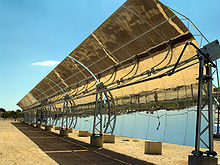
220px-Solar_troughs_in_the_Negev_desert_of_IsraelIsrael is building the world’s tallest tower of power (solar tower) in the Negev desert.  Whilst I’m not going to get into the politics of Israel/Palestine I disagree with actions on both sides.   However, its fair to say that since 1948 Israel has felt surrounded by enemies and after the 1973 oil shock this has influenced its energy policy to a certain extent.  It as we wrote in our book became one of the largest utilisers of solar hot water panels (along with Japan).  However, despite its sunny disposition its been slow on the solar PV uptake, although in recent years this surged.  Still only 10% of Israel’s energy is set to come from renewables by 2020.  This tower of power will generate 1% of Israel’s electricity consumption.  It works by having many thousands of mirrors (50,000) focus their reflected rays onto a central focal point (240m high).  This heats either water or increasingly salt solution up which drives turbines.  Using salt allows the heat to be stored for longer so these towers work after dark.

This tower of power is quite a lot of effort for 121MWp of energy.  I wonder whether it might been better to have stuck PV modules on buildings?   Its also a potential terrorist target.

Neil

Posted in One thing we have learnt this week, Renewables, Uncategorized | Tagged , | Leave a comment

The Clangers

Clanger_7491The Clangers was (and is in its new incarnation) a British animated stop go animated children’s series.  It involves small pink creatures formed of wool that live on a bleak moon down burrows, eating blue string pudding and a green soup.  The Clangers name comes from the fact that their burrows each have a dustbin lid on them which clanged when opened or closed.  I grew up watching this series (which I loved).  Recently (in 2015) the series has been remade using some computer graphics, but otherwise is very like the original clangers series.  I was reminded of the Clangers after an interview with one of its surviving creators Peter Firmin.  What I had also forgotten until I read this interview was how eco aware the series was.  Peter Firmin said they reused a lot of junk to make the sets etc.  This was not just for environmental reasons, but more since they could afford to otherwise.  What is more interesting was that this recycling made it into the plot lines of the show.

The clangers make their living by collecting bits of space junk all of which seems to be human in origin.  Sometimes this crash lands on the Clanger’s moon at other times they go to collect it in a small space ship powered by musical notes from a music tree.  Every time the Clangers try to puzzle out what they have found (never being able to do so of course), but put to a new use that they think is appropriate.  Its fair to say the ecological message got home to Oliver Postgate. He campaigned on nuclear issues and in the last few years of his life against climate change.  Its difficult to say how much you take in as child but the programme probably introduced a whole generation including me to the idea of recycling.

Neil

Posted in Film, recycling, Uncategorized | Tagged | Leave a comment

One thing we have learnt this week – CMA report

10668295_1133346013348006_545104614_nThe competition and markets (CMA) report has just come out today on the UK energy market.  Even in other countries then the UK there is a lesson here.  If you do privatise your energy market then do expect continuing government interference.  This also goes for railways and other things.

The CMA have taken a very long time getting to publish what is a 1000 page report (I have no intention of reading all this, even the summary is 46 pages!).  But the main conclusions are available and these are;

  • Customers are being over charged by the big six to the tune of £1.7 billion a year.  The CMA said this is because too many customers are on the most expensive default standard variable tariffs (SVTs).  The overcharging seems to be about £300 per year.  However rather than force the big six to reduce prices the CMA report proposes keeping a database of customers that have been on standard rates for three years.  These details would then be released to the energy companies and comparison websites for direct marketing.  In other words to companies who think that they are cheaper would contact us with offers.  When I heard this it was one of those heartsink moments.  Currently my household is bombarded with nuisance calls many “energy related”.  At the moment the feeling is you will have to opt out of these mailshots rather than opt in. Its also worth remembering that those in low incomes have little access to the internet and when people say its easy to switch this is what they mean.  It is online, but almost impossible otherwise- since its difficult to find out what the best deal is.
  • Those on pre-payment meters to have their payments capped until smart meters are fully rolled out.  Apparently then this problem of those least able to afford bills will magically disappear. (No I cannot work out why this should be so either).
  • Remove the four tariff rule.  Currently a supplier is limited to offering a maximum of 4 different tariffs.  Its worth remembering why this was removed.  It was done so since all the big energy companies had so many different deals that working out which was best was almost incomprehensible.  This looks like a backward step.
  • Allow those on economy 7 meters (basically these allow people to purchase cheap electricity at night- mostly to heat their houses using storage heaters) to switch to cheaper tariffs.  Motherhood and apple pie – why couldn’t they do this now?

There are also some more technical suggestions not directly related to domestic customers.

  • The CMA are critical of the contracts for difference.  For a brief explanation for these see this post.  They reckon the government are not getting the best out these and this is raising costs to consumers.  The government awarded some contracts outside the auction.  The Secretary of State for Energy responded that the government had changed the way they did this and all was well.  Who can say?
  • Locational adjustments for transmission losses.  Obviously in absence of high temperature superconductors there are resistance losses in transmission between generation and consumption.  This costs money.  The CMA want generators concerned to pay 100% of these costs rather than everyone pay 45%.  While the CMA say this cut pollution of NOx and SOx by my reckoning this will penalise renewable generation.  Few people have picked up on this – but expect a big row if my conclusions are correct.

As you can tell I’m for the most part not very impressed with this report and it looks like the CMA have caved into the big six.  To those reading this in countries without privatised energy companies take this lesson don’t privatise them it makes things more complicated – not simpler.

Neil

Posted in Uncategorized | Tagged , , | Leave a comment