A few thoughts about Autumn, the season of mellow fruitfulness

sycamore leafAutumn finished last week, its one of my favourite seasons.  I like the change in the colour of the leaves and more recently I have found I like the shortening days. Autumn  is a time to curl up round the wood-burner with some lapsang tea and chocolate.   Autumn  also makes you realise that one more year is drawing to an end and with the leaves falling the cycle of life is going on.002

A search on my Bible software only found only three direct references to autumn, the best of which says;

They do not say in their hearts, ‘Let us fear the LORD our God, who gives the rain in its season, the autumn rain and the spring rain, and keeps for us the weeks appointed for the harvest.” Jeremiah 5v24

Another verse from Gen 8v22 clearly shows the concept of seasons and Autumn is implied;

While the earth remains, seedtime and harvest, cold and heat, summer and winter, day and night, shall not cease.

Clearly looking at both verses the seasons are seen as reminding us of God’s providence for us which is I suppose what I was trying to express above.  And even in the ugliest urban environment you can sense something of the wonders of God’s creation in a changed leaf.

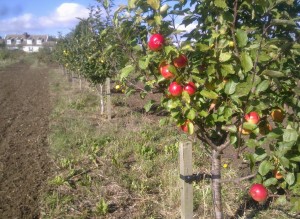
2014-09-20 12.00.52However, there are other things that Autumn makes me think of.  Within the context of energy insecurity, food insecurity, climate change and economic insecurity I start to think about my energy use and whether there are any energy efficiency measures I can take.  Are there any additional areas of insulation I could install?  What about my electricity use, what is the energy efficient bulb situation looking like?  I also decide what I am going to grow in the food line next year as well as harvesting the last of the winter vegetables and turning apples into cider or juice and fruit into jam.  Increasingly Autumn makes me think about the homeless and those who struggle to find enough money to pay their energy and food bills.  We face a whole range of interrelated issues going forward, there is something about the earlier colder nights I find comforting, but at the same time which takes me out of my comfort zone.

sycamore leaf just turning

Neil

Posted in Creation, energy costs, Lifestyle, Nature, Practical low carbon living, Slow living, Uncategorized | Tagged , , | Leave a comment

One thing we have learnt this week – Eon is leaving conventional energy

wind and solar in GermanyThe big news of the week is Eon is leaving conventional energy.  The surprise to many people is that Eon has not done this before.  Nursing huge losses as a result of ignoring renewables, hit by the nuclear shutdown and having to close gas and coal plants the company has decided to concentrate on renewables and “energy services” such as smart grids. As this blog has covered before the energiewende has led to problems but also a huge switch to renewables and a decline in coal fired power (despite what the critics say).

The fact that Eon is leaving conventional energy is a huge boost for renewables and will be very significant worldwide.  All the big German energy companies have a long to go on this front since the great majority of renewable generation in Germany is owned by private individuals, community groups or regional companies.  Less than 5% of non-hydro renewables is owned the German “big four”.  Like Denmark this community ownership has largely neutered opposition to onshore wind.  Also most wind farms are a few turbines (the picture I took above being a fairly typical view) not huge commercial conglomerations like in the UK or US where there is little community ownership

The final reason Eon is leaving conventional energy is the new German climate bill passed last week which mandates a 40% cut on 1990 emissions by 2030.  This will lead to closure of more gas and coal fired power plants.

Neil

Posted in One thing we have learnt this week, Renewables | Tagged , , | Leave a comment

Finnish Energy crisis?

finnish flagThere seems to be a bit of a Finnish Energy crisis, there is certainly an old adage when in a hole stop digging…  As described by this blog recently the nuclear power plant in Finland is way over cost and behind schedule.  It was with a sense of disbelief I read today that not only the Finnish thinking of ordering a nuclear reactor, not only that, but from Russia!

The Finnish have always had an interesting relationship with their vastly bigger neighbour since they broke away.  They were the only democratic country to fight on the Germans side in WWII (to fight the Soviet Union), although they switched sides and fought a brief war to kick German troops out.  After the war Finnish foreign policy reversed so much so that they became known as the democratic member of the Soviet Block.  You can see why when it comes to energy.  Finland relies on Russia for 100% of its gas and the overwhelming % of its other fossil fuel imports, almost half its nuclear fuel along with 28% of its electricity.

However, lets not exaggerate on the face of it this does not denote a Finnish Energy crisis.  The quantity of fossil fuels the Finns use compared to most other countries is negligible.  Renewables contribute 36% of all energy, mainly in the form of biomass, although there is a growing wind energy sector, some hydro and even a small amount of solar PV.  The Finns have a fantastic network of district heating systems which provide most domestic heating and very well insulated buildings.  If the Finns want to reduce their energy dependence on Russia then buying a Russian reactor seems a funny way of going about it.  Even stranger is that they are going down this route after the disasters at Olkiluoto.

Neil

Posted in Nuclear, Renewables | Tagged , , | Leave a comment

One thing we have learnt this week- oil price

1393663411Yesterday after an OPEC meeting the oil price fell dramatically. Brent crude fell by almost $6/barrel in one day and there is talk of it going as low as $60/barrel.  The latest falls come after around a 30% fall in the oil price since the summer.

What’s with the oil price if we are running out of it?  The latest falls are due to OPEC not agreeing to price cuts, but the fundamental issue is that since the summer the Saudis have been pumping more oil.  This has coincided with what is probably the near peak in US shale oil production which most analysts think will be in decline by 2018.  The question is why are the Saudis doing this when they need much higher oil prices for their economy?  No one seems to know for sure, but the reasons could be the following;

  • Geopolitical – to damage the economies of Russia and Iran and bring them to the negotiating table.  Iran has had lower output for years due to international sanctions and its debatable how much the lower oil price will hurt them.  There is no question about the effects on Russia though.  Around 85% of Russia’s export earnings come from oil and gas, most of this being from the oil, the gas seems to make them very little money.  Whether this is good news is debatable, countries with tanking economies tend to seek foreign diversions and the lower oil price has not stopped continuing intervention in Ukraine so far.
  • Economic.  The global economy is slowing down even the BRIC countries are now facing economic trouble.  This is certainly part of the reason for the fall.
  • The Saudis want to finish off the US shale oil industry.  Whilst the rumours are the US government has persuaded the Saudis to pump more oil, this is one reason being suggested.  Whilst the production price has fallen (supposedly) of shale oil to below $80 or even $70/barrel with sweet light crude being less than $70 as I write this there is every reason to think the shale oil industry will be devastated if this low oil price continues.

This brings me to a couple of my own ideas.

  • The Saudis want to finish off electric cars.  In the paper yesterday there was a report saying sales of electric cars were really taking off.  This is despite range anxiety and still very high costs of the cars cf. conventional fossil fuel cars.  There are reasons to think over the next year or so the price of batteries will plunge.  If so electric cars will look a lot more viable.  Since most of the world’s oil is used for transport this is a huge threat to Saudi oil hegemony.
  • Next year there are the critical climate change talks in Paris.  Cheap conventional energy has to be a threat to a climate agreement since it makes the alternatives so much more expensive.

None of these ideas are mutually exclusive.  As we have blogged on here recently there are good reasons to think the oil price decline maybe temporary.  It depends on how long Saudi Arabia can hold its nerve.  Once they agree cuts the oil price will soar again.  As a last point despite a large fall in the future traded price of natural gas over the last year or so there have been no cuts in energy prices here.  Funny that.

Peak oil is not dead but only resting…

Neil

Posted in climate change, energy costs, One thing we have learnt this week, Peak oil | Tagged | Leave a comment

Christian Climate change deniers

carbon cycle infographicIt was bound to happen, with only a year to go to the vital Paris climate change talks Christian Climate change deniers are on the march.  The Cornwall alliance (the name sounds so cuddly) have issued a ten point manifesto to protect the poor from a harmful climate change treaty.

Taking each point in turn…

1) Point 1 suggests whilst we can damage creation, God’s made it so wonderfully that it will self correct so we don’t need to worry.  Where to start…  The first thing to say is that God has made a wonderful world and to a degree this point is true.  Out this morning I saw a wonderful maple leaf and praised God for it.  Later this leaf will rot and help maintain the soil, this is self correction.  The earth’s climate will self correct as Chris Rapley made plain in his article in the Observer on Sunday, but just not in a timescale that’s any use to humans.  In the meanwhile we will have to suffer the consequences.

2) The next point these Christian Climate change deniers make is that “Earth’s temperature naturally warms and cools cyclically throughout time, and warmer periods are typically more conducive to human thriving than colder periods.”  Again sort of true, but not helpful.  In researching our next book, its clear that even the natural temperature changes have been highly disruptive to humans especially for agriculture (see below).  The kind of changes scientists forecast are out-with anything humans have experienced. See this.

3) Point 3, like most deniers this lot cannot suggest climate change is not real, just pore cold water on the whole thing and its not going to be that bad.  Maybe, but if we are wrong it will be too late…

4) Again sort of true again, but in my view not helpful.  The point is since the industrial revolution its us that are changing the climate.  At the moment we are having the largest effect.  In addition el nino and sunspots maybe masking greater change…

5) Similar to the last point above and scientifically illiterate.

6) Are yes the old CO2 is fertilizer argument… See this post I did here.  To summarise its thought that increased CO2 in the tropics will not have any positive effect on plant growth, whereas in temperate regions it may do.  This is because many tropical plants use an additional pathway called the C4 pathway.  This makes them as efficient as they can be at fixing CO2.  However the biggest effects will be weather changes on plant growth, these could be beneficial or disastrous depending on when and where you are.

7) Point 7 suggests they might like to read our book, in recent years certainly in Europe with natural gas and globally with oil fossil fuel energy has become increasingly expensive and insecure.  There is reason to believe the current price falls will not last.  Fossil fuels and uranium are finite we need to get off them for other reasons other than climate..

8) I’m tempted to say we don’t know since we have not tried,  all the science from 97% of climate scientists suggests getting off fossil fuels will stop future increases in temperature.

9)/10) It curious isn’t it that China, India and a growing number of developing countries are switching wholeheartedly to renewable energy.  It looks as though solar electricity will be cheaper than gas even in the UK soon.

The problem with this bunch of Christian Climate change deniers is they have taken things that are true and distorted them out of proportion.   The real fact is that far from protecting the poor climate change will harm them hardest and first.  A fact that the Christian development agency I support recognises.  Andy is interviewed by Valerie Comer on why Christians are not interested in the environment here.

Neil

Sceptical science linked to above was set up by a Christian climate scientist.

The infographic above was created by me to go in our new book.

Posted in climate change, Faith | Tagged , , | Leave a comment

One thing we have learnt this week -more doubts over Hinkley C

More doubts over Hinkley C have been raised this week after the nuclear power manufacturer Areva that has a stake in the prospective plant issued a profit warning.  Why this story which has almost passed by almost unnoticed this week is raising alarm bells is that Areva’s problems are caused by the construction problems they have had building the reactor in Olkiluoto Finland as well as the two reactors they are building in France which are running over cost and behind time.

Its difficult to find unbiased reports on the Olkiluoto project but the project was signed in 2003, construction started in 2005.  Very like the UK and Hinkley C there was supposedly no state aid although the loans were very cheap and subsidised.  A consortium of private Finnish companies (TVO) ordered the reactor.  From then on everything that can go wrong has done.  Part of the problem for Areva was it promised in its contract to build it for a fixed cost, after huge cost overruns its tried to get out of this and both TVO and Areva have sued one another. Even Areva’s website shows the delays (according to it the reactor should have been operational in 2012!).

The latest is that operation is expected to start in 2018 and the reactor costs have soared by at least 3 fold.  One hidden cost for TVO is they will need to buy power in the meanwhile from somewhere else.  This has to raise more doubts over Hinkley C, since Areva’s three projects have gone pear shaped.  The warning signs have been evident in the UK.  I saw Vincent de Rivaz– CEO of EDF Energy say on Channel 4 news in 2005, they wanted no subsidy.  Then a few months later on the same show he said that they wanted £1Billion, I believe to clear the ground at the site (seemed a lot to me).  After much delay we understand they want a guaranteed price of 9.5p + RPI for 35 years and now finally we understand that the cost of the project may have risen by £10Billion.  Its hard not to see the government being asked to bail this out at some point down the line.

In the interest of balance our view that nuclear is not the answer to climate change or peak oil has not gone unchallenged (see our books Amazon page) and our responses here.  The whole business of Hinkley C is especially puzzling when the UK energy secretary says that solar will be the cheapest energy source.  Its up to those who disagree with the above to explain themselves.

Neil

Posted in energy costs, Nuclear, One thing we have learnt this week | Tagged , | Leave a comment

Zero growth- are we in a new era?

economics wordleAre we entering a new era of zero growth with another global crash and slump?  Yesterday David Cameron just back from the G20 summit warned of another global crash.  Whilst this maybe domestic politicking there is some evidence to suggest he could be right.  China has slowed down,  Brazil has slowed down, the Euro zone just avoided recession, Japan is in one and there is political and economic uncertainty with Russia’s activities in the Ukraine and with Ebola.  Add into this mix going forward energy insecurity and climate change and I have been wondering once again whether conventional economic growth is over and we should get used to zero growth?  There is a built in assumption in the global economic system that endless growth is possible. We wrote about this in our book.

…conventional economics with its expectation of continual economic growth seems to ignore the fact that humanity exists within a closed, finite system. Our way of life, our
expectations, our economic models are built on the presumption that the resources humanity draws on (such as energy) are unlimited – and that business as usual can continue ad infinitum“.

Many of us think its not possible (to me this seems quite logical). We briefly examined the work of Herman Daly the Christian economist who is one of the few to have faced up to what a zero growth economy would look like.  The answer is by design it would look very different, but it seems we are slipping into an era of zero growth not by design, but by accident.

Neil

Posted in Book, Economics | Tagged , , | Leave a comment

One thing we have learnt this week- IEA WEO more pessimistic

The annual IEA WEO (International Energy Agency World Energy Outlook) report is out.  This is a big deal in the energy world and comes at a very interesting time.  Today the oil price has hit a four year low.  Some people think we are entering a new era of new oil prices due to unconventional oil.  Despite all this the IEA WEO 2014 report is far more pessimistic than you might think.

The IEA is the rich world’s energy watchdog, it was formed after the first oil shock in 1973 to advise Western Governments on energy matters.   It has had a variable relationship with the idea of peak oil a good summary of which can be seen here.  In 2005 the US government Hirsch report came out, this was the first report to take peak oil seriously and raised its profile as an idea more than it had been for 30 years. In the IEA WEO 2005 report though everything was rosy and it wasn’t really until the IEA WEO 2010 report that peak oil got a mention, of course it was not called that.  The exact phraseology was far more subtle, we would not want to panic everyone;

Crude oil output reaches an undulating plateau of around 68-69 mb/d by 2020, but never regains its all-time peak of 70 mb/d reached in 2006, while production of natural gas liquids (NGLs) and unconventional oil grows strongly.

By 2012 everything in the oil garden was once again rosy.  This IEA WEO report made big news, unconventional oil would fill the gap and peak oil was dead (our first ever post!).

The IEA WEO 2014 is again despite a background of falling oil prices far more pessimistic.

  • The report has its usual warnings on climate change (the IEA are not climate sceptics) and on phasing out fossil fuel subsidies (worldwide these are huge).  It remains to be seen if anyone takes nay notice of this.  I’m praying for the big meeting in Paris next year but the news from the Asian summit over the last few days has been encouraging.
  • The IEA WEO 2014 report sees an energy system under “stress”.  They think that low oil prices will lead to slump in exploration and new production and therefore a supply crunch.  They think energy demand will climb another 37% over the next 25 years.  This will be very difficult probably impossible for our fossil fuel supplies to meet (in my view).
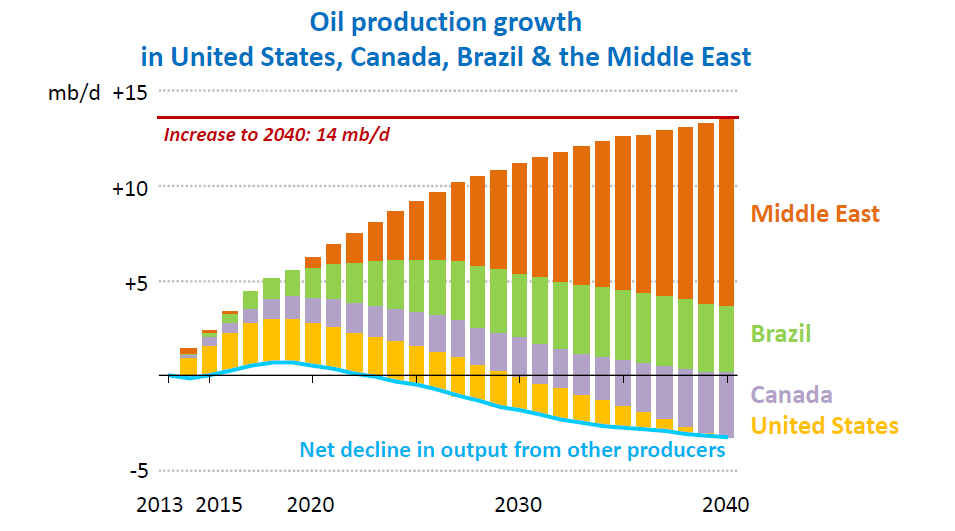
  • Whilst everyone rubbished peak oil in 2012 there were two things they missed in the IEA WEO report from that year.  The first was that unconventional oil would not last long in the US and the second that we would still be very dependent on the middle East.  Both these points are shown in the following graph from this years report.

oil supply projections from IEA 2014

  • US shale oil will go into decline in four years time, we need a another 14mbd of oil and oil equivalent to meet global demand and all that shortfall is mysteriously going to come from the middle east (no I don’t think so either).
  • The IEA think there will be more nuclear but that it will provide a far smaller & of global energy and recognise public concerns over its safety.  A massive 50% of all new energy investment will be in renewables.

This latest IEA WEO report shows peak oil is not dead but at best has been delayed a few years and we still face significant energy supply challenges.  All this will have profound implications for all of us but also for Christians and the church and its a bit surprising that we don’t think about it a bit more.

Neil

Posted in climate change, Peak oil, Renewables, Uncategorized | Tagged , , | Leave a comment

Peak oil and end times theology

siluetA few weeks ago the film “Left Behind” came out, this and my daily readings set me thinking again about peak oil and end times theology.  As we wrote in our book;

Some churches and Christians, it seems particularly in America, are fixated with the second coming of Jesus and the events that might presage it. Conflicts, political events and groupings of countries are often assessed to see if they could fit with the various prophecies and pictures that the Bible provides.

and

Some of the speculation is informed not so much by biblical scholarship, but by
the best-selling books and films which have woven the supposed events into fictional narratives.

As I read through my daily readings recently on Matthew 24 my mind again turned to peak oil and end times theology. The whole issue of peak oil which will hit us eventually, if it has not started already (see posts to numerous to list on this site) does lend itself to the apocalyptic.  After all the whole of civilisation is heavily dependent on fossil fuels for almost every aspect of daily lives.  We can argue about when this stuff will run out but at the moment civilisation would be very challenged to do without it.  Yet surprisingly most Christians seem blithely unaware of peak oil and its implications and the end times theology seems firmly centred in other aspects of the middle east such as the conflict between Israel and Palestine.

The problem with many of the passages that end times theology is dependent on are that in my view they talk about the present, the future and the return of Jesus all in the same section.  This makes disentangling the meaning challenging.  Our culture thinks about time in a linear manner, people in the past didn’t think that way.  Read the old testament prophets and you see this with the narrative going forwards and backwards as you move through the text.  We can pull out a few conclusions though;

  • People get too obsessed by the whole business looking for signs.  No one knows when it will be Matthew 24v36, don’t believe those who say they do.
  • To me there seems little love in those who are obsessed by this issue, it seems all about revenge and judgement rather than grace.
  • The whole obsession seems to corrode an interest in life here.  There are plenty of problems that we should try to solve here, environmental, social and health wise.  Sure we will not solve them all or build heaven on earth, but if you believe the earth will soon be burned up you are unlikely to try.  There are plenty of verses in scripture which tell us to get stuck in down here building the kingdom, not least the lord’s prayer.  As Martin Luther said “Work as though he will not be coming for a 1000 years.  Be ready as if he should come today.”

Christianity today no less gave the Left Behind movie a terrible review.  For a more intelligent look at the second coming I recommend “The Clowns of God” by Morris West.

Neil

Posted in Faith, Film, Lifestyle, Peak oil, Uncategorized | Tagged | Leave a comment

One thing we have learnt this week- Irish wind power

the irish flagWith all the talk of the German energy transition are we missing another countries change, that is Irish wind power?  There are now a whole heap of websites where you can look at what’s happening on the grid in real time.  Yesterday looking for something else I found one and was very surprised to see earlier on that day 70% of Ireland’s electricity was from wind power.  By the time I had found it had dropped to a still very impressive 30%.

Ireland rarely gets mentioned in energy terms.  I have read about big battles over offshore gas finds on the West coast and I know Ireland used to get a lot of its electricity from unsustainable peat, but the rise of Irish wind power has crept up on me.  A high voltage DC interconnecter has recently opened to the UK.  This means both countries can iron out excess or shortages of power.  What I don’t know is whether the wind industry in Ireland has a lot of opposition as it has here.

Obviously Ireland being a small windy country will find it easier to its needs from wind than a larger country like the UK or Germany, but its still very impressive.  Well done Ireland.

Neil

Posted in One thing we have learnt this week, Renewables, Uncategorized | Tagged | Leave a comment