Wind power – still a cause of debate

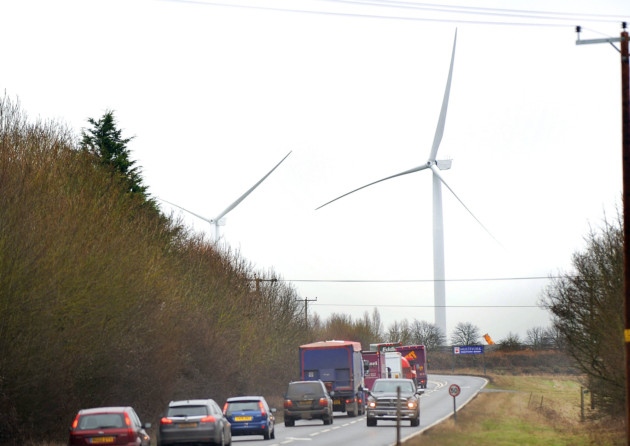
2 new wind turbines recently erected on the former airfield at Eye in Suffolk

About 8 miles from my home in rural Suffolk (in the East of England) two wind turbines have recently been erected and will soon be producing electricity. These are the first large ones in this area, though there are several in Norfolk, as well as many more being put up off the coast. As there is a continuing debate around the benefits (or otherwise) of this technology, here are just a few comments:
These turbines are big – 130m to the blade tip, and definitely dominate the local landscape. In the relatively flat East Anglian landscape, there has been concern that these tall structures would have a wide visual impact. However, whilst they appear huge up close (I drove right up to the base of one tower) to my mind, as soon as you get a couple of miles away the impact is muted. The countryside here is not billiard-table flat like parts of the nearby fens. There are undulations in the landscape, trees and small woods which block the view. Only a few miles south is the (much taller) Mendlesham TV mast which we have all become used to. Opposition has been somewhat tempered by the fact that the turbines have been sited on an industrial site, close to a busy main road, which hopefully relieves some concerns about the noise impact.
As I follow the debate around wind power, both nationally and locally (we have been dealing with a series of applications in my own village) I find the debate increasingly polarised: To the “antis” wind farms are a blot on the landscape, a blight on property prices, a source of visual and noise pollution and even the cause of illness. Above all, they are inefficient, don’t actually reduce CO2 emissions, and are a waste of money. In contrast, those in favour see them as a source of clean, green energy and part of the solution to the looming problem of climate change.
For what it’s worth, I see some merit in both arguments, but am generally in favour of them, with the caveat that I would like to see a statutory distance between a wind farm and residential dwellings. I don’t think they are visually intrusive at a distance – in fact to me they look rather elegant. Neither are they as useless as protestors claim – any form of electricity generation is substantially less than 100% efficient, and at least in the case of wind we are not using up a finite resource and producing a pollutant, nor are we leaving a toxic legacy for many generations to come, as with nuclear. However, since this blog is looking at these issues from the perspective of Christian faith, where do we stand? What wisdom can we bring to the situation? One area where perhaps we can help is in bringing a little peace into the debate. Discussions on this issue can be fractious and ill-tempered rather than polite and reasoned. One campaigner described the response to an application as “hate-filled hysteria” Let’s help here at least with salt and light where we can.
A final thought – yesterday a planning application in Devon, for the Totnes community wind farm, was turned down by the local planning authority. One reason given was because it would cause a “loss in amenity” to a local listed building – the church.

Andy

Posted in Renewables | Leave a comment

We don’t eat oil do we?

The modern food production systems which developed over the course of the twentieth century are only part of the story of agricultural development that has taken place over millennia, as man has learnt how to make land, crops and animals more and more productive. However, what took place from the around the Second World War onward was a remarkable leap forward, as science was rigorously applied to the task of raising food production after the shortages of the war years. Improved varieties of crops and superior strains of animals together with new agricultural techniques increased crop yields and productivity substantially, and enabled swelling populations to be fed. The impact of these changes was felt first in developed countries, but in later decades the uptake of these new technologies, particularly irrigation, in parts of the developing world led to the so-called ‘green revolution’ where food production was also raised substantially.

Though much of this development can be put down to improved plant and animal breeding and improvements in farming skills and practice, there is a significant underpinning provided by sources of energy. To understand this, we need to look back at the significance of soil fertility to food production. The earliest farmers would simply move on when their soil became unproductive – leaving the land fallow for several years would allow its fertility to slowly re-build. As populations grew, there was less room to leave land fallow, and other methods came into use: In the not-too distant past, the only way to improve soil fertility was by using the wastes from animals in the form of manure, in some parts of the world human excreta was (and still is) used for this purpose. Farmers also made use of leguminous crops which fix nitrogen from the air through symbiotic relationships with bacteria attached to their roots. A productive system could be maintained by rotating nitrogen fixing and nitrogen-using crops, and incorporating animals into the system as well. This all changed with the introduction of fertilizer in the 19th century. Initially this came from natural sources such as guano (vast deposits of seabird and other animal droppings) which were mined, transported and spread on the land. The mineral content of these fertilizers was high, particularly in nitrogen, potash and phosphates, the three key minerals needed for plant growth, and the effects could be clearly seen in improved crop growth and increased yields. But as the guano began to be used up, farmers had to look elsewhere for sources of fertility.

Chapter 6. “No oil in the lamp”

Posted in Book | Leave a comment

Climate justice

“Isaiah anticipates a future where there will be harmony between human and animal; wild and domestic creatures (Isaiah 11:6-9, 65:25). Similarly, St. John foresees harmony between God, humanity and the whole of creation (Revelation 22:1-4). If Christians are to reveal the new creation, we will glorify God when we live out that harmony today. Given the damaging impacts of climate change, a key component has to be lifestyle choices that support this harmony. This will mean reducing carbon emissions through a myriad of different lifestyle choices. Joining a local Transition network or similar environmental group might help us develop lower carbon lifestyles. Whether we fly less, grow our own food to reduce food miles, cycle or put solar panels on our roofs, there are numerous ways in which we can live in a more climate-sustaining lifestyle. We must also be
concerned at threatened biodiversity hotspots globally, and our care of nature, locally. So we might refuse to purchase items made from tropical hardwoods, or items grown on areas cleared of tropical forest. We might seek to demonstrate human and ecological harmony in our own local areas through positive recreation schemes, which strengthen local community and have a policy of encouraging ecological diversity.”

Excerpt from “Carnival Kingdom Biblical justice for global communities”

Posted in climate change | Leave a comment

Book out of stock at wholesaler

Our book is out of stock at one of the wholesalers, the first time this has happened.  What this means I’m not quite sure but there are plenty of books in stock on the on-line retailers.  Incidentally the cheapest place to buy our book seems to be play.com…

Neil

Posted in Book | 2 Comments

One thing we have learnt this week

Christians are interested in the idea of a carbon fast for lent. There is probably a wordpress plugin to measure post popularity but there is no doubt about it the most popular post we have written so far are the lent carbon fast ones. Even more popular than the Chasing Ice review and size of my potato one (its not about that but a gardening update post) which had mysterious popularity with hundreds of Swedes. We’ve had literally hundreds of hits on both Rachel’s and mine carbon fast blog posts which is very encouraging. There are more ideas in our book to take the ideas forward for the rest of the year for you and your church.

Neil

Posted in One thing we have learnt this week | Leave a comment

Swap and share

Last night our Connect group (home-group) held its swap and share evening. Di had worked out how it would work and to you do need some ground rules.  This is how it worked for us (very successfully).

  • No one was forced to bring anything but were encouraged to bring two things.
  • If you didn’t bring anything you could still take stuff away.
  • All the things people brought were placed on a red blanket so that no one walked off with the telly etc.!
  • We had a meal which we normally do on this Thursday in the month.  During this people were encouraged to have a look and write down two things they wanted.
  • After the meal we met together took our two things and then you could take anything you wanted.  We read a passage of scripture prayed and thought about what we would do for lent.   The remainder of our stuff that wasn’t taken we will give to a charity shop

Intentional living is something the group has started to think about in the last few weeks.  What does it mean to live Christian fellowship in the 21st century in a potential age of scarcity?  This is a small but meaningful way of being less materialistic and fits in well with lent.

Neil

Posted in Peak oil, Practical low carbon living, Slow living | Leave a comment

Andy interviewed on video by Valerie Comer

Andy is interviewed in this video by Valerie Comer about why Christians are disinterested in the environment. The quality is mostly OK (it was recorded on Skype).

Andy interview

Neil

Posted in Uncategorized | Leave a comment

African archbishop calls for a carbon fast for lent

The Anglican church in southern Africa includes some of the countries most vulnerable to climate change. Two Dioceses (Lebombo and Niassa) have been hit by devastating floods, leaving over 150,000 people homeless.

Archbishop Thabo Magkoba, convenor of the Anglican Environmental Network invites Anglicans from around the globe to join him this Lent in making a difference by focussing on ‘acts of love and sacrifice’ – of which Ash Wednesday speaks, and on our contribution to climate change and those most impacted by it.

Lent is a time of repentance and fasting, of turning away from all that is counter to God’s will and purposes for the world and all who live in it. A specific action is prescribed to each of the ‘forty days’ which educates the participant and provides a significant action affecting creation positively.

The fast builds on traditional Lenten practices where we give something up, such as chocolate or alcohol. The Carbon Fast asks participants to focus on giving up, or making changes to our lifestyle, to reduce our ‘carbon footprint’ – our total impact of environmentally damaging greenhouse gas emissions, usually measured in carbon dioxide equivalent, hence the name.
A traditional Lenten observance is ‘Fish on Fridays’. Why not also have a ‘Meat-free Monday’ – or some other day, if on Mondays you usually eat Sunday’s leftovers? Did you know that ‘a kilogram of steak could be responsible for as many greenhouse gases as driving a car for three hours while leaving all the lights on at home’ (D Fanelli, New Scientist, 2007, 2613:15)?

The carbon fast is available at http://www.facebook.com/l/PAQH8Hdu1AQGtYmDhkuet6tAoMpqaFokSU6c5mQ1TTGcA4w/acen.anglicancommunion.org/_userfiles/File/a_carbon_fast_for_lent.pdf
Participants can record experiences at a blog http://www.facebook.com/l/MAQFWgP_uAQG0hnRiiFn546hjHxmuNmcrPPP2LhiJbNwhqg/www.carbonfast2013.wordpress.com which will be available from Ash Wednesday through to Easter Sunday.

This is a guest post by Rev Rachel Mash who is now environmental Coordinator for ACSA (Anglican Church of Southern Africa ) covering RSA, Lesotho, Namibia, Angola Swaziland and Mozambique.

Further details can obtained from mashrATctdiocese.org.za.
Rev Ken Gray rectorATcolwoodanglican.ca

Posted in Guest Blogs | Leave a comment

No Fear in love

“Like a river of fire stretched across the sky
Peering into the veil of the aurora’s light
My soul is drawn by love, too pure for words
Deeper than instinct, beyond my reason

I am lost in wonder at what fills my gaze
Lost in my thoughts of such infinite ways
I am found in mercy, I am found in love
I am found in the flow of water and blood

There is no fear in love
There is no self to gratify
There is no argument to win or lose

Love is beyond the mind
Love is beyond its reasoning
Love is the path that leads to paradise

Like this great arc of sky, a window to infinity
A bright and deathless morning waiting for me
Love to be imprinted on my heart, like notes upon a score
‘The music eager to open heaven’s door

There is no fear in love
There is no self to gratify
There is no argument to win or lose

Love is beyond the mind
Love is beyond its reasoning
Love is the path that leads to paradise

On this distracted planet
So wounded by our greed
Where we have taken more
To satisfy our need

Where love is our salvation
The perfect mystery

There is no fear in love
There is no self to gratify
There is no argument to win or lose

Love is beyond the mind
Love is beyond its reasoning
Love is the path that leads to paradise”

“No Fear in Love” from the “The Circling Hour” by Iona

Posted in Uncategorized | Leave a comment

Second Law

As we wrote the section in our book on Christian attitudes to peak oil I felt we should put in a general section on Peak oil in the wider culture. To the best of my knowledge no other book on peak oil has covered this. Not surprisingly its a short section. However, it needs to be extended very marginally thanks to the new album “2nd Law” by the alt rock band “Muse”.

Successful rock bands tend to deal in large numbers be it album sales or income, but also of course carbon emissions. In the era of downloads and piracy most bands make their money by touring. This does not come cheap to people or planet. Imagine my surprise when I opened my newspaper and read a major article and interview with Muse about an album “which encompasses the global economic crisis, peak oil theory, food security, evolution, the taxation proposals of 19th-century economist Henry George and the concept of the “stress nexus“” (http://www.guardian.co.uk/music/2012/sep/30/muse-2nd-law-tour-interview).

Its hard to believe now but 30 years ago progressive (prog) and heavy rock dinosaurs ruled the earth. Then along came punk. Punk’s effect on prog rock sales has been exaggerated (certainly by prog protagonists). Post 1977 prog bands still shifted albums and had hit singles (Pink Floyd, Genesis and Yes). Punk was short lived mainly UK phenomenon with little album chart success. However, post punk musical fragmentation meant that prog’s glory days were over, there was simply too much other competition. Despite this surprisingly prog rock continues to have influences. Christian bands such as “Iona” and “Glass Hammer” continue to carry out the work of prog (the concept album), with a degree of success beyond the Christian subculture. Secular bands such as “Mars Volta” and “Muse” are said to fit into the “new prog” category, with influences that include prog amongst a variety of other genres.

When I once asked an old friend why he did not like the “Beatles” he replied every British band has been trying to sound like them since. More recently I would say lots of bands have tried to sound like “Coldplay”. Personally I like Coldplay, but people who don’t can rest assured, there is no Coldplay influence here. Certainly like other current prog influenced offerings (such as Iona’s albums) “2nd Law” is musically hard to pin down with a variety of different genres linked to make a complex whole.

Tracks such as “Survival” combine very Queen like vocals with Brian May style guitar solos (apparently May is an admirer). “Big freeze” reminds this reviewer of U2. Other tracks use an orchestra and choir and even lead vocalist Bellamy’s child’s heartbeat. Tom Lehrer was supposedly challenged that he couldn’t write a song about the periodic table of the elements, so he did. Even Lehrer would have been challenged to write a song about the 2nd law of Thermodynamics*, which is where the title of album is derived from. Muse sensibly don’t try. Instead the two tracks based on the the 2nd law and about the myth of endless growth consist of the Channel 4 news reader Katie Razzell reading the text to electronica and minimalist Mike Oldfield influenced backing. Another track “Explorers” worries about the unsustainability of a life built on diminishing stocks of oil.

 “A world lush in bloom
With rivers running wild
They’ll be re-routed South
With none left for you or for me
Don’t give in and hear the
Engines roar
And save our crops from drought
But when the black gold’s in doubt
There’s none left for you or for me

Fuse helium-3
Our last hope

The track goes on to hint at religious faith.

Free me, free me
Free me from this world
We don’t belong here
It was a mistake imprisoning our souls
Can you free me
Free me from this world“.

 As do the two tracks written by the bassist who is a recovering alcoholic about his struggles in this area.

I’m on red alert
Bring me peace and wash away my dirt
Spin me round and help me to divert
And walk into the light

I listen to wide variety of music and still despite myself like prog rock despite its tendency to pomposity. Prog is the only genre of rock that in my view that can offer moments of transcendent beauty. Whilst this album is apparently less prog influenced than the bands previous offerings ( for example it is only partially a concept album) it manages these moments of beauty plus a number of good wig outs. The depressing thing it takes a rock star and not a politician to point out that limitless growth is not possible; -oh the irony.

A species set on endless growth is unsustainable.” “The 2nd Law: Unsustainable

This was a Christmas present. [Warning there is some swearing on one track.]

* Spontaneous change cannot occur in a closed system without the entropy (disorder) increasing.

Neil

Posted in Uncategorized | Leave a comment