One thing we have learnt this week- Generating renewable energy in ever more bizarre places
2013-07-13 19.28.08Generating renewable energy in ever more bizarre places
Over the last week I have come across three different ideas for generating renewable energy in ever more bizarre places. The first is a PV system laid down the lanes of a Chinese motorway. This was supposedly a first although I’m sure I have come across mention of PV’s on a road in France before. Maybe its the first on a motorway. Note this means the lane is formed of PV’s not that they are on the verges or overhead, as is beginning to happen elsewhere.

This idea seems to me a gimmick. The PV’s on the average Chinese motorways are hardly going to see much uninterrupted sunlight (which more decent output is what is required). The only time the highway is likely to be clear is at night!

The second way of generating renewable energy in ever more bizarre places was not so much the place as the idea behind it. The place (the north sea) is now a conventional place to generate electricity using offshore wind. The twist is that a company is suggesting putting an artificial island on the dogger bank. This would have sub stations on it and allow power to be shared between a variety of nearby nations using interconnectors. This to me is the most sensible of the three ideas providing any environmental objections can be overcome.
The third is perhaps the most odd. The idea is to collect dog poo in special containers attached to lampposts. The poo is then mixed and anaerobic digestion used to produce methane which is used to produce light for a couple of hours. Well I suppose it saves people bagging it up and throwing the bag into the nearest tree which is what seems to happen at the moment. One unanswered question was what would happen to any plastic bags? Happy new year.

Neil


Posted in One thing we have learnt this week | Leave a comment

One thing we have learnt this week – plastic waste is everywhere

plastic bottle greenhouse at CATThis week I listened to a report on plastic waste and increasing the rate of recycling in England on the radio news.   What is horrifying is where plastic gets into everyday products in unexpected ways.  Its now in teabags.  This was a real shock.  Teabags I thought were formed only of paper.  Apparently they used to add vegetable matter I think to hold them together better but now have replaced this with plastic.  So putting your teabags on the compost heap only adds to the plastic waste in the environment. (In addition the thought of the plasticisers in the plastic dissolving in your tea is not an appetizing one).

The discussion moved onto cucumbers.  Shrink wrapped in plastic to protect them.  None of this is simple but I’d rather have the food waste, than the plastic going into the environment.  Recycling rates have stalled in England (Wales does really really well) supposedly due to the fact that all the easy to collect places have been done.  Flats are much more difficult to collect recycling from.  (Although Wales has managed to collect very much higher levels?!)  The government wants to make recycling uniform over England and part of me can see this is a good idea (rural areas being really behind throughout the UK).  Part of me thinks this takes no account of local conditions.   One thing is for certain the government needs to cut plastic use fast.  Luckily there alternatives coming on fast.  A company in the next lab to where I work is developing biodegradable plastic wrap made from shellfish.

Neil

Posted in Practical low carbon living, Uncategorized | Tagged | Leave a comment

Are Solar Panels still a good investment in the UK?

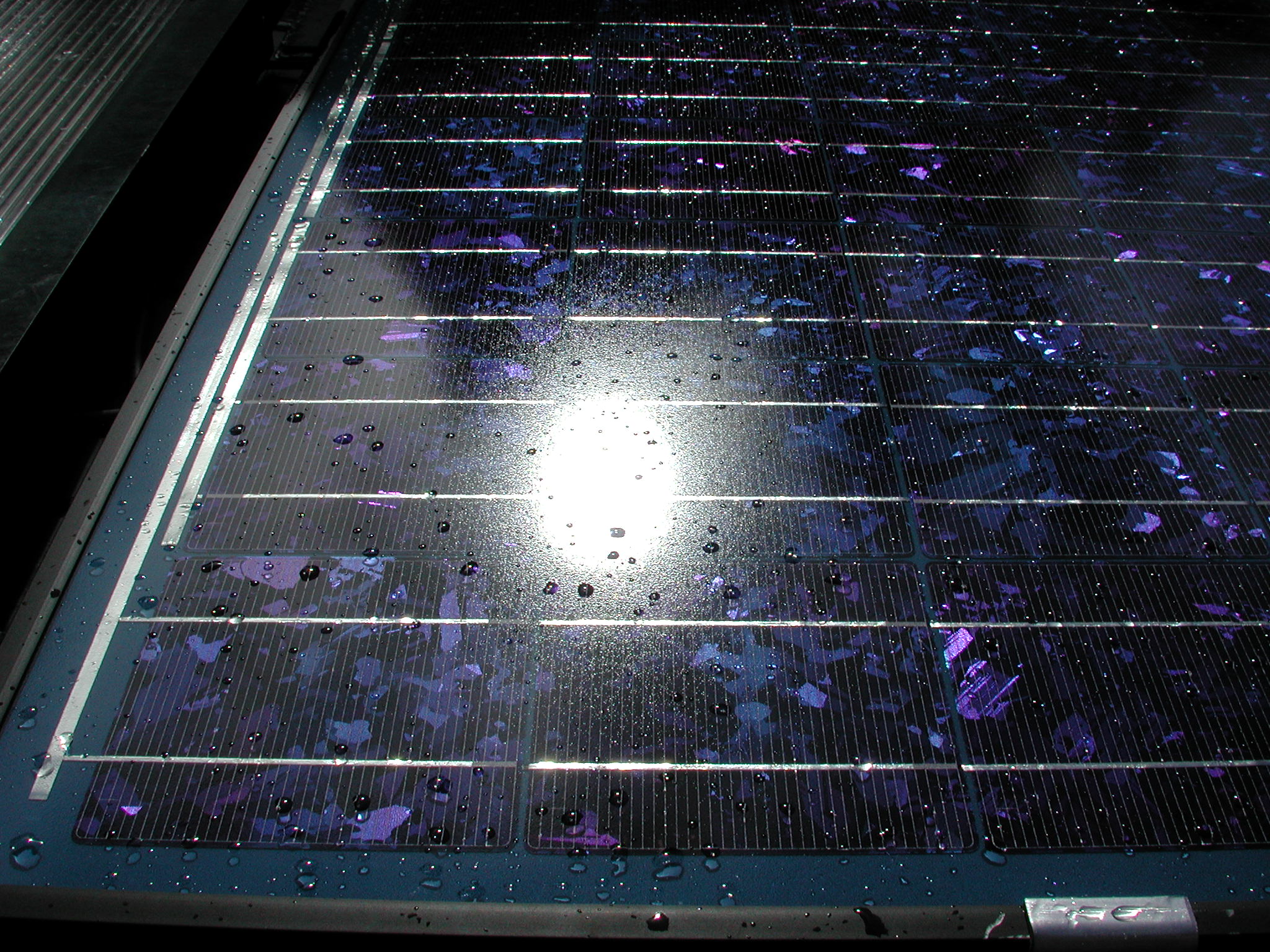
DSCN1669Are Solar Panels still a good investment in the UK?  I have been putting some of my FIT income in a spreadsheet.  I’ve read a bit about this recently and the answer to the the question “are Solar Panels still a good investment in the UK?” seems to be yes.

The background of course is the huge cuts in the Feed in tariff that have taken place over the last few years as the solars’ success has led to the funds allocated for this not being enough and being blamed (only partly correctly) for rising bills.  Currently for new systems (OCT17) the rate paid per unit is 4p when the Feed in tariff (FIT) was launched in 2010 it was about 10 times as much.

However three other factors have to be taken into account which work in solars’ favour.  The first is the price of systems has plunged although this rate of reduction is slowing.  The second is the price of electricity has risen.  Some people say the returns from electricity savings now outpace those of the FIT.  This is a surprise but the figures given look plausible.  It has to be said all calculations rely on steadily rising electricity prices going forward although there is little to believe at the moment this is going to change much.   The third factor is the very low rate of returns on other investments.  Very low interest rates and quantitative easing since 2008 have led to very low returns on almost all other investments.

Have a look at a look at investment returns on this current best returns list.  The very high ones are the most risky.  That’s not to say they are dodgy by any means but while still legit are more risky and are not covered by the financial services compensation scheme (FSCS).  By the time you scroll down and get to the less risky bank and building society investments you are getting less than a 2% return.  Compare this with the aim for solar systems of 4.5% PA return (at first 4.11 and now better at 4.9%) and you can see that solar still makes a good investment.  Of course solar systems are not covered by the FSCS but do come with very long term guarantees and are very reliable.

Financial investment is not the only or even the main reason you should or I did invest in PV systems.  Energy security and tackling climate change are the main ones.   The golden rules of investment are don’t put all your money in one thing, ignore telephone scams (its amazing as I have written how many of these are energy related) and do some background checks on the company concerned.

Neil

PS. This PV return on investment calculator although complicated is giving me accurate answers on my current PV income putting in all my details.


Posted in Renewables, solar, Uncategorized | Tagged , | Leave a comment

One thing we have learnt this week – windpower may decrease

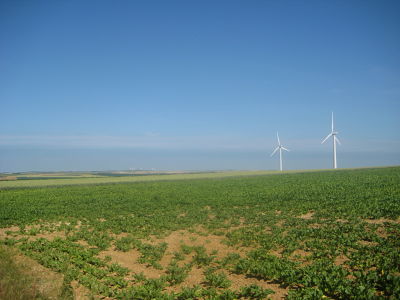
00002_optWindpower may decrease.  That’s the message this week in Nature.  We know that climate change will affect the weather.  A group this week have predicted it will lower wind speeds in most places. Using the same climate models from the UN’s Intergovernmental Panel on Climate Change the group predicted big falls in the UK, central US, Russia and Japan.  The only place to buck the trend is Australia.  The range was from 17% in the US to 5% in the UK.

This is slightly surprising but in some ways good news.  I’ve always thought that wind speeds will accelerate with climate change.  The finding that windpower may decrease means less damage to crops and buildings and people.  The fact that wind powered electricity output may fall can be compensated for.  First it would be stupid to put all your eggs in a wind power basket.  We need to develop other sources such as wave and tidal power.   Second by a bit more thought where the wind farms go as well as adding more capacity we can compensate for this fall.  Another plus point is that this will probably a gradual reduction in any case.  This will be easier to plan for and cope with.   I hope someone is going to look at solar output since mine seems to be falling.  I’m not sure this is weather related or due to other factors.

Neil

Posted in climate change, One thing we have learnt this week, Renewables | Leave a comment

Electric revolution 9 years on

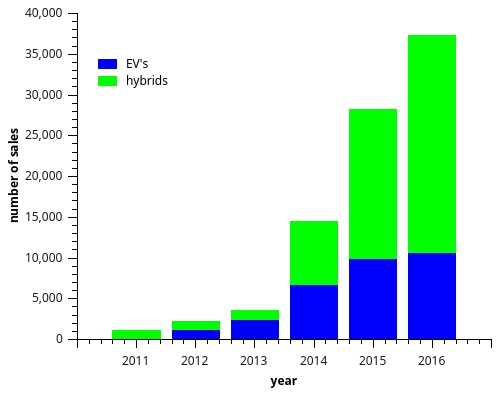
EV salesElectric revolution 9 years on.  About 9 years ago I went to a Scottish parliament renewable energy group meeting on electric vehicles.   This was based around a report that had just come out on future UK sales.  Yesterday we found this in a sort out.  Its very interesting to look back at what has happened in the last 9 years with the benefit of hindsight.

First a few general points.

  • Diesels were seen as a good idea in 2009.
  • The oil price was much higher in 2009.

The scenarios are based on a number of criteria and the report gives a heap of these.  However sales of EV’s taking hybrids and pure electric vehicles are way behind where they were forecast in 2009.

This is not down to EV’s.  Sales seem to be ahead of where they are forecast.  Its a bit difficult to read the point on the graph in their report for 2018 but total sales were forecast to be 261,000 in 2o30.  Sales were over 10,000 last year and have been even better this year so far.

The report has contradictory things to say on the oil price effect but this has been shown to have little effect on sales of EV’s recently.  What was forecast was the price of batteries would have a huge effect.  They did not make a forecast price as such due to the variability in the estimates but did say that £100/kWh from 2012 would have a huge effect on sales. Prices are currently higher than this.

Deployment of solar/wind has consistently beaten all expectations (and continues to do so).  Car sales have not.  What has changed is the expectations.  All governments and manufacturers have huge EV targets and battery prices are plunging.  While not totally ideal the electric revolution in transport is coming.

Neil


Neil

Posted in cars, Practical low carbon living, Uncategorized | Tagged , | Leave a comment

One thing we have learnt this week – cycle to cut air pollution

2016-09-14-17-16-48Cycle to cut air pollution that’s the message this week from Sustrans.  Air pollution has been in the news a lot recently and is both a developed/developing problem although far worse in the developing world where there is a lot more industrial pollution and cooking on open fires.

The idea to cycle to cut air pollution is one that would cut 8300 deaths in England and 4000 in Scotland.  The savings to the public purse would be almost £10 billion over the next decade UK wide.  How much cycling does this require?  If 10% of all journeys were made by bike this would meet the targets above.

There is a lot of talk of electric cars but as we outlined in our book these have their own problems.  Apart from not sorting out the issues of congestion almost half of air pollution generated from cars is not from the engine but from brakes and tyres.  Clearly the general population have to be convinced that its safe and worthwhile to cycle.  But it seems that to solve this problem they will have to be.  On the plus side cities with cycling majorities are more pleasant to live in (the actions of some cyclists being left aside) and building cycling lanes is far cheaper than building roads.

Neil

Posted in Cycling, One thing we have learnt this week, Practical low carbon living | Tagged | Leave a comment

Getting to grips with insulation

insulationI’ve been adding more roof insulation.  We recently threw away a pile of junk in the lofty space.  This has lowered the temperature in our bedroom in particular.  I know this from years of monitoring the temperature with a thermometer most recently on a alarm clock.  It hasn’t been as warm.  I’ve also tried to put some in the roof space in the kitchen which has helped although I’m too claustrophobic to get in far enough to do everything that needs doing.  Although I have not given up.

I’ve put a lot of loft insulation in the past in multiple goes, although not for a number of years.  Part of the problem in doing it this way is I’m not sure how much is present.  The UK building regulations suggest 270mm and any added on top of that is going to be less and less effective (and cost effective).  Nevertheless laying stuff down and rearranging the loft space has led to me seeing places which need more.

I have used rockwool (glass fibre) in the past but its thoroughly unpleasant stuff to work with.  Its very itchy on bare skin and gets in your lungs.  One of my MSc lecturers in Biomedical science was a world renowned lung expert and reckoned it did no long term damage.

The more recent alternative is made from recycled plastic.  This not only reduces the plastic waste problem (search this blog for other posts on that) but is very very nice to work with.  No need to wear gloves and its easy to tear with the hands.  The R-Value is almost identical to that of rockwool.  For an explanation of R-values and U values see here.

What I have done over the last years with the floored bit of the loft is rescued “cloud nine” floor underlay from skips and laid it as a base layer of insulation (up to 5 layers).  This should be reasonably effective and allows moving around.  I’ve also rescued polyisocyanurate boards from skips and put as much as possible of our stored stuff on top of them.  I’ve just discovered these my leach CFC’s becoming less effective over time.   Now I’m filling in with 100mm recycled plastic shown above and I’m considering a rack shelving system so I can lay insulation under stuff.

Neil

Posted in Uncategorized | Leave a comment

One thing we have learnt this week – problems with hydropower

2500Who would have thought that there could be any environmental problems with hydropower?  This form of energy is clean, does base load and can be relatively unobtrusive.  Dams behind reservoirs can be beautiful as I have seen myself many times.

There are some problems though.  In the tropics as this blog has outlined before the dams can be net greenhouse gas emitters.  Amongst the other problems with hydropower are flooding of beautiful wilderness and displacement of indigenous tribal groups.  The way around this I thought was to build not vast dams producing multiple gigawatts of peak output but many small “run of river schemes”.  In these there is no dam and water travels down a pipe and is then returned to the river.  These are generally regarded as friendly and benign to wild life.  It seems I and other like me might have to think again.

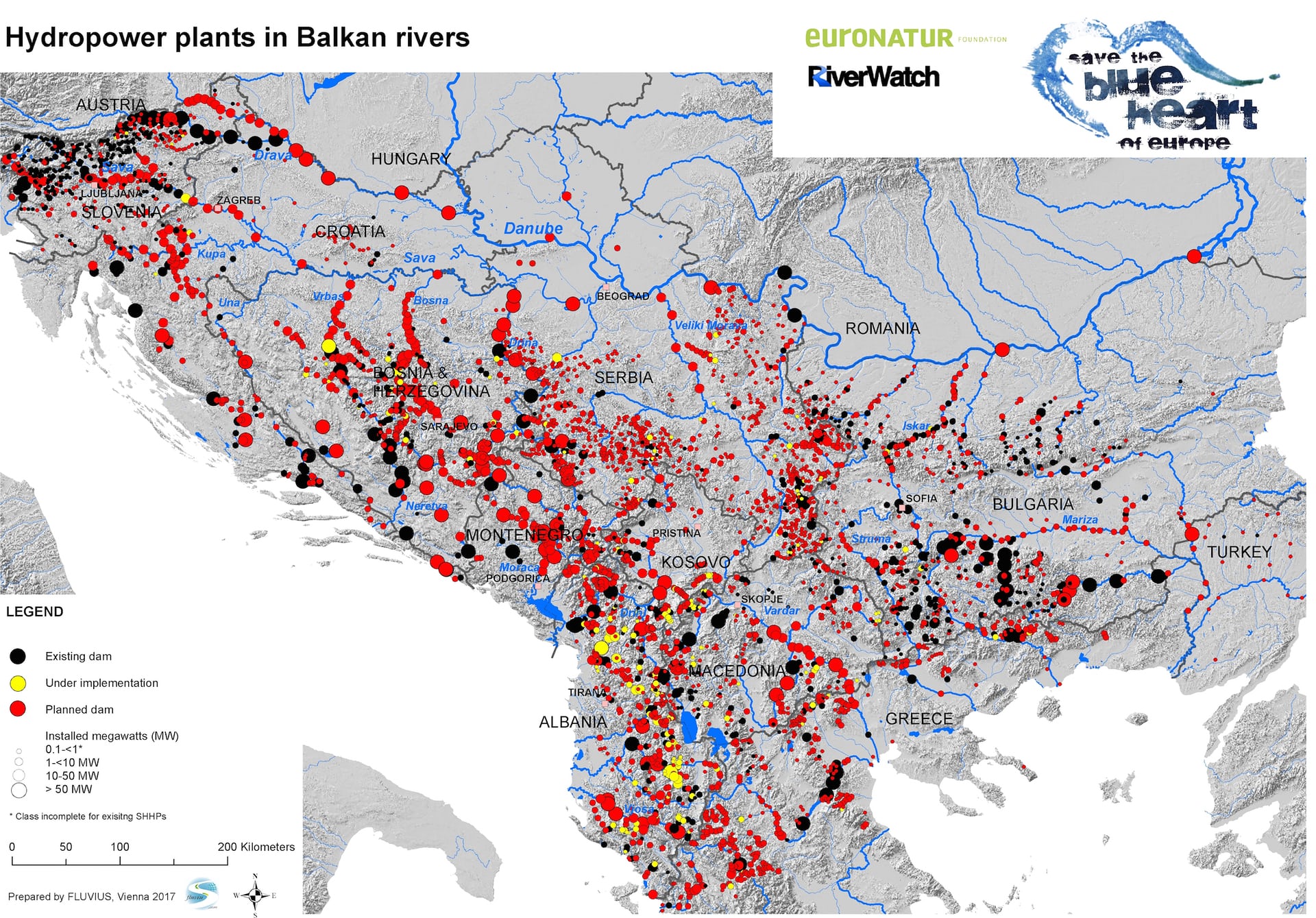
In the Balkans nearly 3000 hydrpower plants are planned with 187 under construction.  Most of these are very small with no dams.  This should tick OK boxes but obviously there are concerns.  Many of the plants are in national parks or protected areas.  The problems with hydropower here have arisen since the run of river plants are taking too much water out of the rivers leaving the stretches between the extraction and return pipes dry.  In addition very multiple small plants are being put in on the same bit of river which individually do not require permission but cumulatively have a big effect.  There have between conflicts and even murders committed in the conflicts between the small farmers and large energy companies in Albania.  In the UK permission has to granted, the rules are strict and it takes a long time to get the go ahead.  It looks like this may be a good thing.

Neil

Posted in One thing we have learnt this week, Renewables | Leave a comment

Big data energy bill

Dual_processorBig data energy bill.  The amount of energy the internet is responsible for is increasing.  This is a hidden amount of energy that we do not think about.  In 2009 someone claimed that each google search produced 7g of CO2.  This figure was denied by google who stated it was far lower at 0.2g CO2.  This is still quite a lot of energy.  It worth thinking about where this energy use and hence the big data energy bill comes from.  Some of it comes from electricity use of masses of computers in server farms being left on and some comes form the cooling of these server farms.

The big internet companies have responded to this criticism in a number of ways.  They have made their server farms more efficient by reusing the heat or even siting their farms in cold parts of the world, like Finland.  They have also been helped by the continuing efficiency of technological change with machines using less power.  They have also bought or installed lots of renewables and it should be said lobbied or ignored Trump on climate change.

Despite this the energy use of the internet continues to grow.  Currently its 7% of worldwide electricity use.  By 2020 it will be 12%.  Its an astonishing figure.  What amazes me is that humanity keeps coming up with new ways of using energy.  Another digital villain producing a big data energy bill is the online currency bitcoin.   This next bit is a bit difficult for those of us not involved with it to understand.  You can buy coins or earn them by verifying them digitally (bitcoin mining).  This last thing requires a small server farm…  It reckoned that bitcoin uses more electricity than 159 countries or 0.31% of world electricity and by 2020 bitcoin mining will need as much electricity as Denmark.  Solutions?  Not many- stay off the internet and use bookmarks.

Neil

Posted in climate change, energy conservation, Renewables | Tagged , | Leave a comment

One thing we have learnt this week- why are cyclists an oppressed minority

church on suussex downs with my bikeAre cyclists an oppressed minority ?  Perhaps oppressed is not quite the right word which I do not like to trivialise, but it does feel that way.  Let me just say cyclists are not always right.  I think the way that the group rallied together over the case of the cyclist who ran over a woman without having any front brake was disturbing.  He should have been punished and ignorance is no defence.  Its common sense you should have working brakes at both the front and back.  Nevertheless I can see why cyclists banded together in that case and others.  (I don’t think the law needs changing to stop more cases like this in the future).  Are cyclists an oppressed minority?  Well we do get it in the neck all to often.  Having nearly been squashed by a van on my way back from work one week and then last Friday told off for cycling in a a prohibited area.  It wasn’t that I was right.  I thought I could cycle there but was wrong about that.  It was the way I was told off.  The shear pleasure the person took in doing so was what made it so difficult.  I really had to turn the other cheek.  For every person like this though there is a lorry driver that gives you a cheery wave as you let them past or the car driver who lets you out of a side road.   It feels we are got at though.  As an ex colleague said (who didn’t cycle).  Those who have a go at cyclists should have a go at cycling in this city.

Neil

Posted in Cycling, One thing we have learnt this week, Practical low carbon living | Leave a comment