“Just Christmas”

Just ChristmasOur Church is involved in something called “Just Christmas”.  The idea is to have a more simple and less materialistic Christmas whilst remembering its true meaning, giving money you would have spent on presents away.  To be honest we have struggled with it as a family and I suspect as a church, but after a congregational survey the church have stuck with it.  Its very difficult to break away from the materialistic feast that Christmas has become, especially if you have children.

One way to create a “Just Christmas” is to make your own gifts and our connect group (home group) had a go at this last week.  Having floated the idea and asked for volunteers we were pleasantly surprised at how much talent we had in the group.

We tried four activities.

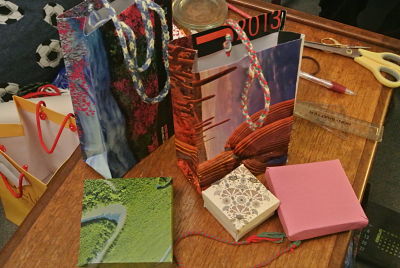
Making boxes and bags (this involved braiding).

braids bags and boxes

braids, bags and boxes

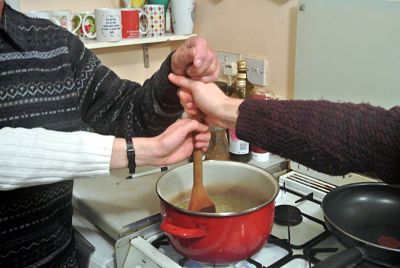
Jam making.

jam making

jam making

Making beads.  These are made from torn up magazines dipped in glue wound round a spindle (a kiddies paintbrush handle).

Beads made from old magazines

Beads made from old magazines

Candlemaking (meant to be red but turned out a bit pink).

Candles

Candles

Hopefully this has given you some inspiration to do the same and have a more “Just Christmas”.  As we wrote in our book we are going to have to make do with less material goods in the future and making presents yourself will become necessary, but its also fun to do, especially as a group.  Another way to have a “Just Christmas” is to invite someone for a meal this Christmas who may not have somewhere to go.

“For to us a child is born,
to us a son is given;
and the government shall be upon his shoulder,
and his name shall be called
Wonderful Counselor,Mighty God,
Everlasting Father, Prince of Peace.”

Happy advent.

Neil

Posted in Faith, Intentional living, Slow living | Leave a comment

One thing we have learnt this week- green crap and climate change despair

wind turbine from below taken in France.

wind turbine from below taken in France.

There are climate change talks taking place in Poland, and by all accounts they are not going very well. This in the same week the PM was reported as saying he wanted to get rid of all the green crap on our bills. As I wrote in a previous post this is undeliverable.  It also come soon after he made comments about the typhoon in the Philippines, saying we would should act using a precautionary principle on climate change.  This is a view I wholeheartedly agree with.  The recent IPCC report does nothing to suggest that climate change has gone away and recent research suggests that we have underestimated the warming trend.

Reports yesterday told us that most (but not all NGO’s) walked out of the climate change talks due to the lack of urgency and ambition in them.  Japan and Australia have reneged on earlier promises.  Whilst Japan may have some excuse with its nuclear shut-down, I fail to see Australia has any.

However, there is another argument as we have argued in our book to conserve and switch to renewables etc. That is energy security.  I have just checked the oil price and its still very high by historical standards.  We need to get off increasingly costly fossil fuels for energy security as much as climate change reasons.  The PM should surely be aware of this in a UK context, with depletion of North Sea gas and oil and the fastest rising energy bills in Europe?  Other countries such as Japan do; its making a whole-scale switch to renewables as fast as possible to get off gas.  This in my view means it may cut more carbon in time than its suggesting it will now.  Lets pray that the climate change talks are successful in Poland leading to a new treaty in 2015.  More ambition please politicians, you know it makes sense.

Neil

Posted in climate change, Lifestyle, One thing we have learnt this week | Leave a comment

Can we cut energy bills? Part 3.

In the previous two posts in this series we examined some of the ideas currently being discussed to cut energy bills.  As authors of “No oil in the lamp” we think energy bills are just going to keep going up. We need to stop avoiding that issue and see if there is any way round it.  Here are some potential ideas.  They get more radical as you read on.

Self help groups

TEARFUND are keen on these in a development situation.  The idea behind them is that people band together and gain economies of scale on food and other purchases.  Its happening in this country as regards energy.  However, consumer groups say the savings are less than if you had switched as an individual.  Some of these groups are extending themselves to become community energy companies (see below).  The Department of energy and climate change is apparently setting some up.
My verdict: Could be worth exploring or starting one yourself.  The savings seem to vary widely.  It probably depends on how good a deal you are on at the moment.  The general impression is you can expect about 10% of your dual bill.  Not earth shattering but would knock out the latest increase.

Politics:  Motherhood and apple pie, but not the magic bullet in the long term.

Community Energy

As the following graphic from the Institute for Local Self Reliance shows the pattern of energy ownership of renewables in other parts of Europe is very different to here.

germany-people-powered-2012-003In Germany most renewable energy is owned by individuals.  In Denmark most wind farms are community owned.  There are many advantages to this outlined here.  One is members of what are small not for profit companies can expect lower energy bills.  There are relatively few schemes in the UK but they have been expanding in number.  I have heard speakers from two, at Fintry near Stirling and the Island of Gigha.  Both are using the income from wind turbines to do community level energy efficiency and micro-generation.
My verdict: Could be worth exploring or starting one yourself.   However, this is a more complicated and daunting prospect.  The economics are probably better in country areas off mains gas, since wind and hydro become possibilities with rapid pay back times, although schemes involving solar PV have been launched in Gloucester, Brixton and Lewes.  In the long term such schemes could disrupt the current energy market and give an income stream to help the most vulnerable.

Politics:  The government is very keen.  There is a report coming out soon on how to encourage such schemes.

Standing charges and prepaid meters

I had a debate on Twitter with people about whether the green levies are regressive, but standing charges definitely are in my view.  One company is charging 26p a day just for a gas connection.  The upshot of this is that however little or electricity or gas you use you have to pay something.  I’ve heard people on the radio complaining that they don’t use any gas and still have to pay about £90 a year to be connected (nor can they get disconnected).

For people who do fall into arrears the companies install a pre payment meter for gas and electricity.  Now this can automatically payback their debt as well as paying for their current usage by means of cards which are topped up with money in advance.  While I can see that using this means of payback on debt is a good one in principle, people pay higher tariffs for their existing energy use than other customers who pay via direct debit.  This is the case for most suppliers and anecdotal reports suggest people are sitting in the dark since they have totally run out of money and cannot pay their energy bills.
My verdict: This standing charge situation is apparently getting worse as companies simplify their tariffs under pressure from the government. Not all companies charge these, mine doesn’t.  Switch to one that doesn’t.  All customers should pay the same for their energy whether its by direct debit via a bank account or by pre-paid meter.  Again the supplier I use makes this their policy.

Politics: Politicians don’t seem very interested in these issues.

Price differential

One suggestion that crops up now and again is reducing the price or even making the first x number of units free for everyone.  The representative of a consumer group I heard suggested that the green tariffs should be taken off the first x portion of a bill.  As we saw in the last blog post in this series this would be insignificant.  I would suggest going the whole hog and making the first x number of units free or very cheap.  The question is what is x and how much does it push the remaining units up by?  The average electricity use in 2011 was 3300kWh and gas was 16,500kWh (according to OFGEM). I’ve done the maths on 1000kWh for electricity and 5000kWh for gas using both figures of zero and 3.5p and 1p respectively. I’ve assumed that knocking the proportion off the bill for the free or low cost portion then pushes up the remaining energy bill by that proportion removed.  I’ve also assumed electricity costs 17.6p/unit and gas 5.5p/unit.

So for electricity currently at 17.6p/unit charged at zero pence, the remaining 2300 units would increase by (1000/3300*17.6)+17.6 = 22.93.  A simple calculation shows a modest saving on energy bills of £527 compared with £580 without.

Calculating the saving on the 3.5p rate is more tricky.  I’ve taken this figure (1000/3300*17.6) and subtracted 3.5p from it and add this figure to 17.6p which gives a rate of 19.4p.  The savings are far more significant (£481) with the user paying a bit since the rate for the remainder is not pushed up at much.

Doing the same for gas gives a cost of £824 compared with £907 without if the first portion is free.  For a portion at 1p the total cost would £797.  The savings are more modest as percentages for gas although the 1p figure was plucked out of thin air.  Its possible other values would work better.

My verdict: This idea has merit.  The poorest customers would really save if they could keep their consumption to just above the low cost cut-off.  The idea would help students and all sorts of people on low incomes keep their energy bills down.  It would also encourage conservation.  The energy companies are used to differential charging so administratively it would not impossible and could be introduced this winter. There some drawbacks though.  Would the 1000kWh be spread over the year, by quarters or by the week or in winter?  Of course with smart meters the individual customer could choose.  Also the standing charge would have to go (hence the high starting price per unit above).

Politics: Politicians don’t seem very interested.

Carbon tax

This is not a response to high energy bills but climate change.  Its an idea proposed by Dr James Hansen with whom I had an exchange of views about it at a public meeting.  The idea is that fossil fuels are heavily taxed at source.  The money is recycled i.e. people are compensated by lower taxation elsewhere in the economy.

My verdict: This idea has little merit in my view. To be fair the idea is that all countries that are major polluters do it.  The main problem is that the poorest people struggling with their energy bills don’t pay income tax and lowering consumption taxes may have unintended consequences as far as emissions are concerned.

Politics: Forget it

TEQ’s

Tradable energy quotas or TEQ’s are a means of rationing energy in a fair and redistributive way.  This is what we wrote about them in our book .

This is a form of carbon rationing invented by economist Dr David Fleming, but since his death taken forward by others.256 In principle the scheme is very simple: all adult  members of the population would have an entitlement to a certain amount
of energy use each week, given as TEQ units on an electronic card – (similar to the Oyster card used to pre-pay for using the London transport system). Other energy users such as government, industry etc. would bid for their units at a weekly auction. When purchasing fuel, electricity, or any type of transportation tickets, the corresponding energy requirements are deducted from your card. Users who don’t use their full entitlement of units can sell the surplus, and if someone needs more, they can buy them. However, the overall number of units issued to everyone falls every year, with the percentage decrease set by the climate change committee.”

My verdict: This ticks all the boxes for me.  Its fair, effective, redistributes wealth and puts everyone in touch with their energy use.  However, its not a short term solution and would be complicated to implement.

Politics:  No recent polling exists on this, but polls in the last decade when it had some political support were positive.  Would be a hard sell though, since your carbon allowance would disappear completely over time.  In the long term in my view this will have to be introduced.

Conservation

Perhaps we need to ask whether we can heat our buildings as hot in the future and use ever more electricity, as we do at the moment.  Not a popular thought, but lots of practical ideas of how to cut your energy use hence and energy bills  in our book .

Neil

Posted in Book, climate change, gas, other, Practical low carbon living, Renewables | Leave a comment

One thing we have learnt this week -cycling strategy

Custom made bike for carrying children in seen in Amsterdam.

Custom made bike for carrying children in seen in Amsterdam.

The UK governments cycling strategy has come under scrutiny this week as several people have died on London’s roads.  At the same tine the transport minister for England has suggested in Parliament that cycling will fall in England to 2040 after some growth in the next few years.  This is despite the launch of a shiny new cycling strategy a few months before.  In Scotland the SNP government also suffers from a paucity of cycling vision with cycling spending not rising enough to meet a target of 10% of all journeys to be made by bike by 2020.  All governments in the UK both devolved and national seem wedded to idea of the car and road building with cycle spending being a fraction of road spending.  This is ironic since as reported on this blog previously car use in the UK may have peaked (probably due to high oil prices).

We can argue about when peak oil will occur, but it seems very unlikely that there will be much oil around by 2040!  It would seem sensible to try to encourage cycling properly, rather than make half hearted attempts to satisfy the cycling lobby with a token cycling strategy.

Cycling is much safer than people think despite the recent high profile accidents suggest.  Once the number of cyclists reach about 3% of the total vehicles on the road then accidents fall.  There are particular problems though at roundabouts, at which one of the recent deaths  in London took place, with lorries turning left and at the end of cycle lanes where they run out and hit the road.  We need to educate motorists about the dangers they pose and equip lorries (as some are) with wide vision mirrors which allow better vision down the left hand side.  As far as cycle lanes there are two alternative ways forward.    In Amsterdam cycles dominate and the law is such that the presumption is that if motorist hits a cyclist its automatically their fault.  But they share the road with cars.  I have not been to Copenhagen but my understanding is motor vehicles and cycles are separated.  As they are in rural parts of Holland and Germany.  In practical terms in a crowded island we probably will require both ways forward.

By the way as we were taking the picture above the woman owner appeared and said that unfortunately she was going to sell her bike since her children were getting too big to fit on it.

Neil


Posted in climate change, Cycling, Lifestyle, One thing we have learnt this week, Peak oil, Slow living, Transition | Leave a comment

Can we cut energy bills? Part 2.

In the first blog in this series we looked briefly at the background issues on cutting energy bills when at the same time we are trying to de-carbonise. Commentators and politicians have made a number of suggestions over the last month or so. Lets have a look at these ideas currently doing the rounds.

Switch from the big six

The PM and Secretary of state for energy are particularly keen on this one. In fact they want to make it far quicker to switch. I’m not with one of the big six, but one of the minnows. At the moment according to the switching site I’ve just had a look at I could save about £450 (if I was an average user) by switching. This looks at first glance as though this is a winner. However, 60% of people do not switch suppliers, most regarding it as too difficult.

My verdict: Often the deal when switching is not as good as it first seems, special deals to get you signed up then vanish after a year or so. It also assumes users have a back account and are internet savvy.  This puts the elderly and those on low incomes at a disadvantage. The Department for energy and climate change are training volunteers to help people switch to tackle this latter problem. In addition my supplier has raised their prices ahead of others, so in a month or so the price advantage may not be as great as it seems by switching. If you went to a price freeze deal suppliers used to be able to kick you off it if prices rose. They cannot do that any more, although some have yet to realise this judging by the results I found on the switching site.

Politics: All keen on it in government with more changes on the way including the fact you must always be put onto the lowest tariff. Motherhood and apple pie, but not the magic bullet in the long term on energy bills.

Increase competition

Another announcement this week has been that examination of how well competition has been working between the big six will be made soon (and then every year hereafter).

My verdict: This is been done so many times that I’ve lost count.

Politics: Labour think this is sham. I agree.

Cut green energy out

Many Tories are climate sceptics who hate wind turbines. What could be better than to get rid of green levies? Especially as this is the only part of energy bills (apart from VAT) that the government controls. However, a glance at the graphic shown in the first part of this blog post suggests that the overall saving, even if you could remove it all would be at most 9% off your bill. The renewables support could not be cut for the following reasons. First, its “grandfathered”, guaranteed for 20-25 years ahead. Those of us who benefit would take legal action. Second, the government would fail to meet its own legally binding climate bill. Third, we would not meet the 2020 EU target either, with very large fines the result. In fact Cameron has promised that these are safe going forward. The most likely thing is that the Energy company obligation (ECO), which is used to insulate homes of those who are struggling with their bills will be switched to general taxation. Apparently whilst the energy companies blame these for part of the bill rise they have radically different figures for the % increases in these measures going forward. The ECO spend has not changed in recent years.

My verdict: We can argue about whether the green levies are regressive. They probably are mildly regressive, but at the same time we have all created the climate mess and all need to pay to to stop it getting worse. I am also very cynical when middle class people state that some tax or measure (almost always a green one) should be cut because it affects the poor.  To cut green levies would be crazy. The ECO improves the nations energy efficiency infrastructure and we would end paying more for those in need penalised through other parts of the social security system. Switching to renewables whose costs are fixed at installation rather than relying on ever more costly gas or nuclear would be stupid. Also this is a one off cut that would soon by undone by higher wholesale cost increases. There is a danger that if this spend is moved to taxation it will be cut in the future.

Politics: Under political pressure the PM got desperate. The Lib Dems will not let him cut green levies although its possible some of this may switch to being paid for by general taxation such as the ECO. Therefore you might get a 4% cut in energy bills after Christmas.

VAT

Sales tax (VAT) is levied on energy at 5% by the government.

My verdict: It would be illegal to cut this under EU law.

Politics: This would depend on the UK voting to leave the EU. I think this is unlikely and in any case is years off, even if it did happen.

Renationalise big six

This has been raised in an article in the Guardian recently and current polls are said to show about 70% in favour. At this point I should like to add a disclaimer. I would not have privatised the energy industry nor have I ever bought shares in any of the big six. However, this is not quite the magic bullet it quite seems. It would probably be illegal under EU law, especially since four of the big six are owned (ironically) by European majority state owned energy companies. In addition we do own shares indirectly through our pension funds. Therefore we could just seize the companies we would need to buy them. This then becomes a very expensive operation. Its not that easy to find out their market capitalisation, but British Gas was worth about £15 billion in 2011 and SSE last time I looked about £6 billion. This starts to look very expensive for the taxpayer.

You then have to ask how much we would save on our bills. One of the justified criticisms of the big six and the current energy market is the big six both generate and retail energy. This allows them to make money twice. So in the graphic in the first post the profit given is 6% which is not totally unreasonable considering what we are asking them to do. However, this is probably not the whole story, 47% of the bill, or nearly £600 is made up of wholesale prices. Some say this includes the profit they make generating electricity or providing gas. Its almost impossible to work out how much of this profit they make out the wholesale part but the highest figure I’ve heard quoted is 20%, or £120 of the £600 total. Added to the 6% figure (£79), if this latter figure is merely a profit on the retail side, gives nearly £200 off a bill. Except its not as high as that since the state owned company would still need to make profits to invest in new generation.

My verdict: I’m not totally opposed if some way could be found to do this on the cheap. I do have concerns over the government then effectively funding the building of the new nuclear power stations which are bound to run heavily over budget and also over the status of micro-generation. This would not be the magic bullet over energy bills due to increasing gas prices anyway. I will leave the reader to work out if they would be better off with the government borrowing the money to fund renationalisation through higher taxes so we could bills by something less than £200.

Politics: Non starter. No party supports this. It does strike me as ironic though that the party that privatised gas and electricity finds itself in such a scrape over this and has no idea what to do.

Price freeze and break up

I’ve blogged on my concerns over the price freeze. The Labour party don’t mention this so often, but they also intend to break the big six up. The CEO of one of the small suppliers I heard on the radio reckoned that if the wholesale market was truly open this would reduce prices at the moment by about £50 (this puts the £120 figure I came up with in perspective above).  Which figure is correct – I haven’t a clue.

My verdict: I think this is a good idea. To me it seems wrong that companies can make money twice in the way they do with so little transparency over how they make it. However, your energy bills may not show that much difference. My only concern is that the generators are left big enough to have the financial clout to invest in new kit.

Politics: If labour win in 2015 this will happen.

Fracking

Surprisingly fracking hasn’t come up much in this debate. I oppose fracking but even if it would reduce energy bills, it won’t for about 10 years.

My verdict: I’m cynical enough to expect fracked gas to be sold for the current market price. This won’t lower energy bills. In fact the government have as good as said so in suggesting the wholesale price of electricity is going to double in the next 10 years with their strike price for Hinkley C.

Politics: Looks good until its in your constituency!

All of the ideas above are due to people casting around for a short term solution to a long term problem. Energy bills are just going to keep going up and we need to stop avoiding that issue and see if there is any way round it. In the next blog in this series I will look at some ideas to cut energy bills that no one is talking about.

Neil

Posted in gas, other, Renewables | Leave a comment

One thing we have learnt this week- the Haber process is 100 years old

The Haber process is 100 years old this year.  Haber its inventer was both a controversial and contradictory figure.  A chemist, his most famous contribution was to discover a means of removing nitrogen from the atmosphere and make it chemically available, although he worked on many areas of chemistry.  Born to a Jewish family in what was then Prussia and is now Poland, Haber converted to Lutheranism.  The irony was he became an ardent German nationalist who felt forced to leave Germany after Hitler’s rise  to power.  This nationalism had a darker side.  First, the process of making ammonia which he gave his name to (strictly speaking it is called the Haber-Bosch process since a scientist called Bosch made the Haber process a practical success) was discovered in 1913.  This allowed the Germans to –  at least as far as nitrates are concerned – overcome the British navel blockade.  Most nitrate was mined in Chile in those days and the Germans faced a shortage.   Ammonia can be made into nitrates.  Most explosives have nitrogen base.  So apart from its use in agriculture its reckoned that the Haber process lengthened the first world war by a year by its contribution to explosive manufacture.  Second, he worked on poison gases, (enthusiastically), being part of a unit that deployed the first use of chlorine gas on the Western front.  This led his first wife Clara (another chemist) to shoot herself and also his son by his first marriage commit suicide many years later.  In what has to be one of the most controversial Nobel prizes ever, he was awarded it in 1918 for the Haber process.  Most of the allies boycotted the award ceremony which was held in 1919.

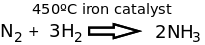
The Nobel prize was controversial but you can see why they awarded it. It may lead to violence today as well as then (unfortunately fertilizer makes a crude but effective explosive which is still used by terrorist groups) but it fundamentally changed modern agriculture.  Nitrogen in the atmosphere exists as molecule made of two atoms of nitrogen joined by a triple bond.  This triple bond makes the nitrogen molecule very stable.  Only some bacteria, plants (legumes) in a relationship with some bacteria and lightening can break this bond in nature.  Haber discovered that by using high temperatures and transition metal catalyst (usually iron) the nitrogen triple bond can be broken and made to combine with hydrogen to make ammonia as shown below.

The chmical basis of the Haber processThe irony as far as agriculture is this has been both very bad and very good.  Its undoubtedly kept literally billions of us alive.  The “green revolution” which allowed growing global population to be fed, was only possible after the second world war in part due to nitrogen based fertilizers.  However,  the environmental effects have been very high.  Fertilizer tends to be added in excess and tends to end of in water courses.  It effects plants, animals and leads to the formation of algae and has effects on our climate.  Excessive use has altered the chemistry of soil making it almost dead in terms of micro-organisms, ironically making the use of fertilizers even more necessary.  Nitrates if ingested in excessive amounts by humans react with organic compounds in our stomachs forming nitrosamines which are carcinogenic.

However, one of the biggest problems with fertilizer isn’t often talked about.  That is its fossil fuel dependency.  Hydrogen has to be made, since little is present in nature.  Its made from natural gas by means a reaction called the shift reaction.  The Haber process also takes a lot of heat and therefore energy to carry out.  All in all something like 1-5% of the worlds natural gas to make the fertilizer we need worldwide.  This has led to use been horribly dependent on a declining resource.  As we wrote in our book

Sustained high prices or actual shortages of fertiliser would inevitably lead to a significant drop in food production. When this scenario was outlined to a group of farmers here in the UK, one succinct response was, ‘If they can’t give us fertiliser, we can’t give them food.’”

There are some solutions as we outline in our book, but its not going to be easy to replace the Haber process.

Haber left Germany resigning as the Nazis gained control in disgust at their treatment of his fellow Jewish academics.  He fled to the UK but died in Basel in 1934.  His son by his second marriage also fled to the UK and later wrote a well respected  book on chemical warfare.

Neil

Posted in Food, gas, One thing we have learnt this week, Peak oil, Uncategorized | Leave a comment

Can we cut energy bills?

Can we cut energy bills?

Apologies to non-UK readers (of which this blog has many) but for the last month or so the UK media has been full of suggestions of how to cut energy bills. Various ideas have been put forward of how to achieve this and this blog entry will consider those and some other ideas. Before you read on don’t get too exited, most of the bill is not under government control and none of the suggestions will cut much money off your bill as this graphic below from the Department of Energy and Climate change (DECC) via Transition Basingstoke suggests. I would also add to overseas readers, don’t be complacent, one minute you have loads of natural gas the next you are having to buy it on world markets and the price of gas and electricity is shooting up.


Factors that make up a UK energy bill. Source DECC.

The blog will mainly talk about the 9% that is due to “Green measures” but will address some other aspects of energy bills.

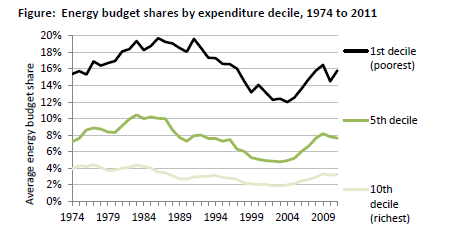
The first question to address is as very few people have (although I did hear someone on radio ask this question last week), should we cut energy bills? This blog is not climate sceptic, if you want that, go somewhere else. We believe and make it clear in our book we need to use energy conservation and renewables to manage both peak oil and climate change. As I wrote before energy is both too cheap and too expensive as this graph below from the Institute of Fiscal studies makes plain (1).


% of UK income spent on energy (source IFS)

% of UK income spent on energy (source IFS)

Energy expenditure makes up just 3% of the richest 10% of the UK population’s expenditure, but 16% of the poorest 10% of our population’s expenditure and lies in between the two for the rest of us. Interestingly its been higher for all groups pre-privatisation (of which more later in the next blog). So we have one group who don’t notice their bills and another group who are struggling.  This is  especially true when you add food and transport costs which have shot up over the last 10 years or so in tandem with the oil price. Food will be at least another 15% on top, maybe more. So a third of the poorest income group in societies expenditure has gone on essentials before they start.

I would make the following points.

  • This trend of higher energy costs looks likely to continue as we wrote in our book . Even if some renewables like solar PV look like producing very cheap electricity down the line, the need to switch to electricity use for heating and transport will raise demand very steeply. This is unlikely to make electricity cheaper.
  •  The only way to get people to cut energy use is to raise the price. We need to cut our carbon emissions and peak oil means we are going to have less energy to play with. Higher gas prices have cut domestic use drastically in England and Wales with Scotland also showing a substantial fall http://www.bbc.co.uk/news/business-23723385.
  • Lastly higher energy prices mean renewables become economically viable faster and subsidy can be removed, which is what we all want to see.

In part two of this post I examine ways we may be able to square the circle and make energy simultaneously cheaper for the poorest but expensive enough to get people to conserve it. Also I will demolish some of the other ideas going round to reduce energy bills.

Neil

1) From the Institute of fiscal studies report “Inconsistent taxes on energy use raise costs of meeting carbon targets and need to be overhauled”. http://www.ifs.org.uk/publications/6917


Posted in climate change, energy costs, gas, Peak oil | Leave a comment

One thing we have learnt this week – HS2 hoo ha

logoIts easy to forget with all the hoo ha over energy prices this week, there has been a HS2 hoo ha.  In principle our book supports high speed rail and by extension HS2.  However, speaking personally its hard not to have concerns.  The route being brand new has caused a storm of controversy, with at first glance a surprising amount of opposition compared to HS1.  This was originally a Labour government plan but the current government in many ways has seemed much more supportive and given the Tories historical antipathy towards rail this is a surprise.   In recent weeks the Labour party has seemed to have cold feet since the cost has escalated to £42 Billion.

The opposition and Hs2 hoo ha is understandable in many ways, the new line will cut through some very pretty country, but so does Hs1 in Kent.  In fact HS1 was said to be made to take a long way round via Dagenham to avoid as many Tory voting areas as possible.  However, the government has made a number of mistakes selling HS2.  The first is not to have a station in the Chiltons between Birmingham and London so that locals have some advantage from the new line.   The second was to talk initially about speed rather than capacity.  There is little doubt that more capacity is needed as the railways as we have mentioned on this blog before are almost carrying record numbers of passengers in their history.

However, I think given the cost increases and level of opposition the time has come to look at any alternatives.  I would suggest three.

West Coast Main line

This is my least favoured option.  It has fairly recently been subject to a lengthy and costly upgrade with large cost over runs and the route skirts a national park.  Its also more twisty than the alternatives.  The fact that the tilting trains that run on it are built to travel at 150Mph and are limited to 125Mph is a crazy treasury cost cutting measure and this line should have the signalling upgraded to 150Mph operation, which should squeeze more capacity onto it.

East Coast Main line

This was my favoured option until I heard about Great Central (see below).  The East Coast mainline which I know well is both straight and much is 4 track sections until York.  Even the next section to Newcastle contains some 4 track sections and is reasonably straight.  On possibility would be a partial upgrade, turning over two tracks of the 4 track section to high speed operation and adding two tracks at least as far as Newcastle with trains running at at least 180Mph.   My suggestion between Newcastle and Edinburgh would be that the trains tilt at 150Mph.  I would be the first to admit there are problems with this idea.  First, upgrading an existing railway is much more difficult and costly.  New tunnels would need to be built north of London.    Perhaps the biggest problem is existing stations.  Any readers familiar with Hs1 will be aware that trains don’t stop every time at every station but bypass those they are not stopping at at high speed.  This would be very difficult to engineer in many of the existing stations.

Great Central reopening

The Great Central railway was the last main line built in Britain until Hs1 (which says something about how much we invest in infrastructure).   Built by Sir Edward Watkin Great Central was arguably the worlds first high speed line – at least in intention if not operation.  It ran from London (Marylebone) to Manchester via Rugby, Nottingham and Sheffield.  Watkin was a visionary who wanted not only a high speed North-South line but also to run trains to France through a tunnel.  In fact he started building a channel tunnel which reached about two miles under the sea.  He held parties there and the Prince of Wales even attended one.  However, Queen Victoria was “not amused” and Parliament stopped construction just in case we had a war with France again!

The line was built to European loading gauge (mainland Europe have always had bigger trains than us), with shallow curves, very shallow gradients, only one level crossing on its entire route and most interestingly island platforms surrounded by the track with space on the outside to put additional tracks so trains could bypass stations they were not stopping at, as described above.

By the time it opened it was regarded as redundant since there other North-south lines in operation.  This is its attraction in the current debate. It was part of the Beeching cuts blogged about previously.  The Labour party is said to be considering this as an alternative to HS2.  One labour MP who has been working on this for an number of years reckons the cost could be as low as £6 Billion.  Reports are sketchy about what is being proposed.  £6 Billion seems too low for a high speed electrified line which is minimum that should be considered along with connections to the east and west coast main lines (one is simple at Rugby).  The advantage there are likely to be less planning issues and the line could be built faster.  The Beeching cuts as I have written about are still very unpopular and reopening railways is popular.  Part of the line is used by a heritage railway group though.

All over the world people are building High Speed lines with varying success (bad crashes in China and Spain), cost overruns and planning issues like HS2 in California.  But from the peak oil perspective these lines are essential and as someone living in the North I want a fast connection to HS1 and therefore to the wider European network.  If Hs2 is only possible route then reluctantly I will support it but I want careful considerations of all the other alternatives first and much faster construction than is being proposed.

Neil

Posted in One thing we have learnt this week | Leave a comment

Apple day

Bramley apples from Neil's tree

Bramley apples from Neil’s tree

Around this time in late October, many places around the UK are celebrating Apple Day.  It’s a commemoration launched by the charity “Common Ground” back in 1990, to celebrate “apples, orchards and local distinctiveness”.  We have good reason to celebrate:  the climate in the British Isles is particularly suitable for producing good flavoured apples, and also we have an amazing heritage of apple varieties.  The incredible species Malus domestica has over 5,000 named varieties, and many thousand more un-named:  essentially every apple pip if planted would result in a new variety.  Heritage varieties with names like Ashmead’s Kernel, Ribston Pippin and Adam’s Pearmain are now becoming more widely known and treasured for their texture, aroma and flavor.  Unfortunately you are unlikely to find them on the shelves of your supermarket, as the global apple supply market is dominated by four apple varieties of Antipodean origin: Gala, Braeburn, Jazz and Cripp’s Pink (marketed as “Pink Lady”).  These four and their close relatives have the advantage of being good, consistent yielders and do not bruise easily during transport.  They also have a consistent texture and flavor, week after week, that many older varieties struggle to maintain.  They are not all grown on the other side of the world: Gala makes up over 20% of the UK apple crop, and the area is increasing as varieties like Cox decline.
 
Part of the reason that we see only a few varieties on sale is our changing shopping habits – we mostly shop at the supermarkets, who are all tied in to global supply chains so that apples are available year-round.  The old high street greengrocers are mostly gone, though a good street market stall may have a box or two of some different apples for sale.  Farm shops are another place to look for interesting varieties.

Last Saturday we had an Apple Day celebration in our village hall.  Over twenty different varieties were on sale, and a further twenty or so on display, from the odd looking “Codling” to the “Bloody ploughman” – the giant cooking apple “Edward VII” to the diminutive “Katy”. If we lose these varieties we lose something of our national heritage, and the best way to make sure they stay around is to eat them!  So ask around for something a bit different, see if you can find a variety with an odd sounding name, buy a pound or two, and have a bite.

Andy

Posted in Food | Leave a comment

One thing we have learnt this week – Hinkley C

One thing we have learnt this week – nuclear power is back or is it?  This week we have had an announcement that two reactors will be built a Hinkley point in Somerset by a French/Chinese consortium. Supposedly the first to be built without public subsidy, although as we will see this is not strictly true. So what have we learnt?

Whilst there is no public money per se going into the deal the UK government has guaranteed a price for the electricity (strike price). In the week where there has been almost constant controversy over energy prices we learn this is 9.25p/kWh approximately double the current price of electricity on the wholesale market. We can learn from this that this is what the government thinks this price will be competitive with the wholesale price of electricity in 2023 when Hinkley C is supposed to open. Its also linked to the prices index so will rise with inflation. This implies the cost of electricity in 2023 will be double the current price for the consumer.

Second, we know the projected cost is £16 billion for 3.2GWp of installed capacity. This is up from £14 billion on Monday, which I assume was a reporting mistake.

The department of energy and climate change rushed out a dodgy infographic on land area. People have questioned particularly the land area attributed to the same capacity of solar and wind. I have not done the math on this, but in any case its missing the point since the best place for solar is on a roof, of which there is plenty available. However, the graphic did give some useful information that is the projected output (presumably of both reactors). This allows the calculation of the projected installed cost and the price of electricity and the capacity factor. The installed cost is easy, that is £16 billion divided by 3.2GWp or £5/Watt installed. This compares with a domestic solar installation of reasonable size which has an installed cost of around £1.2/Watt, large ground mounted systems are even cheaper.

But how much will the electricity cost and has the consumer got a good deal? For any renewable energy installation you can consider that as the costs of running it are minor the cost of installation determines the cost of the electricity (or heat) you have effectively bought up front over the projected lifetime of the system. Conventional plant (and renewable biomass) is not the same since the price of the fuel is not free and may change but we can get an indication. To do this calculate the installation cost divided by the average output per year. So we are told this yearly output over 35 years of support will be 26TWh. I prefer to think in kWh and pence.

So 26 TWh = 26000GWh = 26000,000MWh = 26000,000,000kWh

£16 billion = £16,000,000,000 (assuming US billion)

cost per watt of generation is therefore

£16,000,000,000 / (35 x 26000,000,000) = £0.0175

or 1.75p/ unit

The capacity factor is the actual projected output divided by its theoretical output if the plants operated 24/7/365 expressed as a percentage by multiplying it by 100.

So 26000,000,000/(3.2*1000*1000*24*7*365)*100 (all in kWh)

= 13.2%

These last two figures seem implausibly low. Even allowing for the fact that EDF will not get a return on their money for over 10 years and running costs are not included, this does not look like a good deal for the consumer. The load factor also seems amazingly low. If I have made a mistake in either calculation then please correct me.

The likelihood is that EDF will not be able to build Hinkley C for this cost in any case. The question is will they coming running to the government and if they do what will happen? One thing is for certain solar will be cheaper by 2023. The solar trade association are asking for a strike price of less than 9.25p/unit for 2018.

Personally I will believe Hinkley C when I see it open….

Neil


Posted in Nuclear, One thing we have learnt this week | Leave a comment