Population

We wrote about population in the economics chapter of our book “No oil in the lamp”.  A week or so ago I read a very provocative post on the site “Seedbed” on population.  Its with some trepidation I blog on this subject matter, since its a minefield.  You don’t have to move too far into it and you are in the highly controversial areas of abortion, contraception and eugenics.

There are a number of criticisms of Adam Roe’s article I would make.  The first is that people are not worried about population.  As we wrote in our book this is not true at all.  We cite a number of different writers and reports in our book that show continuing concern about the earth’s rising population. Amongst them is the “Christian Medical fellowship”.  As good background reading on this issue this short paper is recommended.  There are a number of projections made about the population to come, the range used by the UN is from 7.7 to 10.5 billion.  This is a significant increase in population from (roughly) 6.5 billion now by anyone’s standards.  Whilst the rate of population growth increase is plummeting in dozens of countries, but there is lag in the system since many humans of reproductive age are now born. In addition Adam Roe’s analysis of what is happening in the USA is only partially correct.  Whilst the birth rate has fallen slightly below replacement level (taken as 2.1 births) its still high by developed country levels at around about 2.08. births.  Live births are in any case not the whole story you have to take immigration into account.  Both the relatively high replacement rate and immigration are expected to increase the US population from  317 million today to nearly 500 million in 2050.   See this reference for full details.

This brings me to the next criticism – this time implicit rather than explicit, that endless economic growth is possible.  This is why in our book this subject was raised in the economic chapter.  All the 1.2 to nearly 3 billion extra mouths need to be fed, watered and provided with energy.  Something the CMF paper raises, being surprisingly peak oil aware.  As we have blogged on and raised repeatedly on our Facebook page there is growing realisation we are facing a global food crisis (there are updates on this in the new ebook).  All are not equal- a baby born in Africa currently uses many less of the worlds resources than one born in the West.  As we have tried to get across in our book, endless growth of the type we have now is simply not possible as we bump up against physical limits.

I’ve got more to say to criticise this article but this is for another post.

Neil

Posted in Faith, other, Peak oil | Tagged | 2 Comments

One thing we have learnt this week (artificial meat)

One thing we have learnt this week is about artificial meat.  The press have been full of stories about the lab grown hamburger at $250,000 a go.  This has set off another rash of stories about eating insects.  Insects, or artificial meat things are going to have to get pretty drastic before I will eat them!

I recognise the problems; in that meat is responsible for almost 20% of greenhouse gas emissions, we will never grow enough to feed a western diet to everyone if they reach the same standard of living as westerners do.  However, artificial meat apart from the yuk factor has other problems for me.  The fact that it was grown on foetal calf serum is one.  Apart from the way foetal calf serum is produced, having used it to grow cells in the lab I would not eat anything grown on it or near it!  Clearly using foetal calf serum would mean meat dependency has not been eliminated, but I know from experience finding other media that are as rich will be a problem.  Another problem is that growing artificial meat will still need a lot of energy.  According to channel 4 news about half as much as growing normal meat, but still a lot especially if we did largely replace animal reared meat with it.  In a post oil world this is still going to be problem.  So both the energy and protein source for culturing artificial meat are going to be problem.  However,  the whole story has opened up a whole useful debate on the future of food and that is healthy.

Neil

Posted in One thing we have learnt this week | Leave a comment

“No oil in the lamp” ebook

No oil in the lamp: fuel, faith and the energy crisis ebookNeil, Andy and DLT are pleased to announce we are working on an ebook version of “No oil in the lamp”. The ebook will be slightly updated and different to the print version. It will be available in epub, pdf, Amazon Kindle, iTunes, Kobo etc.  On of the advantages is the ebook will have one click purchase worldwide particularity in the US.  We launch the ebook at Greenbelt 2013 where we are giving 2 talks.

Its inevitable that some things will be out of date as we move forward in time.  Going through the book after a year its amazing how little has changed.  Some of the facts and figures did need updating, for example installed wind and solar capacity.   The main updates have been on fracking (especially shale oil in the US and gas fracking in the UK) and “the Arab Spring”.  As I blogged here this latter issue is a tragedy that shows no sign of abating soon. We made some predictions about the Arab Spring in the print edition.  The whole situation is moving in a worrying but at the same time very unpredictable direction.  We have also added two graphs showing the extreme fossil fuel dependency of food to the food chapter.  Please note the ebook version does not contain the study guide.  If you want that you must buy the print edition.  We know of one church that is doing a group study utilising the study guide.  Another church has used the book as the basis for a Sunday morning service.Unfortunately as the oil price hovers around a high historical level of $100/barrel  Christian’s complacency about this issue has not changed.  Through the ebook we hope to change this.


Neil

Posted in Uncategorized | Leave a comment

One thing we have learnt this week

One thing we have learnt this week is that protest in the UK is not dead merely sleeping. The UK has a long history of protest. From CND, nuclear power, new age travellers, raves, the poll tax, nuclear missiles, anti-roads, 3rd runway etc. the list goes on. You could say that there are always a small group of people who want to protest about something. And you would be right, although that does not mean they are wrong to protest. Perhaps because the recession things have been quieter recently, however in the last week or so we have seen major protests in leafy Surrey against fracking at Balcombe.

Looking at the Frack off (UK) website other groups in areas threatened all over the UK are organising fast.  Some against Fracking others against mine gas.  Its become obvious to some politicians that they have a fight on their hands.  Lord Howell suggested fracking should be confined to the North-East of England presumably since he thinks its some post industrial wasteland where his party gets no votes (unlike Surrey).

Its been pretty obvious to most of us that this isn’t going to work out the way the government wants.  The UK is not the US.  The crown owns the land underneath us so we have less financial incentive than in the US.  Parts of SE England are water stressed (Fracking needs lots).  As we have seen most of the areas where fracking is proposed are beautiful (including NE England where we are going on a short break later this year) and the locals don’t like it.  In the meanwhile new gas powered stations will be built but with no shale gas to run them we will have import gas from abroad at increasing expense.

Neil


Posted in One thing we have learnt this week | Leave a comment

The Arab “Spring” and energy security


TEARFUND Syria appeal

TEARFUND Syria appeal

Early 2011 saw the so-called Arab “Spring” – an abrupt and unexpected change in the political landscape across the Arab world. Starting in Tunisia, widespread street protests took place as ordinary citizens demanded human rights and political change. The leaders of Tunisia, the Yemen and Egypt were deposed, while protests in Syria and Bahrain have been brutally repressed. In Syria the situation has degenerated into a brutal civil war with huge humanitarian problems. In Libya, intervention by NATO to prevent the repression of a grass-roots uprising led to the overthrow and murder of Colonel Gadaffi and in other countries there have been rumours of discontent. However, the central government has struggled to gain control of the militias that overthrew Gadaffi and there was an attack on the US consulate in Benghazi in which the ambassador was killed. In Egypt the president has just been overthrown in an army coup and there is widespread unrest on the streets with many people having been shot by the army.  Even in the most settled country Tunisia there has been a political assassination recently.

First and foremost much of what has happened in the region since the Arab “Spring”, particularly Syria is a human tragedy.  The number of refugees in neighbouring countries stands at over a million.  Whilst the initial protests against Assad were peaceful and people only responded with violence after extreme provocation, there don’t seem to to be many good guys now.  Both sides have committed atrocities and possibly used chemical weapons.  The West seems impotent to intervene partly because of Russia and China.  However, I for one would oppose the arming of the rebels.  They have been infiltrated by Al Qaeda and it would be like pouring petrol on a fire.

Syria, the Yemen and Egypt produce relatively little oil and in any case their fields were in decline long before 2011 (although in a tight oil market their combined output could be vital). The concern around energy security is the fear of the civil war in Syria spilling over into other countries in the region with oil and gas supplies. The Syrian situation is taking on an increasingly sectarian tone between the Alawites (Shias) who support President Assad and the Sunnis who make up the bulk of the population. Both sides are fighting the Kurds who want an independent homeland.

The whole “Arab Spring” has been totally unpredictable so far but one possible scenario is that the civil war in Syria spreads to its neighbours (Lebanon and Iraq) and then beyond and becomes a general conflict between Shia and Sunni. Whilst Shias are a minority overall in the Middle East they are very widely dispersed. In Iraq they make up a majority and there are large populations in the Gulf States and Saudi Arabia. From what I can gather the Shia/Sunni split in Islam is over who was the designated successor to the prophet Mohammed.  Shia’s believe it was Ali, the prophet’s son-in-law, Sunni’s that it was his father-in-law (or senior companion).  In some ways its not a million miles from the Catholic/Protestant split for Christians with other theological differences having grown up over the centuries.  This Shia/Sunni conflict scenario whilst looking relatively unlikely would lead to very major fossil fuel supply disruptions as well as a major humanitarian crisis.  There is however no doubt that the violence between the two groups is spreading in recent days into Iraq where they fought after the Anglo-US invasion, although in recent years the violence had largely subsided.

Another flash point is the Kurds. The Kurdish part of Iraq is semi-autonomous and wants independence. It is also the part of Iraq with the greatest recent increase in oil production. If the Kurds declare independence, or fighting spills over from Syria then war is very likely in Iraq again. It is also possible that the Libyan government may fail and lose control of the oil fields which are largely concentrated in the east. In all these countries Al Qaeda is trying to exploit the situation. The one remaining scenario which has been ongoing since we started writing our book; that of war with Iran, looks less likely. Whilst Iran is the Syrian government’s only friend, a reformist president has been elected and negotiations over the nuclear issue look very likely. However, it seems that the current high oil price is partly due to these geopolitical factors and this will continue.

Clicking on the image above takes you to TEARFUND’s Syria appeal.  All we can do in this case is give money and pray for a good outcome for the country where this seems in doubt. We need to pray for peace throughout the region but especially Egypt and Syria.  Lastly it should not be forgotten that many of these countries have substantial Christian minorities.  Syria has one of the oldest Christian presences in the world (Acts 9).  These Christians are at risk from both sides and organisations like “Open doors” are seeking to help them.

This is an expanded excerpt from our soon to be released ebook version of “No oil in the lamp”.

Neil

Posted in Faith, Peak oil, Politics | Leave a comment

One thing we have learnt this week about fracking and GM

One thing we have learnt this week is that politicians hopes and plans regarding fracking and GM do not always succeed…  Recently in the UK the government has been hoping that they could push GM crops again.  Some polls at least suggest that the public has softened its opposition.  Part of the sell of course was jobs.  But yesterday Monsanto announced it was pulling the plug on its planned GM crops in the EU.  Of course Monsanto is not the only company involved but it does give an indication of the way things are going with too much opposition in the EU. (Although its not illegal some GM crops are grown in Spain and Portugal.)  As we blogged here GM is not the answer to peak oil.  In addition the government announced tax breaks for fracking.  It clearly hoped the promise of lower energy prices, jobs and a large bribe (actually not that large) for communities affected would swing the rural public in favour of this energy source.

Not at Balcombe it hasn’t!  A well organised protest has been going on over-night from yesterday.  Like GM fracking is not the answer to peak oil either.  Its strange as this crisis develops how many magic bullets we have gone through.  Biofuels, nuclear, electric cars and now fracking (through all this period energy prices have increased).  At Balcombe they are after shale oil and only have a month before their planning permission runs out.  Here’s hoping the protesters can stop them.  Our ebook available on the 2oth of August has updated sections on shale oil and gas.  Buy a copy!

Neil

Posted in One thing we have learnt this week | Leave a comment

Zero carbon Britain 2013

The centre for alternative technology have brought out another Zero carbon Britain report.   There is not the space to blog on the full report, but here some of the main points of interest as far as we are concerned.

Energy conservation

Zero carbon Britain envisages a reduction in energy use from the current 1,750 TWh to around 665 TWh per year (60%).  This is largely to be brought about by insulation and much more efficient use of energy (smart meters and smart demand as we cover in our book).  Industry and domestic users switch to electricity and synthetic methane.  Zero carbon Britain does not advocate a way of getting there but describes a number of approaches (such as TEQ’s or carbon taxes) with their pros and cons.

In my view. Gone is the previous Zero carbon Britain reports reliance on implausible numbers of house demolitions.  However the report is too vague on how we really get such a huge reduction in energy use.  The drivers for this will have to be very strong.  Other than TEQ’s which is my preferred option (see our book for details in the Transition chapter), there are huge uncontrolled rises in energy prices due to crisis’s or taxes.  A little more detail would have been good.

Energy production

We will still need energy.  Zero carbon Britain sees a totally renewable future with 770 TWh annual energy demand met by renewables (105TWh a year comes from heat pumps added onto the figure above).

source output (TWh/yr) details
offshore wind 530 140 GW maximum power,
14,000 turbines rated 10 MW
onshore wind  51  20 GW maximum power,
10,000 turbines rated 2 MW
wave power  25  10 GW maximum power
tidal (range and stream)  42  20 GW maximum power
solar PV  58  75 GW maximum power,
covering 10-15% of UK roof area
geothermal electricity  24  3 GW maximum power
hydropower  8  3 GW maximum power
 Total  738

In addition they visualise another 25TWh/year of renewable heat from solar hot water and 15 of geothermal heat used to heat buildings and the 105TWh from heat pumps. On top of this Zero carbon Britain looks for another 274TWh of biomass energy this is used to power a few vehicles, run some industries (for example cement needs large amounts of heat), heat some buildings and act as an energy storage medium to balance renewable supply with user demand.  This biomass is largely grown on land used for meat production, which is much reduced.

In my view.  Much to commend here.  If anything they are being conservative on the renewables, although as they point out if you added more you would end up with a surplus at some times of year and still end up with deficit at others.  It does raise some interesting questions though.  For example there are just under 4000 wind turbines of the size that disturb people onshore.  Its difficult to see this doubling in number with increasing resistance.  However, the slack could be made up by other renewables.

75GWp of PV seems on the low side.  I just wonder what to do when PV cruises past 75GW?  This is only 10-15% of the available roof space, although some of the other 85-90% is allocated to solar hot water.  I calculate from the projected heat output there would be 16-17 million such systems, most of the houses in the UK would have them fitted.  Of course my house has both and there would be a possibility of having both on many UK houses.  My biggest gripe with this section is over heat pumps.  Having looked into them for our book “No oil in the lamp” I’m not convinced they will work retrofitted into new buildings.  The problem is most forms of renewable heat systems won’t either.   Nor is a COP value of 2 any use.  The minimum such value is 4.  There is however some very interesting work on balancing out different renewables using 10 years of past weather data.  82% of the time using the Zero carbon Britain model the electricity supply is in surplus. The rest of the time they look to synthetic gas to balance out the deficit.

Transport

Zero carbon Britain (like our book) envisages almost all transport to be electrified.  The amount of electricity needed for this is large but manageable.  Dividing their figure for the electricity required in kWh by electric cars per person per year we get almost the same figure of about 1kWh per person per day.  This assumes no range increase.  They are negative about the hydrogen economy, as are we, but for different reasons.

In my view. The only questions I would raise is over supply of rare earths and the energy used to make the cars although they allow energy in their scenario for industry.

Landuse

Zero carbon Britain looks to a much lower consumption of meat.  I think this is right.  I’m trying to cut the meat down in our family.  They usefully indicate what the diet would look like in 2030.

Campaigning and what you can do

Very positively the report has some sections for individuals and campaigners on changing their own and other peoples lifestyles.

Conclusions

Despite my criticisms above I’m very positive.  The modelling on balancing out renewables is particularly valuable.  Its just a bit vague on how we are going to get there on demand reduction.  But for anyone interested in the kind of areas this blog is, its a valuable resource.

Neil


Posted in Uncategorized | 2 Comments

One thing we have learnt this week- heat wave

One thing we have learnt this week is that we are in a heat wave.  Last summer whilst the US baked in a drought it rained and rained here.  When I want away last year and returned everything in the garden had been in stasis.  Nothing had grown for two weeks.  This year could not be more different.  Plants had tripled in size.  Tomatoes (indoors) had gone from flower to ripe in 6 weeks.

At the same time the weather we are basking in has a number of implications.  Our weather is affected by the jet stream and this is becoming increasingly erratic and is slowing down.  This may have something to do with the Arctic sea ice melting in Summer (i.e. climate change).  If this is the case we can look forward to increasingly extreme summers. This heat wave has already lead to more deaths (old people dying of heat) and younger ones drowning by cooling off in old quarries (as has happened this week).  We  are also a rush to buy air con systems which will stretch our electricity supply still further.  One the plus side we can expect a rush of people having solar panels fitted to their houses.  Food security is affected too.  After last years terrible harvests due to rain some types of crops will still be affected by lack of water and the heat such as root vegetables (berries, Apples and salad crops have done really well though).

So the extreme weather is something we will have adapt very carefully and thoughtfully to.

Neil


Posted in One thing we have learnt this week | Leave a comment

BP on renewables

In the previous post we had a look at the state of the traditional energy sources.  This blog post will cover renewable energy sources.  According to BP global solar energy output was up 15.% year on year compared with 2011.  Although this increase was less than the year before. Its still part of a healthy long term trend of double digit growth in renewable energy stretching back 10 years.  However,  before we get carried away renewables still only produce 4.7% of all electricity generated in the world although this is a record figure.

Output

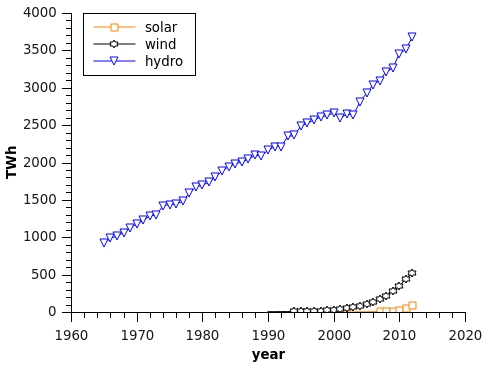
Hydro leads the field as you can see from the following graph.

wind hydro solar

Wind, hyrdo and solar output (data from BP).

I’ve put all the data on the same axis to indicate to you how far wind and solar are behind hydro output.  The plot is deceptive, hydro looks like its output is growing far faster than the others.  Not true; hydro output growth was 11x less than solar output last year.  On current trends that will overtake at some point, but it is going to take many years.  Germany of course was the leader on solar, but the UK solar output increased over 4 fold from the year before and for two years has been measurable.  The USA has the largest wind output.

Capacity

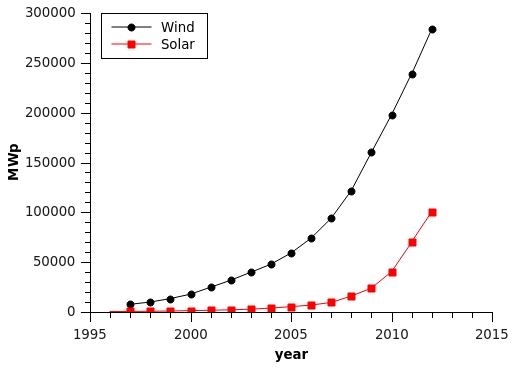
Capacity continues to grow fast.  Hydro data is not given by BP, but wind and solar capacity is growing fast.  Solar capacity increased by almost 75% last year and wind by a very respectable 18%.  The graph below shows the BP data.

wind and solar capacity

Wind and solar capacity (BP).

In the next post we will wrap it up with a look at what effect if any this is having on carbon emissions.

Further details can be found  here.

Neil

Posted in Renewables | Leave a comment

Carbon emissions from BP

We often have a look at the BP statistical review – it’s a useful compendium of energy industry data.  In the 2013 edition they examine the carbon emissions from energy use.  What of these?  The IEA view seems to be that renewable energy is starting to make some inroads into emission levels.  Is it?  Looking at the data for 5 countries two things stand out.  The USA and China emit vastly more carbon than anyone else and it does look like the USA’s carbon emissions (at least those from electricity production) have peaked.  The overall global figure rose by 1.9% but many countries in BPs spreadsheet have falling emissions from energy.  This includes almost all European countries but also countries in Latin America and Asia.  It does look like a high penetration of renewable energy is starting to have an effect.  In the long term this bodes well for energy security as well.

Carbon by country

Carbon by country (data from BP).

Of course not all carbon emissions are from energy use.  The biggest sources are agriculture and forestry.  Nevertheless we can take some encouragement from these figures.  Even China’s carbon emissions are slowing down.  We’ve left it awfully late but just maybe we will manage to have falling emissions by 2020.  It remains an open question whether this is anything like soon enough, or whether as some climate watchers argue, by then it will be too late.

Neil

Posted in Uncategorized | Leave a comment