Cycling counter

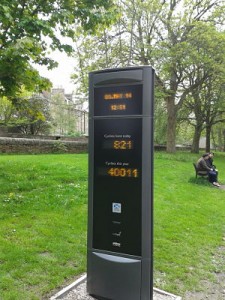
I was cycling through Edinburgh when I came across this cycling counter.  I hadn’t been 2014-05-08 12_optthat way for a while and was pleasantly surprised.  It looks a bit like TMA1 from “2001: A space Odyssey“.  The cycling counter has two counts one for 24 hours and one for the cumulative total.  The idea is to encourage people to cycle by saying you are not alone!  As I wrote previously cycling is not the answer to peak oil but is part of it.

Therefore anything that can encourage cycling is to welcomed.  I also came across this neat idea at the railway station.2014-06-01 15_opt  A pump and tools securely fastened to a large post, in the very large cycle park area of the station.  There is cycle parking for hundreds of bikes and even on a Sunday I had problem finding somewhere to lock my trusty steed up, presumably because people are commuting in by train and cycling the rest of the way.

Both the cycling counter and the free to use tool post are small ways of encouraging people to cycle and are to be commended.  Anyone seen any other neat ideas?  Why not try cycling, make contact with your local cycle pressure group, they often do coaching to get you safely back on the road.

More cycling blog thoughts here.

Neil

PS there will be no “one thing we have learnt this week” this week since I’m away.  Although I’m sure we will have learnt something….

Posted in Cycling, Peak oil, Practical low carbon living, Slow living, Uncategorized | Leave a comment

One thing we have learnt this week- Obama’s new climate plan.

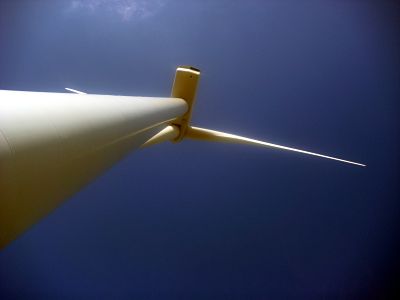
wind turbine in France from below bladesThe big news this week is that Obama’s new climate plan has been announced.  At long last and not before time…  The scheme is a sort of cap and trade one but one on a state by state basis.  So each state can adjust its portfolio of generation to optimise CO2 reduction.  They can do this by renewables and energy efficiency, making existing plant more efficient and more controversially by the use of nuclear and shale gas.

For once the word historic describes Obama’s new climate plan.  By 2020 each state will have cut emissions by 25% and by 2030 by 30% over 2005 levels.  Is this achievable?  I would say so.  The amount of solar power in the US is leaping as the US vies with China to become the world’s biggest market for PV.

However, at the moment Obama’s new climate plan is just that.  There are already threats of legal action from the coal industry.  There is also a danger.  Over the last year US natural gas prices have edged up and with them emissions as power plants have burnt more coal.  But over the last few years shale gas has led to a drop in emissions (does anyone take into account both the energy use of extraction and leaking methane?), but the coal has been exported to us.  Its essential that there is a wholesale move to renewables.  Germany has shown how it can be done with Germany meeting 75% of electricity demand from renewables on the 5th of May.

Finally we should not forget this is a moral issue.  The poorest around the world and in our own society will be effected before the wealthier of us, but ultimately civilisation itself is at risk.  As it says in Isaiah 3v15

What do you mean by crushing my people, by grinding the face of the poor?”
declares the Lord GOD of hosts.

A lot more detail on Obama’s new climate plan can be found here.

Neil

Posted in climate change, One thing we have learnt this week | Leave a comment

Bread making

breadFor about a year now I have been volunteering at a local community centre through attending their bread making workshop. Before joining this group I knew very little about making bread. I had tried my hand at some pizza dough and even attempted pita bread hoping for that elusive “perfect puff”, but I was never brave enough to attempt your basic sandwich loaf. However, now that I have been kneading with my friends at the community centre for the past thirteen months not only have I nearly mastered the simple sandwich loaf, but I have also learned the great value of a simple cup of tea with a stranger.

The thing about making a sandwich loaf is that it really only takes 30 minutes of hands on time, but the workshop I’m in lasts for 2 hours. That extra hour an half of proving and baking time allows our group to get down to what I now know is the real business of our workshop- having a nice cup of tea together. However, when I started in the group, tea time was the scariest bit of the whole experience! First off, as they say, I’m not from around here. I’m an American living in Edinburgh and the community centre that I’m at is full of locals with some mighty thick accents. In the early days of being in the group I struggled to understand my fellow bread-makers and it took most of them months to correctly pronounce my name. Slowly but surely, I began to expand my Scottish vocabulary as I learned to blether with the best of them and I think they are now quite endeared to the sound of a yankee in their midst.

If it weren’t for this group, I would probably never have met the people who I’m making bread with because our life circumstances have been so very different. This particular community centre that I volunteer at is geared towards providing a safe space where vulnerable adults can come learn practical life skills but more importantly can learn the often harder to attain social skills that will enable them to succeed as they work towards a more self-sufficient life.  My fellow bread makers have been though some struggles that I hope to never face. Even to this day, it can be hard to find common ground to chat about, but after a year’s worth of bread kneading and cups of tea, I can genuinely say that these are some of the people whom I count as dearest to me in my new home town.

So, if you are looking for a great way to bond with some people whom you might not normally have much to chat about, might I suggest you assemble to following ingredients and locate a kitchen. A shared, practical experience like bread-making is a wonderful way to stimulate the blethering spirit in just about anybody.

Simple Sandwich Loaf in Eight Easy Steps

500g of your choice of flour (plain white, wholemeal or even half white half wholemeal)
1.5 teaspoons of salt
1 tablespoon sugar
2 tablespoons oil
300 ml warm water
2 teaspoons active dry yeast
(You can also add in seeds, nuts, herbs or dried fruit if you’d like)

1. Mix dry ingredients (flour, sugar, salt, yeast) in a large bowl. At the community centre, we really do use teaspoons and tablespoons to measure with- not the official measuring kind, but just whatever you use at home to stir your tea or eat your soup will do.
2. Add the water and oil to the dry ingredients and stir together until the dough begins to form and you can turn it out onto a work surface to begin to knead. Note: wholemeal flour may require a bit more water, add a spoonful at a time until the dough is workable.
3. Knead your dough for 10-15 minutes. No big secret here, use the balls of your hands to press the dough down into the work surface, then stretch it out, then press it together, then stretch it out….. At the centre we say this is by far one of the best stress busters out there! The dough may start off a bit sticky, but as you work with it the water will incorporate into the flour and the dough will come off your hands. Note: wholemeal dough is more difficult to knead, it isn’t you! Also, this is the time to add in your seeds, nuts, herbs etc.
4. After 10 minutes your dough should have smooth surface texture and if you press your finger into it, the dough will spring back. Using your hands, roll the dough into a slightly wide baguette loaf shape.
5. Generously Oil a bread tin and place your loaf into the tin. No need to press it into the tin, it will rise and fill up the space.
6. Place the tin in a warm spot and cover with a tea towel. Let it rise for 30 minutes. Preheat your oven to 200 C. Now it’s time for a spot of tea!
7. Once dough has doubled in size, place it in the oven and bake for 35 minutes or until browned on top. When you remove it from the oven you can take it out of the tin and tap the bottom of the loaf to check for doneness- if it sounds hollow it is done.
8. Let cool for a few minutes before serving. If you aren’t going to eat it right away (or within a day or two) you can freeze the bread for up to 3 months.

Guest Blog by Ansley


Posted in Food, Guest Blogs, Intentional living, Lifestyle | Leave a comment

One thing we have learnt this week-recycling

DSC_1020_optRecycling rates in the UK (particularly England) are flatlining.  So says SITA on yesterdays news (although on their website the story is far older).  Its a mixed picture in some parts of England recycling rates are 70% and in Wales overall its over 50%.


They say “England is also facing the danger that it won’t achieve its EU 2020 recycling target of 50 per cent but, despite this, the current Government has withdrawn funding and focus from sustainable resource use – placing its future in the hands of the waste management industry.

On the news item yesterday the man from SITA was complaining not of government cuts, but green fatigue for lowering recycling rates.  There then followed a debate on whether households should sort recycling before collection and whether this would improve recycling rates.  Mixing recycling makes it easier for the householder but cross contaminates the recycling making it potentially unusable.

I’m not sure what’s best and whether cuts are the cause or green fatigue, but I do know the following.

  • Where I live recycling has got easier and we can recycle more.
  • When we go on holiday to rural areas whether its in England, Scotland or Wales recycling is far more limited.
  • There is still too much we cannot recycle.
  • There is still too much packaging, its very difficult to avoid this completely and most of the packaging concerned is not recyclable.
  • Most plastic is not recyclable more than a few times anyway.

We need to use less and design in reuse.

Neil

Posted in One thing we have learnt this week, recycling | Leave a comment

Food in War

Vegetable patch 2013Food in War

Food systems have always come under stress in wars. From the siege of Jerusalem by the Babylonians described in II Kings to the scorched earth policy of the Russians in both 1812 and 1941, food has played a major role in deciding the outcomes of conflict. In conflicts at the moment people are starving such as those in Syria.  However even in a times of relative peace there are some lessons we can learn from the first and second world wars. By the time the first world war started the food system was starting to become fairly globalised and Germany and the UK were no longer completely self sufficient. For the UK these imports were disrupted by U-boats and for Germany by the Royal Navy blockade. In both countries this led to widespread hunger (Neil’s grandmother could remember this). In 1918 the UK introduced a system of food rationing, but also advice such as a cookbook to make use of what there was.

What happened during the second world war is perhaps not only better known but also more significant. In 1940 the UK government introduced a comprehensive system of rationing for basic foodstuffs which aimed to provide a healthy balanced diet (see appendix for the list and quantities). Not only that but the ministry of food did as much as possible to teach people nutrition and how to cook. This was undertaken by means of both free public cooking demonstrations and widespread publicity. School meals were introduced (the fear was mothers would be too busy after war work to cook). Wasting food was made illegal, the reason being that men risked their lives to bring it in. The irony is that despite stress and shortage the health outcomes in many ways were very good. There was a second very important lesson we could learn from this period. The population was encouraged to “grow its own”. Gardens, parks wasteland and even the Buckingham palace gardens were pressed into service. 25% of the nations food was grown in this way, a stunning achievement. There was an unintended consequence, growing your own food or cooking from scratch in this way came to be seen as part of post war austerity since rationing continued into the 1950’s for economic reasons.

Rationing was also introduced in the USA from 1942. The prices of a number of basic food commodities such bread and milk were frozen for the duration of the war. As in the UK 20 million Americans turned over parks and gardens to grow food producing a impressive 40% of the nations food in that way. One problem the USA faced was that internment of the Japanese Americans hit food production very hard in California. This group dominated the states food production.

Food in war still has something to teach us today as we increasingly face fossil fuel shortages.

Neil

Posted in Food, Uncategorized | Leave a comment

One thing we have learnt this week – agrihoods

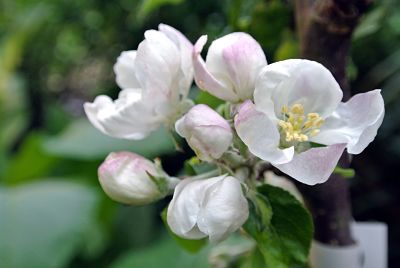
My newest apple tree in blossom.

My newest apple tree in blossom.

Agrihoods- neighbourhoods and communities based around (usually) urban farms.  No I’d never heard of them either until this week.  One of the big problems with peak oil is our current food systems oil dependency. We have covered this in our book and here. Climate change will present another challenge.

One partial solution is to grow food in urban areas.  This is the apparent aim of many agrihoods.  However, having a look at this site with a list of agrihoods I have some concerns.  First many of the agrihoods are not urban but in the country.  Land is lost for building which slightly defeats the aims of agrihoods.  The second is that they are obviously businesses.  Nothing wrong with that, but its not the article implies.  The housing is built around the farm and looks very white, affluent and middle class.  Again nothing wrong with it, but my idea of community includes more diversity.  I’m also not sure having large open air swimming pools makes the agrihoods very sustainable.  Many seem to be building their own schools and health centres.  I’m uncomfortable with the idea of isolation I would prefer to live in a community that shares and uses the amenities around it rather than cuts itself off from them.  Looking at the websites the agrihoods look very controlled and remind me of what I have read about Disney’s town of Celebration.

In principle the idea is a good one.  What I assumed was that the agrihoods consisted of was the following;  a group of people who purchase some land in or on the edge of an urban area and cooperate on growing and selling their food whilst interacting with the community around them.  This is not what the above are.  Please post any agrihoods that you know of that are genuinely  cooperative.

Neil

Posted in climate change, Food, One thing we have learnt this week, Peak oil | Leave a comment

peak oil again

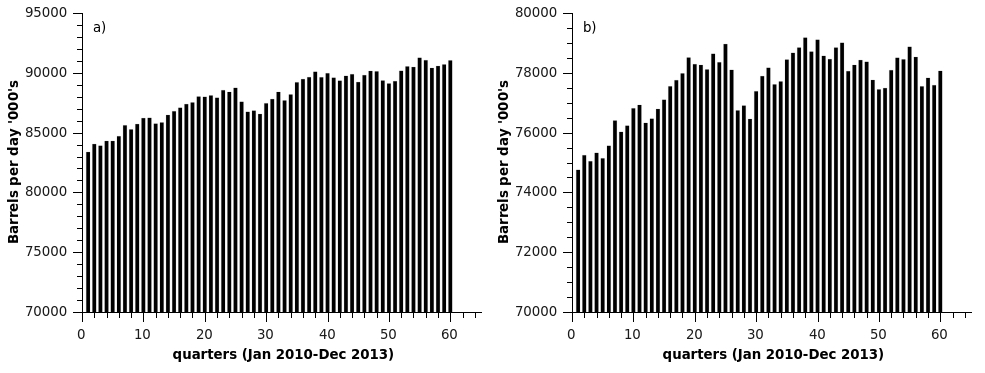
Back to peak oil, a few weeks ago I came across this link somewhere.  In it the person called Patrick from Belgium takes you through the steps to calculate peak oil for yourselves using a spreadsheet.  This looked too good to miss so I thought I would give it ago.  The link above describes the steps.  I followed these and ended up with two graphs shown below.  Graph a) shows the total global oil production in numbered quarters between the dates given.  The second graph has one difference US oil production is removed.  This completely alters the result with oil production on a firm downward trend.

peak oil graphs

At the moment there is not that much talk about peak oil, but a lot about Saudi America. Even the transition movement seems a bit quieter about it.  We think there is lot of hype about shale oil, there being a number of problems with its extraction and how fast the wells deplete.   There is no doubt at the moment oil production globally is increasing and this is driven by US oil production. The question is will this last?  As we wrote in our book about the shale oil hype;

However, even if this is true, this is forecast as being for an extraordinarily short period of time, only for 5 years from 2020-2025. A related finding is that of the US becoming a net oil exporter in 2030. This is predicated on “new fuel-efficiency measures in transport

Has global oil production peaked?  Conventional oil – almost certainly.  All the easy stuff has gone.  There are number of alternative scenarios based around unconventional oil.  The first is that oil production increases due to US shale oil for a number of years and then as US production declines we reach peak oil, in probably less than 10 years.  The second is that other countries join in with shale oil and peak oil is set back again. All this time conventional fields are in decline and unconventional oil has to keep pace with both that and increasing demand.  Either way the oil price looks like staying high, you might notice that for all this increase over the last 35 quarters or so there has been no significant drop in the oil price.

Neil

Posted in Peak oil | Leave a comment

One thing we have learnt this week – crop diversity

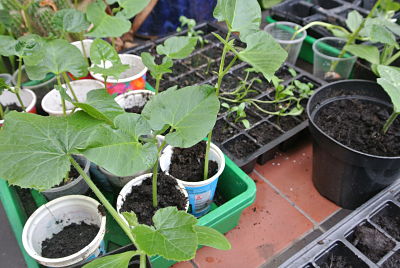
seedlingsI’ve just found a very interesting paper on crop diversity published this year in the journal PNAS.  The authors have assessed the trends in crop diversity over the last 50 years and what they have found is informative and worrying.

The first trend is towards energy dense foodstuffs such as those rich in animal fats, sugars and plant oils with a decline in consumption of pulses, vegetables and traditional crops that fall into the categories of those high in sugars and plant oils. This has health implications with heart disease, cancer and diabetes all on the increase.  All these are diet related, at least in part.

The second trend in crop diversity was that of homogenisation, i.e. our diet worldwide is getting increasingly similar and less diverse.  We are all increasingly eating the “Western diet”.  This also has health implications.

The final main finding is that particular amongst the main commodity crops the diversity is also falling, in other words we are growing a few varieties of for example wheat or maize.  In the 1970’s the US maize crop failed one year since it was all one variety that was disease susceptible.  Currently the great majorities of bananas sold are the Cavendish variety, this is being eliminated by a fungal disease to which it has no immunity.  One of the hidden problems of GM is that it will tend to reduce crop diversity, since GM crops are expensive to develop and usually just cover one desired trait.

Does this fall in crop diversity matter?  I think it does.  Climate change is causing new diseases to appear and spread.  Some old varieties may have disease immunity or drought tolerance etc.  We need to eat less protein and sugars for both health and sustainability reasons so more crop diversity could be a good thing for these reasons as well.  We may need to go back to old varieties for other sustainability reasons.  I read recently that modern wheat is completely dependent on chemical fertilisers which are unsustainable in the long term.

This is a well written paper, although some of the graphs are a little incomprehensible.  The authors admit to shortfall in raw data such as that on what people grow in gardens.  This last point is important, you can help by growing old varieties yourself, collecting seeds and sharing.  I have planted old varieties of apples and grow a diverse range of veg, although ironically some of these are new varieties.  I also increasingly buy spelt flour, primarily because it makes lovely bread, but it should also encourage the cultivation of an ancient form of wheat.  Kew gardens are involved in a project to collect seeds in case of climate disaster.  Links to details about that and the PNAS paper are here.

Neil

Posted in climate change, Food, One thing we have learnt this week | Leave a comment

Veg Bag Scheme

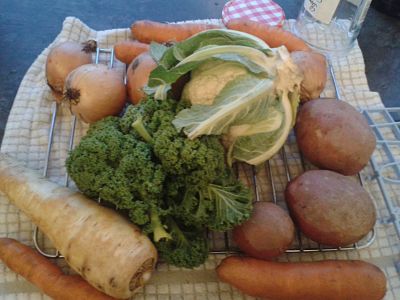
20140116_162313_optVeg Bag Scheme and serving the local community.

When you move to a new city, what are some of the first things that you seek to learn about your new home? Maybe, for you, it’s learning about the best local restaurants, or how to navigate the public transport systems, or where the locals go on that rare treasure that is a sunny Saturday afternoon. Well, when I moved to Edinburgh a year ago, the first thing I wanted to do was find a veg bag scheme.

I know it may sound a bit strange having moved to Edinburgh from the US that my first interests would be in local, seasonal produce rather than the more traditional Scottish culinary delights. However, one thing I have learned in my transition to a lifestyle that is more considerate of the broader impacts and implications of my food choices, is that sometimes you’re going to find yourself doing some things that might seem a bit strange.
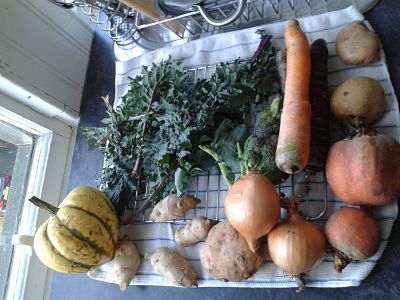
My search for the best local veg bag scheme lead me not only to a plethora of carrots, potatoes and onions (as well as the occasional “mystery root vegetable” that I have no idea what to do with) but also to a great opportunity to help others have access to more sustainable food choices thanks to a student run food co-op at the University of Edinburgh.

Being a cooperative, all of those involved pitch in to run a food stall on campus twice a week during the university terms. At the food stall we sell veg bags that are sourced from a farm outside of Edinburgh as well as local eggs, artisan breads and whole host of whole-sale, ethically sourced dry-goods like nuts, dried fruits, grains and lentils. All of this is offered to students at-cost since the food stall is run by volunteers and there are no operating costs for using university space. The food co-op not only helps give students access to food they might not otherwise be able to afford on a student budget but is also a great example of the powerful contribution that a group of likeminded people can make to their local community through organized service.

Being a part of the food coop has not only stretched my culinary skills (see afore mentioned mystery root vegetable) but has also given me a way to use my desire to eat healthy food to not only serve myself but to also provide a service to others. So, if you, like me, are looking help you wallet and waistline through being part of a veg-bag scheme look no further than your own community as there are shedloads of them popping up all over the UK this time of year as so many foods begin to come into season.

Your local farmers market is a great place to start your search for a local veg bag scheme and the internet can prove quite helpful as well. Most schemes offer a variety of options as to the quantity of veg you get and depending on what has come into season there is always a fun element of surprise as to what you will get. Some schemes will even deliver to your home, others organize central pick-up locations in the community. Some of the more internet savvy farms even have a website that you can use to place your order or find a recipes for your now beloved mystery root vegetable.

Guest post by Ansley

20140206_144544_opt

Posted in Food, Practical low carbon living, Uncategorized | Leave a comment

One thing we have learnt this week – National Climate Assessment

eco-congregationI wonder if the National Climate Assessment a report published by some of America’s leading Scientists will be enough to change sceptics minds, especially I’m sad to say many Christians?

The National Climate Assessment says following;

The observed warming and other climatic changes are triggering wide-ranging impacts in every region of our country and throughout our economy. Some of these changes can be beneficial over the short run, such as a longer growing season in some regions and a longer shipping season on the Great Lakes. But many more are detrimental, largely because our society and its infrastructure were designed for the climate that we have had, not the rapidly changing climate we now have and can expect in the future. In addition, climate change does not occur in isolation. Rather, it is superimposed on other stresses, which combine to create new challenges.

Stresses such as peak oil and rising population I would add that will put huge stress on our food system.

What has changed very recently in the Scientific community is the realisation that the effects of the changing climate is being seen now, not in 20 years time.  In the UK we have seen this dramatically over the last 6 months with some of the worst weather we have seen in winter.

In the US the National Climate Assessment says amongst the effects that are being seen are the drought in California and flooding due to rising sea levels in Virginia and Florida.  In the North East and Mid-West there have been changes in the rainfall patterns with very heavy downpours.  The North East has seen a 70% rise in such events over the last 60 years. (I should add here we were getting such events here in Scotland about 7 years ago, but they seem to have almost stopped now).

Going forward the kind of figures being bandied around for flooding damage in the National Climate Assessment report look insurable, they are huge in Florida alone.  More fires, worse air quality, droughts, floods and lower crop output are all going to be an everyday reality.  Not all Christians are sceptics though and there is some hope with US emissions falling.  A few of us yesterday from church had a meeting and decided to reboot our eco-congregation group.  Lets just hope Obama turns down Keystone XL….

Neil

Posted in climate change, Creation, Food | Leave a comment