One thing we have learnt this week – organic food quality

Isweeds growing in rye field in Wales organic food quality better than non-organic food quality, other than the lack of pesticides?  This question has been raised recently as part of a debate that has raged for years about the health benefits of organic food.  Past studies have suggested little statistical difference, at least in terms of nutrients such as antioxidants, especially for meat1. A recent study does however has claimed to have found statistically significant differences in the levels of antioxidants in plants2. There is some scientific logic to this since the antioxidants tend to protect plants against insect attack. Organic plants had a lower nitrogen content (not surprising since they are grown without fertilizers), but a higher phosphorous content and lower concentrations of the heavy metal cadmium1/2. It should be added that climate change itself maybe affecting the nutrient content of plants. Studies have shown that in some grains, nitrogen iron and zinc content is reduced with higher CO2 levels. Is organic food quality better? It would be nice to think so. We think there are good reasons to eat organic food, but this is not one of them and the science maybe overstated.

1)  http://ajcn.nutrition.org/content/90/3/680.full.pdf+html

2) http://www.theguardian.com/environment/2014/jul/11/organic-food-more-antioxidants-study

3) “Advancing Global Food Security In The Face Of A Changing Climate” the Chicago Council. 2014.

Neil

Posted in Food, Peak oil | Leave a comment

The traditional sources

In my last look at the BP Statistical Review of World Energy data I will have a look at the traditional sources of energy (if you can call them that).  These are hydro and coal but we will also have a look at a new kid on the block, wind.

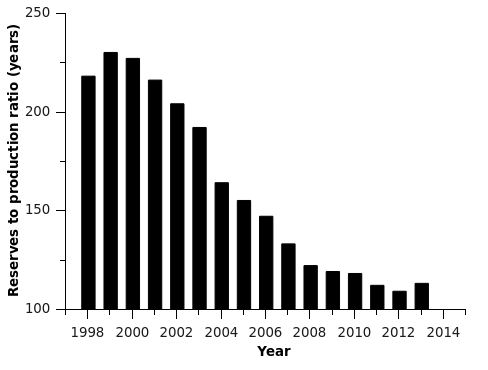
Coal the grubby founding energy father of the industrial revolution makes up 30% of global energy use according to BP.  With the highest CO2 output of any fuel its use is very controversial.  In our book we had a look at the coal supply going forward and noted the data from BP showed reserves had plunged in recent years (there is also a great uncertainty over this data).  It also the case that reserves to production ratio – snapshot look at how much we have left by how much are using overstates how much is left.  This is because production of minerals in the ground doesn’t go at full tilt until they run out, they tend to decline in a bellcurve shaped manner. Surprisingly the coal reserve data has shown a small increase in the last year (graph below).

coal dataIts nevertheless still the case that in just over ten years the coal reserves have halved and relying on clean coal or dirty coal doesn’t look incredibly sensible.

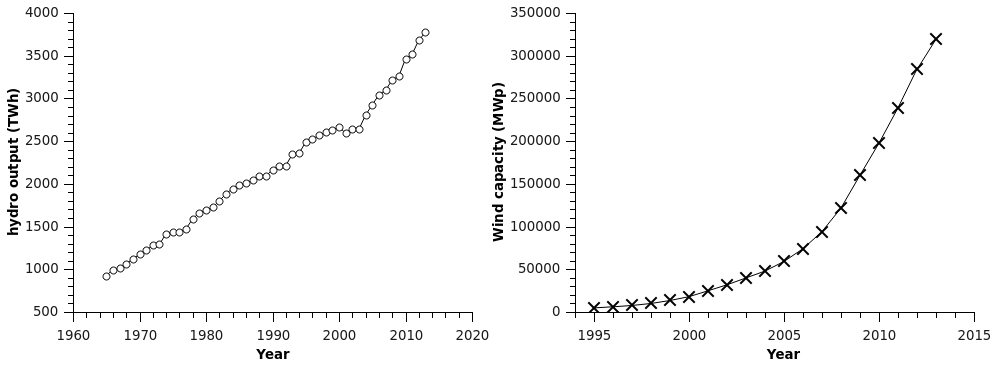
The second of the traditional sources of energy is hydro.  William Armstrong the industrialist had the first hydro electricity plant built on his estate in Northumberland in 1878.  Hydro-power grew rapidly from this point on and in the early days of electricity provided a very high proportion of electric power.  However, for the last sixty years the construction of huge dams is very controversial.  Loss of habitat, visual intrusion, forced movement of people and most recently methane emissions from dams in the tropics make this renewable source of energy not the greenest ever in many peoples view.   Nevertheless the BP data which shows power output suggests a healthy increase in hydro capacity (left hand graph) and hydro produces nearly 7% of the world’s energy, although it was below trend due to output falls in Scandinavia and Brazil.  There is also more scope for more eco friendly hydro power in the shape of small (>10MWp), micro (>100kWp) and pico (5kWp).   These smaller schemes generally don’t use dams (or only small ones) and can built to be fish friendly.  Whether the data below shows only the large capacity hydro or includes the smaller schemes is impossible to say.

hydro and windFinally wind capacity grew by over 12% over the last year but unlike hydro the growth rate is slowing, the most recent years growth fall is blamed on the US, but the trend is down over the last four years.  Is this a backlash against onshore wind or some other reason such as competition from PV?  Onshore wind is the cheapest renewable and almost competes with natural gas in Europe so this slowdown is surprising.

Neil

Previous posts in this series can be seen here and here.

Posted in climate change, energy costs, other, Peak oil | Leave a comment

One thing we have learnt this week- what electric car owners do while we sleep.

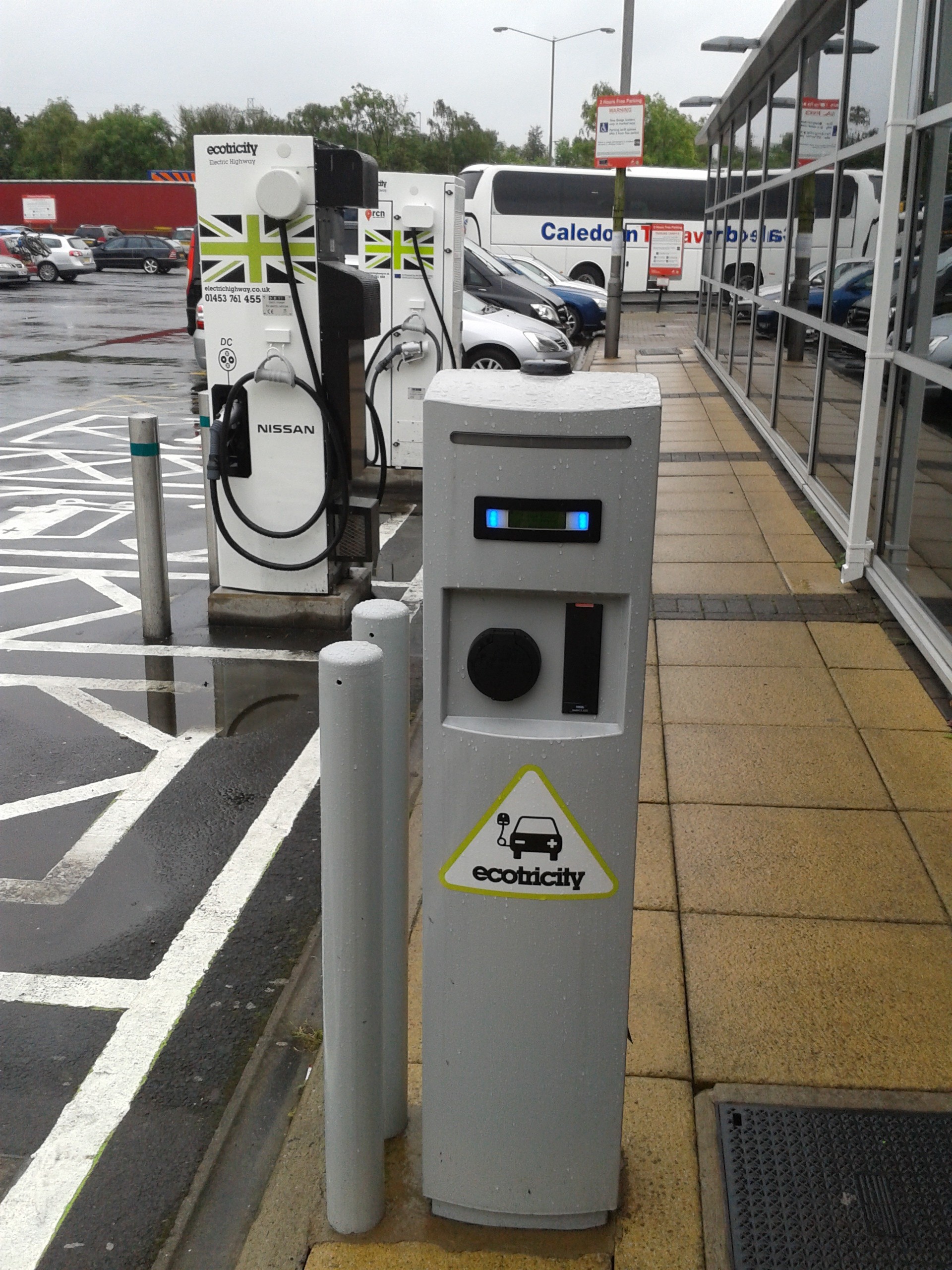
2014-06-28 11.42.29What electric car owners do while we sleep could have profound implications for the grid and our energy use patterns and the practicability of electric cars.  We covered electric vehicles in our book and its fair to say we have our doubts, not only since it would be nice to have less cars on the road but also due to the amount of extra generating capacity that might be required to feed the cars (amongst other concerns).  One thing we did not consider except in passing was when people would charge their cars.  This what an energy information company in the US has done with data from Tesla sports car owners.  There are not a huge number of electric cars on the road but there are sufficient now to draw some tentative conclusions on how it might change our patterns of energy use if they do break through.

  • The first is what electric car owners do while we sleep is use a lot more electricity than the rest of us to charge their cars.  This is because they can get cheap rate electricity to do so.
  • The second finding is that they are more likely to have solar PV.
  • The third is that they use more electricity even during the day than other users who do not own electric cars. (They are more wealthy than those without so this might explain some of this difference).

The first and last findings are worrying.  Its pretty obvious why people are charging their cars at night even if they have solar PV.  Having spent a large amount on a car they are using it to drive to work (you can see their point).  The author of the blog linked to above thinks this night time demand is not an issue, I beg to differ.  The usage is much higher than for those without and the biggest peak of the Tesla owners day.  In a traditional grid in which some capacity (such as nuclear) has to be keep running constantly.  Some night time demand is therefore useful and in the UK is used for heating (night storage heaters) and to refill pumped storage schemes.  But we are heading for a new type of grid with a large amount of renewables when their may or may not be excess power (these supply differences can be ironed out by energy storage but that is another issue).  The problem is that based on the data given here if electric cars really take off, night time will become the time of peak electricity demand.   This may or may not be manageable but its very different from the moment when we have a peak at breakfast time and the biggest peak in the evening (5pm) -at least in the UK.  We could end up  with three very large peaks in demand.  The third slightly inexplicable finding was also worrying, could electric car use push up demand for electricity at other times?  If this is true we would need even more grid capacity.

What electric car owners do while we sleep could be an issue for us all in the years to come as numbers increase.  More research on energy use is urgently needed with electric car owners in different countries and different brands to see if the findings above are replicated.

Neil

Posted in Uncategorized | Leave a comment

latest global energy data

In a previous post I had a look at the latest global energy data from the BP statistical review of world energy 2014.  This revealed disappointingly that most energy was still coming from the four traditional energy sources.  The renewable energy output was still a small component of the stacked bar, although solar does now show up in its own right if you zoom in and look closely.

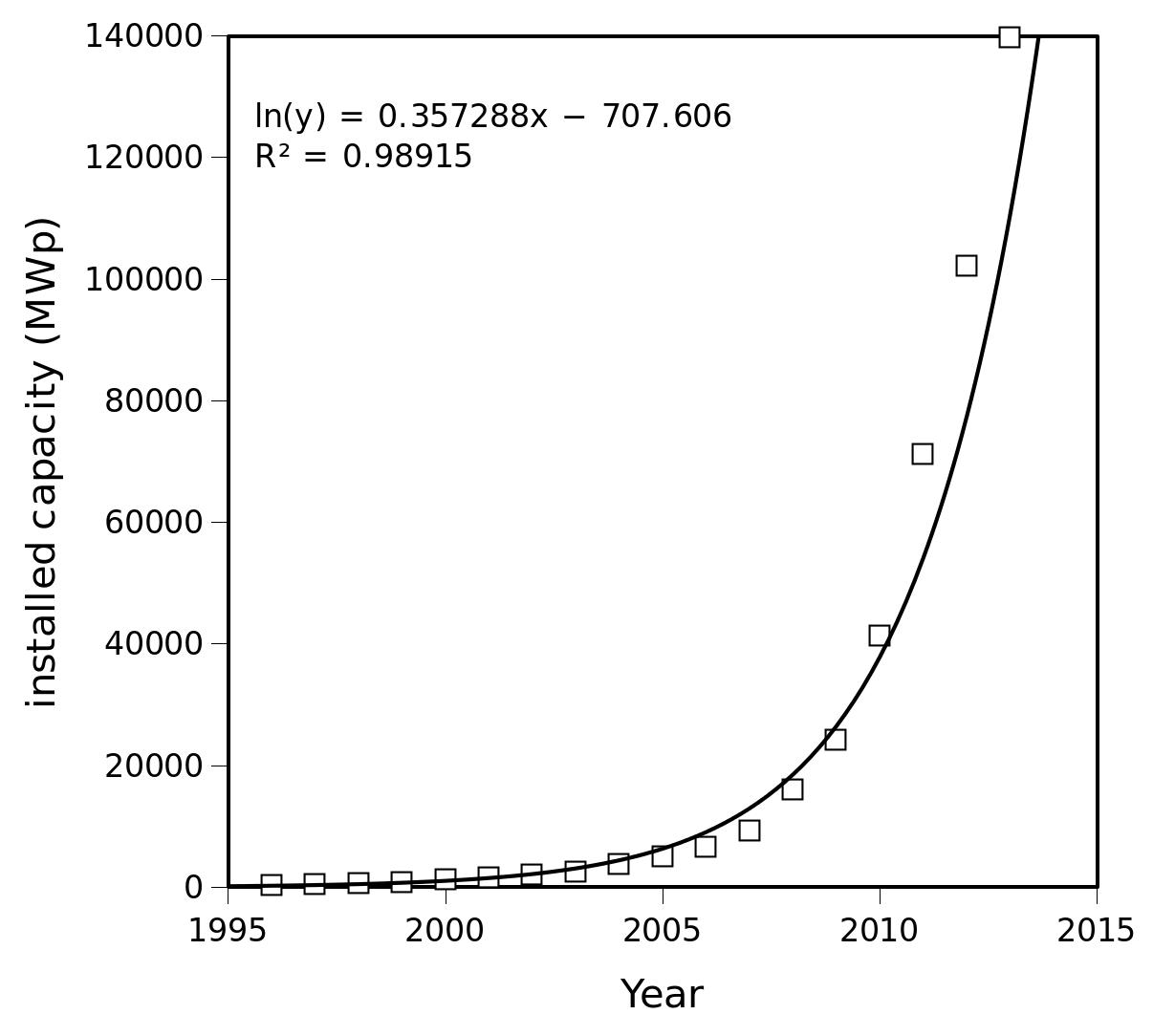
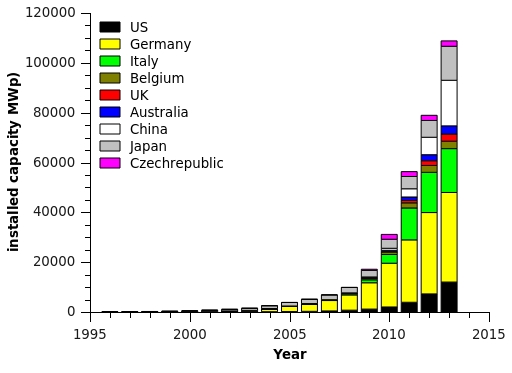
However when you look at the renewables within that latest global energy data its more encouraging.  Looking at the total installed solar PV capacity worldwide its obvious solar is in experiencing exponential growth, which is the fit I have made in this first graph below.

pv capacity global 2014

Picking out some of the individual countries with the most rapid growth provided further encouragement (second graph).

pv capacity in selected countries 2014 Apart from the main one (Germany), other countries stand out.  The US is undergoing strong growth.  Since the nuclear shutdown in Japan in 2011 this country has over doubled its capacity.  For all the talk of China being the world’s largest polluter its making huge strides in renewables and is now the worlds largest PV market.  The performance of some of the smaller countries is very impressive with Belgium and the Czech Republic having enormous installed capacity for their size.  My country has also has done very well.  In fact the data for the first quarter of this year (not included in the graphs) there was record PV installation. Renewable electricity output reached a record in both the UK and Germany (in May almost 8% of the UK’s electricity was coming from PV one day).  The latest global energy data shows a along way to go, but does offer some encouragement.

Neil

Posted in Uncategorized | Leave a comment

One thing we have learnt this week-recycled or not

00005_optWhether something is recycled or not is moving up the agenda again this week as the EU sets a 70% recycling rate. As I wrote a few weeks ago this will be a particular challenge in the UK where recycling rates have stalled. Germany and Austria are nearly at this target being in the low sixties. Something else I discovered is that much of what is recycled in the UK is returned to use as a lower quality product. So there is me thinking all the glass we recycle is used to make new glass, which seems rather obvious, but much of it is apparently used to make roads. However, some glass and plastic is used to make insulation as is plastic bottles which does not seem such a bad use.

We wrote in our book;

As we wrote in an earlier chapter, one of the biggest problems is
our dependence on oil to make ‘stuff’, principally plastics but also
chemicals and pharmaceuticals. The replacement of these products
with alternatives derived from natural materials relies on scientific
research which has (worryingly) barely started, so actions in this area
are more limited. However, as we believe we will all have to do with
less than now, there are habits to be formed.

I guess our Eurosceptic so called greenest government will be forced to go along with this EU directive, although they are resisting at the moment. One of these habits has to be to learn to use less then it does not matter so much if its recycled or not.

Neil

Posted in Book, One thing we have learnt this week, recycling | Leave a comment

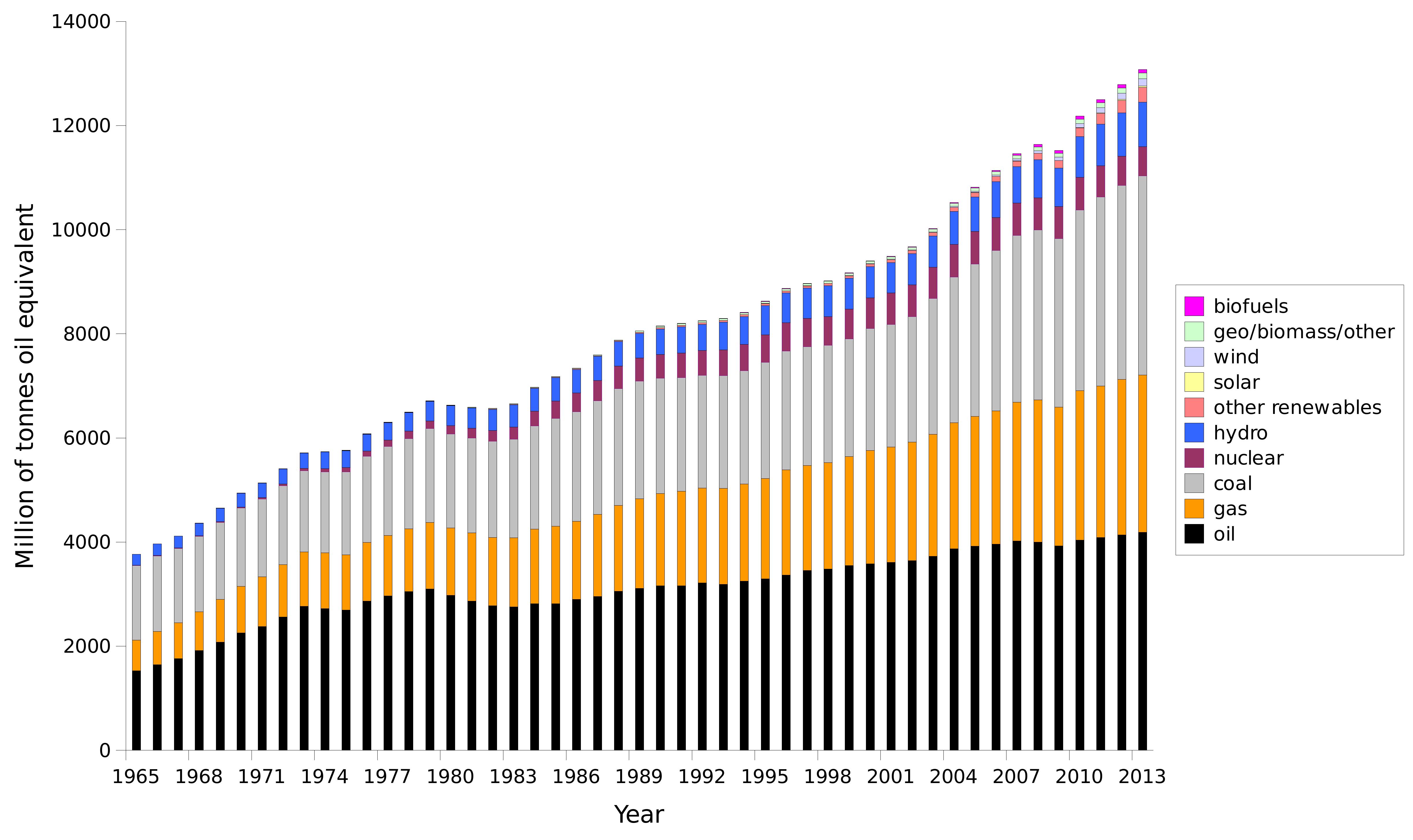
Relentless rise in energy consumption

The latest BP Statistical Review of World Energy shows the world is continuing to undergo a relentless rise in energy consumption.  If anything the rate of energy consumption is increasing.  The only time in recent years this relentless rise in energy consumption has abated was in 2009 the year after the global economic crash.

bp energy data 2014The latest data also shows that depressingly most of our energy still comes from oil, gas and coal.  The consumption of coal, gas and oil is still growing, although the consumption of oil is slowing relative to the others.  The renewable sources are at the top of the graph.  But for example for all the talk of solar power its numbers are all but invisible.  The only major renewable is hydro-power which is not always climate friendly.

We have a long way to go to reach a sustainable climate friendly energy system and little time to achieve this.  How much more the global climate and stocks of fossil fuels can cope with this relentless rise in energy consumption is open to conjecture.  The BP data takes no account of rising consumption. We simply have to learn to use less energy and are finding it hard to do so.  It seems likely that this is a lesson that will be foisted on us by a crisis.  In a separate blog post I will look at the renewables data.

Neil

Posted in climate change, energy costs, gas, Peak oil, Renewables | Leave a comment

One thing we have learnt this week- pesticides are risking our food supply

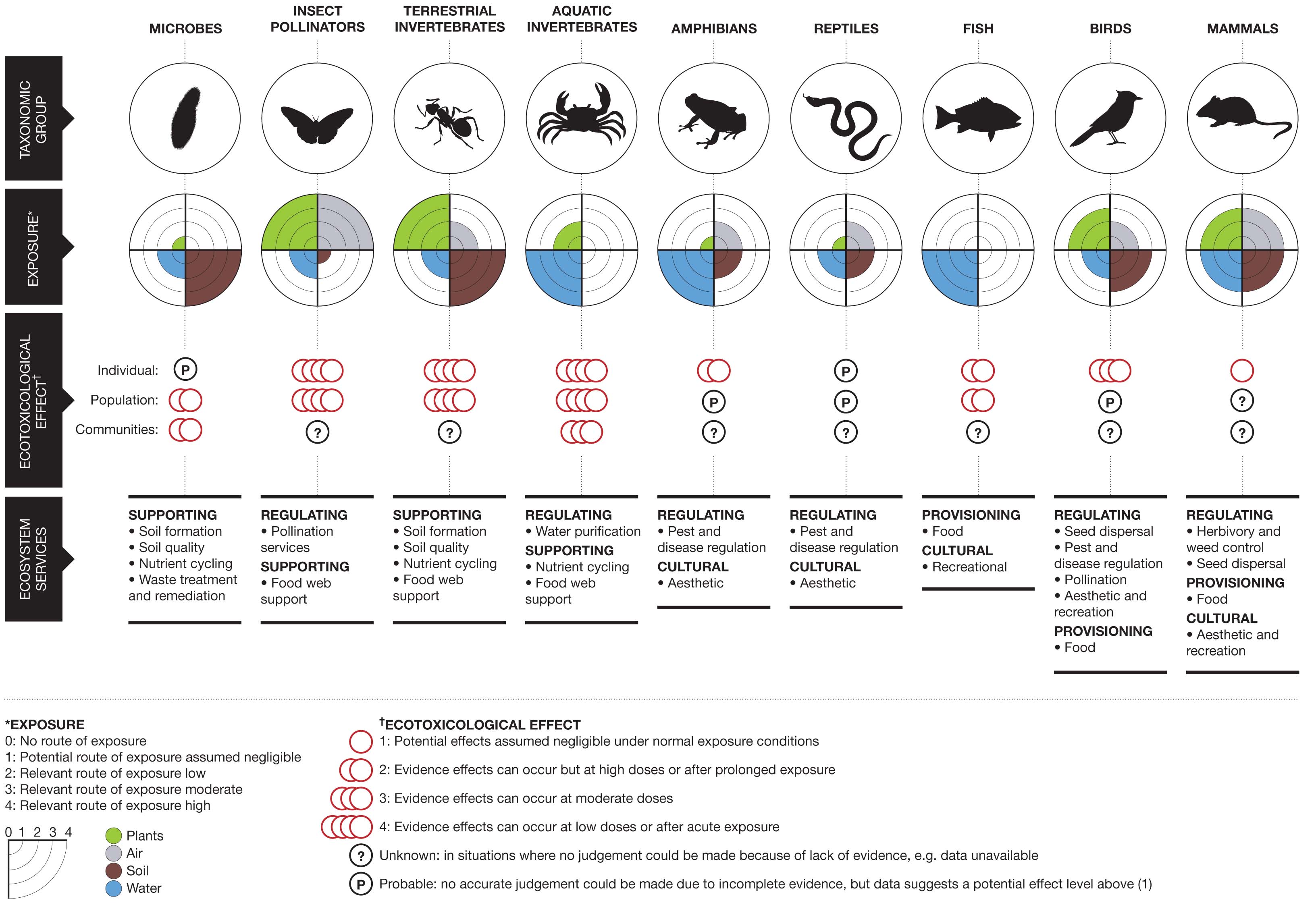
TFSP_infographic_artworkAccording to a new report this week pesticides are risking our food supply.  The researchers say that everything from soil bacteria to bees are being harmed by our excessive use.  We are reliant on bees for 75% of fertilisation of the worlds crops.  We rely on earthworms to improve and maintain soil structure.  Both are being put at risk say the authors since many pesticides such as neonicotinoids and fipronil are being added to seeds routinely.  This means that a variety of creatures come into contact with them, not just bees.  There is almost no data on the toxicity to wildlife of these chemicals.

Its ironic that something we think we need to produce food these pesticides are risking our food supply.  There is another problem of course, that is these chemicals are all oil derived.  We are running out of oil, in the short to medium term this means chemicals and therefore food costs will rise.  In the long term it means doing without which many claim agriculture will struggle to do.  I’ve seen the problem lack of bees can make this spring (this time weather related), with small crops of apples and broad beans on the way.  If  really pesticides are risking our food supply maybe we should start seeking alternatives to them now.

Graphic above from the group that produced the report which can be found here.

Neil

Posted in Creation, Food, One thing we have learnt this week | Leave a comment

Peak gas

Have we reached peak gas? By gas I mean natural gas, not petrol in the US parlance.  Every year in June the BP Statistical Review of World Energy is published.  For those of us interested in energy it makes fascinating reading.  Last year the shocking bit of information was that global gas reserves had fallen for the first time ever.  Something that the report produced with the data did not highlight.  So it was with great interest I downloaded the spreadsheet this year.  As the graph below shows natural gas reserve figures have risen but only a tiny amount.  To be fair its early days but this is beginning to look like peak gas.

gas reserve data 2014Source BP Statistical Review of World Energy 2014

As we wrote in our book about peak gas.

Where does this leave us? It is very hard to come to definite conclusions about gas with so little data on reserves to draw on.

This has never seemed so true, after I plotted the above graph I noticed there had been a previous fall in 2008-9.  Had I missed this last year?  No when I went back to last years data I discovered it had been revised.  So looking the figure for the year 2000 this is 156.78 TCM in the 2009 data, 154.25 in the 2010 data, 168.5 in 2011, 154.3 in 2012, 139.7 in 2013 and 139.2 today.  Confused, your not the only one! and when I find out what’s going on I will let you know by the books Facebook page.

However, to go back to the main point this is beginning to look like peak gas.  Two last points, the data does take into account shale gas, the US reserves have been rising steeply.  Lastly the increase in reserves was 0.2% 2012-13 and consumption rose 1.4% in the same period.  I don’t need to emphasise to regular readers of this blog or our book how vital gas is to energy, chemicals and agriculture.

Neil

Posted in Book, gas, Peak oil | Leave a comment

One thing we have learnt this week- Iraqi oil

Oil and particularly Iraqi oil have been in the news this week. Of course first and foremost what is happening in Iraq is a humanitarian crisis.  Up to half a million Iraqis have fled the fighting, although there were reports of people beginning to go back to Isis controlled areas.  Of course they may not like what awaits them.  People who live under strict Islamic law tend to resent it pretty quickly.

We mentioned the Arab Spring in our book.   We wrote (and it seems very apt to say so now);

The whole “Arab Spring” has been totally unpredictable so far but one possible scenario is that the civil war in Syria spreads to its neighbours (Lebanon and Iraq) and then beyond and becomes a general conflict between Shia and Sunni.

We went on to write;

Whilst Shias are a minority overall in the Middle East they are very widely dispersed. In Iraq they make up a majority and there are large populations in the Gulf States and
Saudi Arabia. This scenario whilst looking relatively unlikely would lead to very major fossil fuel supply disruptions.

This no longer looks so unlikely.

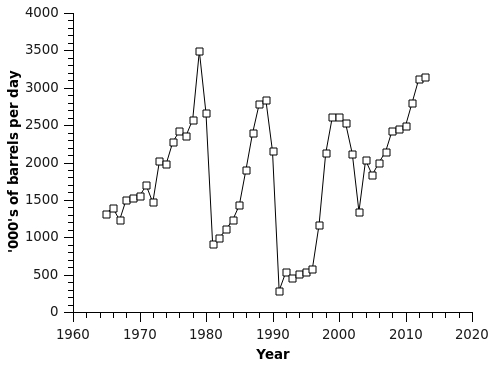
If the invasion in 2003 was about oil it has been modestly successful.  The graph shows production as far back as the BP Statistical Review of World Energy allows.

iraqi oil productionThe IEA world energy outlook 2012 makes it plain that we are relying on Iraqi oil production going forward.

Without this supply growth from Iraq, oil markets would be set for difficult times, characterised by prices that are almost $15/barrel higher than the level in the New Policies Scenario by 2035.

Disruption to the Iraqi oil supply seems certain although it has had little impact on the price of oil so far.   But OPEC may have to increase production to make up for loss of Iraqi oil and the lack of oil coming out of Libya.

The whole situation is a huge mess and we have reached the stage where there probably is no solution (in human terms) and Isis are definitely waging a sectarian war against Shia who they regard as infidels. A link to some more background on the situation is in this previous post I wrote.  Here are some suggestions on what we should or not do.

  • The current shape of the middle east is based on the Anglo-French Sykes-Picot line drawn up in 1916.  Whilst the lines on the map took no account of the religious or demographic differences it still seems to me better for countries to hold together.  There is almost always trouble when they split up.  The demographic/religious composition is likely to be more complex than 1916 anyway.
  • This means that the Nouri al-Maliki government has to go and be replaced with a government with Sunni’s in.  Bombing Isis, whilst tempting, will mean we have taken sides unless this happens first. Even then I’m very wary about he idea.
  • I don’t think the situation has been entirely caused by the Anglo-US invasion.  Its impossible to say for sure but it seems unlikely that Saddam’s regime would have escaped the Arab Spring (there were regular rebellions against his rule).  The Iraqis have also had enough time and freedom to make their own mistakes (which they have).  This has more to do with Syria than Iraq.
  • We need to stop interfering in this region (because of oil) and largely leave the governments alone.
  • We do however need to stop this becoming a war between Sunni’s/Shias, and I say this as a Christian! The two groups exist throughout the middle east and Asia and this could be a major humanitarian disaster with disruption not just to Iraqi oil.  Its very difficult to see negotiations with a group as extreme and unpleasant as Isis.  There is a valid argument that Saudi Arabia and Iran are fighting a proxy war in Syria and now Iraq.
  • We need to get off oil ASAP, it causes no end of trouble, environmental and social.
  • Create good relations with Iran and reach a nuclear deal. We need peace, peace, peace.  Pray for it.

Neil

PS. There are enough keywords here for the NSA to find this post interesting, if you have read the text guys you are going to be very disappointed.  However, can I suggest you buy a copy of our book you might actually learn something….!

Posted in Book, energy costs, Faith, One thing we have learnt this week, Peak oil, Transport | Leave a comment

train and bike travel

pilgrims way holy islandWhen I wanted to go away to for a romantic break to celebrate my birthday I jokingly suggested to the other half we got there by train and bike travel only.  Its been a long time since I have taken my bike on a train.  The last time was when I went on a local train to visit someone in the country who used to go to my church to see their eco-house.  There were no issues that time.  I used to have a friend in our church homegroup who used train and bike travel to get to work. He did have some issues.  In Scotland on local/regional trains space is limited and its first come first served (although bike spaces can be booked)*.  He and others who regularly did the same on the same train organised themselves to put their bikes on in a certain order, so they could get them off in the right order.  But there were days when he could not get his bike on.

We also used train and bike travel in France, but on French Railways bikes do not necessarily travel the same day as you (we had to wait to the next day to collect our bikes).  At the time they hung them up by holes at the end of the front forks as well, and damaged mine.  Eurostar have unfortunately copied this idea and also annoyingly will not take bikes part route (London to Paris – no problem, London to Calais no can do).

It was with mild trepidation then when my spouse agreed and looked into the train and bike travel.  The UK’s train services being privatised there was more than one company we could have used.  On one the bikes travel free and the other you pay a bit.  We chose the one that wasn’t free since we felt there was more space on the train for our bikes.  There was also another complication, the tides.  We were going to train to Berwick upon Tweed and then cycle to Lindisfarne.  This involves cycling across a causeway, so we needed trains that fitted in with that.

The process of train and bike travel was easy without issues.  All the stations had lifts for us to get our bikes too and from the platforms.  The staff at Edinburgh and Berwick were helpful and expecting us.  There are “Sheffield” type racks in the guards van which you strap your bikes to.  At either end the staff lifted our bikes off for us.

The biggest downer was cycling along the A1 which was very busy, although I think there was a cycle route that could have avoided this.  We also had a puncture caused by a thorn from a Hawthorn, although this did not affect us on route either way.  Altogether very easy and we had a good weekend.

Neil

* its only this way since the Edinburgh cycle pressure group (Spokes) staged a lie down protest at Waverley Station many years ago.

Posted in Cycling, Lifestyle, other, Practical low carbon living, Slow living, travel | Leave a comment