One thing we have learnt this week- Balcombe is going carbon neutral

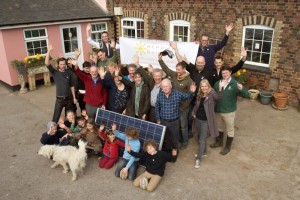
repower-balcombe-group-panel-banner-waving-1000You may remember last summer the village of Balcombe was in the news rather a lot because of fracking.  In actual fact there was controversy over whether Cuadrilla were really fracking at Balcombe but in any case the village became the poster child of the UK’s nascent anti-fracking movement.

The news agenda moves on but thanks to CAT I was made aware this week that Balcombe is going to aim for carbon neutrality.  This is a great positive news story and one I’m only too happy to share since both this site and our book takes a dim view of fracking.

The idea is that the village will aim to generate around 10% of its needs through solar PV over the next few months.  A cooperative has been set up and shares will be issued to all members of the public, although only local Balcombe residents will have voting shares.  Panels will be put on both community buildings and private property.  The returns of at least 5% pa will be paid to investors and used for other community benefit (such as insulation).  This is exactly what Fintry and Gigha have done in Scotland.  Both have used the money generated from wind to improve energy efficiency in hard to heat homes off the gas grid and fit micro-generation such as solar hot water.

Details of the next stage are vague but the organisation 10:10 and others are going to help Balcombe move forward.  More details of the scheme can be found here.

Neil

Posted in energy costs, Fracking, gas, One thing we have learnt this week, Renewables | Leave a comment

Food costs

Bramley apples from Neil's tree

Bramley apples from Neil’s tree

With all the fuss over energy prices and energy security another aspect of oil dependency that of food costs gets forgotten.  That’s why I was so pleased to see a documentary on food costs on channel 4 over the last few weeks.  This a review of the second programme with some comments by me.  It followed the format of the first looking at some key foods which raise some key challenges for the global food system going forward.  This week Jimmy looked at corn, eggs, pork and coffee.

Corn (maize)

Corn is one of the worlds most popular crops.  Used as animal feed and to make maize flour as well as corn on the cob, its price has rocketed from £88/tonne to over £200 in the last 10 years.  There is no shortage of production to blame this rise on.  The culprit is biofuels.  96% of petrol sold in the USA contains 10% bioethanol.  40% of all corn grown in the US is now used for biofuel production at a yield of 2.8 gallons per bushel.  When oil prices are high it makes sense to use corn to make biofuels as a petrol substitute so the price of corn rises.  Of course corn is also used as animal feed and this has pushed up the prices of eggs and pork.  This is a classic dilemma which as occurred in agricultural history, do we eat or use our land for some other than food use?

Eggs

In 10 years we have seen an 80% rise in the price of eggs.  After the war and the end of rationing UK egg demand surged and so did prices.  Farmers developed battery farming which slashed egg  prices.  However the practice was regarded as cruel and after a long campaign the EU in 2012 banned factory farming.  Colony farming was introduced.  Colony farming gives the birds a bit more space and they live in smaller colonies of birds.  Although this to me looked unacceptable in terms of contact with the outside world and the space the birds had to move around in, its still factory farming.  This is one aspect of recent price increases.  The other is feed costs (see above).   Yet another that was not mentioned in this context was energy prices, battery farming was very energy intensive.   However, one possible solution was shown in the US.  In Illinois farmers are using old fashioned small farm diversified techniques.  By mixing cattle and chickens the farmers hope to keep rices down.  The cattle keep the grass short for the chickens and the chickens fertilize the grass for the cattle.  By using varieties of chickens that are good at foraging less feed is used.  Less feed means the price of eggs are less dependent on the global feed market keeping food costs down (eggs are used in so many foods).  Jimmy didn’t think this could compete with factory farming, I think he is probably right.

Pork

Pork at £5/kilo10 years ago is now over £7 a kilo, although farmers in the UK have not seen all the benefit of these increases.  Jimmy at this point headed for Taiwan.  Taiwan influences China and the demand for pork has rocketed 210% since 1970’s in this country.  China now eats an astonishing 50% of the world’s pork.  Of course pigs need to eat and China and Taiwan now buying vast quantities of feed.  One feed is soy, soy prices have from 200 dollars a tones to over 500 today, pushing up the price of this staple.  Jimmy spoke to one pig farmer in the UK who like for beef last week thinks pork will become a luxury even in the West.

Coffee

In 15 years demand has risen 450%.  Everywhere coffee is seen as a sign of  civilised living.   Ethiopia gave the world coffee and its here Jimmy went next.  Ethiopia is the 3Rd biggest producer in the world by means of small organic family farms.  One of the problems is the Arabica coffee plant is a weak plant and is prone to die of diseases.  One fungal disease “coffee rust” is a huge problem.  In 2011 the disease struck in Colombia, that and huge demand sent prices through the roof but climate change is also causing weather related issues and helping the spread of another pest the coffee borer.  Climate change is having such an impact that Ethiopia my not be able to grow any coffee at all.

The programme ended on a cheery note that hopefully something will crop up (no pun intended) to help keep our food costs down but one positive spin off was it might make us think more about where our food had come from and how it reached us.   This was one weakness of the programme that not many solutions were advanced.  Governments around the world fret about energy costs but not food costs.  Is this because they have less direct control?  I don’t know but over the next few months this blog will be returning to this issue and trying to find some solutions to the issue of food costs.

Don’t forget our No oil in the lamp – Lent guide which has some ideas on food.

Neil

Posted in climate change, Food | Leave a comment

One thing we have learnt this week-Libya is on the brink

While attention in the news is quite legitimately on Crimea and MH370 the country of Libya is on the brink of something very nasty.  The latest from Reuters today is that Rockets have been fired at Tripoli airport. To give an update of what has happened over the last week or so.  Rebels seized a ship loaded with oil in Cyrenaica.  The Libyan navy is at the bottom of the Mediterranean  due to Nato action in 2011.  The airforce was in open revolt and it was left to the US navy to seize the (North Korean) ship back and return it to the Libyan government who the oil belonged to.  At the same time the Prime Minster fled in a private jet.  There is a real threat that the country might fall into civil war and break up.

Does that Libya is on the brink matter?  I think it does for three reasons.

  • First, there is a humanitarian issue.  In Syria we have seen a huge humanitarian crisis that we have not been able to solve.  At least one hundred thousand people have died, many of them women and children.  Do we really want to see more carnage?  Is that a Christian response?
  • Second, we will have a refugee crisis much closer to Europe.  The Syrian crisis has been appalling with 2million plus people displaced.  Libyan will want to go to Europe which will cause all sorts of ructions.
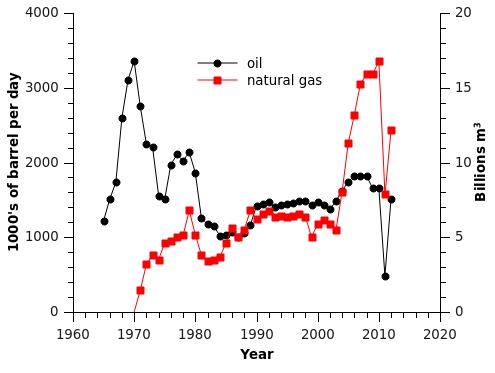
  • Lastly the raison d’etre of this blog, energy security.  The graph below shows the oil and gas production for Libya (source BP statistical review of world energy 2013).  The Italian gas network is supplied by Libya, but ultimately the whole EU gas network is one (with the UK on the end with very little gas storage).  With relations with Russia getting worse by the day and the Russians very willing in the past to use energy supply disruption as a political weapon, this is another reason for us to do what we can to help Libya.

Libyan oil and gas production

As we wrote in our book at the end of the section on the “Arab Spring”;

This is where we are in the unfolding story of oil: dangerously dependent, with a finite supply, and a host of uncertainties to boot.

What can we do?  Western governments need to try to get the Libyan groups talking and encourage the disarmament of militias.  They also need to do everything they can to build civil society and encourage the central government not to be too heavy handed in its dealings with regional groups.  Not easy, or certain of success, but we have to try.  Contact your representatives and pray.  At the same time we need to get off fossil fuels using energy conservation and renewables.  Our lent guide will help you do this No oil in the lamp – Lent guide.

Libya is on the brink- it does matter.

Neil

Posted in energy costs, One thing we have learnt this week, Peak oil, Uncategorized | Leave a comment

Food prices

rice“Food prices; the shocking truth” was a programme broadcast on channel 4 with Jimmy Doherty presenting.  Jimmy Doherty is a pig farmer based in Suffolk my co-author Andy pointed his farm out as we were on the way to London on the train to meet with our publisher.  In recent years he has become one of these media farmers a bit like Adam from “Countryfile” on the BBC.

The programme started by looking at the situation we are starting to get used to – rising food prices.  In 1950 we spent in the UK about 36% of our income on food, by 2008 this was down to 10% as food prices fell.  Now its about 20%.  After giving some examples of the increase in prices of some staples Jimmy asked the fundamental question.  Are we being ripped off by the supermarkets or producers or are more bigger forces at work and are food prices going to keep on rising?  Has this era of cheap food due to our industrial food system come to an end?

The programme focused in on four staple foods.  Rice, beef, bread and chocolate.

Rice

Looking at specific foods Jimmy gave some really amazing statistics.  For example Rice is the staple food for almost 50% of the global population and 718 million tonnes a year is grown.  Its now grown all over the world but one of the biggest exporters is India. The green revolution doubled production over last 50 years and there is no shortage.   Despite this in 2008 the price rocketed to an all time high.  The reasons why according to Jimmy were very surprising to me.  The Indian government spends a whopping 20 billion dollars in Indian subsidy to the poor (900 million) to help keep food prices low.  A wheat short fall in this year caused Indian government to buy more rice at same time as the demand rose elsewhere. The Indian government banned exports. Other countries followed suit. Since then the Indian government stockpiles rice which has led to permanently higher prices.  A different idea from free trade is now the rising idea of “food sovereignty”.  If countries restrict exports we could be in trouble with rising food prices.

Beef

The price has been rising, 70% for mince alone over the last decade in the UK. 85% of Beef consumed in the UK is British.  Jimmy cited three reasons for Beef price increases; fuel, fertilizer and feed. “Food prices” then turned its attention to the oil dependency of agriculture something we have discussed in our book.  A farmer interviewed on “Food prices” said diesel costs had risen from 20p per litre to 70p per litre in 10 years.  Fertilizer costs had also risen an astonishing 350% in the last 10 years due to increasing gas prices.  There was more pressure on prices due to growing demand around the world. One British man Alan Savory in the US has an idea to break this dependency. Grazing cattle on open land but optimising where cattle graze by planning on maps and using them to fertilize the soil he claims increases production 300-400%.  This struck me as a very traditional solution and way of farming we have lost due to our oil dependency.

Bread

“Food prices” turned its attention to another staple – bread.  Fuel costs above have had their effects on the price of bread which has rocketed, but climate change entered the programme here.  2012 had a disastrous effect on our home-grown wheat production.  But climate pressures are cropping up everywhere.  In 1900 the USA produced 14-18 bushel er acre.  Now its 3 times as much.  However severe drought in the US and elsewhere such as Russia is affecting production.  Another long term issue is that the aquifers in the US are running dry. India and China and Saudi Arabia have the same problem with water supply.  Yes you did read that right Saudi Arabia grows wheat!  Not for much longer though they have run out of water.

Chocolate

According to “Food prices” the British chomp their way through an amazing 1800 tones per day. Cacao prices soared by 80% from 2008.  One way manufacturers have coped with the rising prices is by shrinking the size but at the same price per bar- cunning. Demand for Cacao is however outstripping supply.   “Food prices” travelled to Ghana one the worlds largest producers to find out why.  Part of this due to climate change, but also badly paid Ghanaian farmers are leaving Cacao production.  One thing that surprised me is that the Ghanaian government controls their farmers prices of this commodity, meaning they may not always get a fair price.  Speculation on the futures market is also having an effect. In the last decade the investment banks have entered the food speculation market. This speculation may cause extremes in prices (both and high and low).  The EU worried by this is looking to introduce controls on futures speculation.

So there we have it, an interesting programme on the issue of rising food prices.  Part two is next week which looks at issues around some more staple foods.  I think pork and coffee? and some solutions.  There were a few weaknesses in it which I hope will be addressed next week.  Rising population, the idea of eating less particularly dairy and meat are some issues which were not mentioned at all.  Also as a general point he tended to treat the reasons behind the price increases in food in isolation which I don’t think you can do with climate change and food’s oil dependency.

Our lent guide is available here No oil in the lamp – Lent guide.

Neil

Posted in climate change, Food, gas, other, Peak oil, Reviews | Leave a comment

One thing we have learnt this week – power from the people

Solar PV on my roofThis week there have been two examples that I have learnt about of power from the people.  In the first two Germans, Arwen Colell and Luise Neumann-Cosel have set up a not for profit company to buy Berlin’s electricity grid which apparently comes up for sale automatically every 15-20 years.  Whilst the debate on the German energy system is centred on rising costs due to renewables, the phase out of nuclear and coal fired power, these two think everyone is missing the point.

The government and energy utilities are focused on generating capacity but the local distribution grids are the final common pathway. They need to shift from just being the last mile between a huge power plant and the consumer to being a smart, decentralised and adaptive structure.

Everyone that invests get an equal vote but will share in the profits depending on how much they have invested.  It remains to be seen whether they will be successful in purchasing Berlin’s grid.

Meanwhile closer to home Nottingham city council is going to have a go at power from the people.  It has announced its setting up its own energy supply company.  Run on a not for profit basis it will launch next year with a high street shop and a call centre.  It hopes to shave £120 off the average bill.

Both groups are working on ideas that if successful could disrupt our established energy system.  Watch this space….

We have a lent guide to download here No oil in the lamp – Lent guide.

Neil

Posted in One thing we have learnt this week | Leave a comment

No-Dairy February

swiss supermarket yoghurt sectionThis year, we set ourselves three month long challenges- the first of which was “no dairy February”.

In the West, food makes up the biggest part of the average carbon footprint. Over the last few years my husband and I have been trying to adapt our diet to a more low carbon one. We have greatly reduced our red meat consumption, which is now almost entirely limited to locally sourced, wild venison. The next biggest culprit for carbon emissions in the average diet is dairy. There is about a kilogramme of carbon released into the atmosphere for every litre of milk we consume. For cheese it’s over a kilogramme of carbon for every 100grammes. Several years ago we switched from having cereal for breakfast to toast with margarine, in an attempt to reduce the amount of milk and butter that we bought. But cheese, cream, butter and yoghurt were still a big part of our diet. So for this February we decided to see whether we could go without.

Fortuitously, Waitrose happened to be doing an offer on Almond milk that month so we did enjoy some milk equivalents and ironically went back to eating cereal for breakfast. We avoided soya as that can be as ethically dubious as milk. My staple lunch had been cheese on toast but for February I changed to vegetable soup. I discovered that risotto still tasted fine if you left out the cheese and cream, and that the best dark chocolate is dairy free. But we also found that most biscuits and baking were off the menu.

We did both have a couple of minor accidental lapses, and one mutually agreed one when a friend took us out to dinner and we felt it would be rude to be fussy (and it was a very nice restaurant). But other than that we lasted the course. Friends were quick to point out that we had chosen the shortest month.

The biggest challenge for me was drinking black tea and coffee. My vegan sister-in-law told me that I would probably learn to love it, and never want to go back to white coffee. But it was what I missed most, and would have been the first thing back on my menu had it not been for the fact that we woke up on March the first in a remote bothy in the highlands, a day’s walk from the nearest shops, and no, we hadn’t carried in a pint of milk. We had however carried in a Camembert that our friends had given us, and I am also eternally grateful to the person who left the Boost chocolate bar on which I broke my dairy fast.

Now it’s March and I’m back on white coffee and cheese, but we are using less, and we have bought more milk alternatives to eat with cereal. Also with the first challenge month over I feel ready to face the next one set for May (watch this space for the next corny rhyming challenge).

Guest blog by Ruth

S don’t forget our lent study guide No oil in the lamp – Lent guide

Posted in climate change, Food, Lifestyle, other, Practical low carbon living, Slow living, Transition | Leave a comment

One thing we have learnt this week – growing low food miles

farming-underground-550x366How in the middle of a major city do you cultivate low food miles?  By growing underground that’s how.  Michelin-starred chef Michel Roux Jr is now involved in what sounds a crazy scheme.  In fact that’s what he said when he met Richard Ballard and Steven Dring who have been working on the idea for the last 18 months.  According to an interview in the Evening Standard newspaper he was quoted as follows;

When I first met these guys I thought they were absolutely crazy. But when I visited the tunnels and sampled the delicious produce they are already growing down there I was blown away. The market for this produce is huge.

As we wrote in our book.

The resource constraints that the world is facing will
mean that industrial agriculture in its present form will inevitably
falter and fail – and in fact it never did feed the world adequately
anyway. We are all likely to be eating more locally in the future. But
if we don’t plan for the changes that will happen, many of us will
have to eat less.

What we didn’t envision was people would be carrying low food miles food up stairs from an underground den!

There are apparently loads of abandoned tunnels under London and this project uses tunnels last used during the blitz.  They have started growing small amounts of herbs to show proof of concept.  To grow them Ballard and  Dring are using a hydroponic system based around discarded carpet.  Obviously they have to provide light, but not just any old light, the mix of wavelengths would need to match that of the sun.  The pair have sourced some specialist LED’s.  When I heard them on the radio they said that they hoped to power the entire project using they own renewable generation.  Apart from the low food miles another advantage is a lack of weather extremes (constant 16 degrees C) and no pests.  What a great idea, I wonder which other cities could replicate the idea.  I know there are loads of tunnels under Liverpool…  The ultimate in low food miles-  grow it under your feet.  While you are here check out our lent guide No oil in the lamp – Lent guide.

Neil

Posted in climate change, Food, One thing we have learnt this week, Peak oil | Leave a comment

Resource volatility and high prices set to last

Resource volatility and high prices set to last. That was the message that was contained in a report from the the Green alliance a couple of weeks ago.  Over the last decade the price of oil, metals and food has soared. Look at this graph from their report.  The correlation between fuel and food prices is very tight.

The impact of this on our cost of living has been huge.  The Green alliance reckons that the combined energy bills would be half what they are today.  Food bills would be about 25% less. Of course as I have blogged before the poorest have been the most affected.

They reckon this resource volatility is set to continue with energy bills approximately doubling by 2020. The question is what to do about it?  They briefly come up with some ideas.  We could cross our fingers and hope for the best.  For example hope that if there is a food shortage other countries will continue to sell us food.  Or we can conserve energy and food and recycle more in the way of materials.

Whilst I don’t disagree with their conclusions I think they need to emphasize the community nature of our response more.  We need to cooperate to find a way through this crisis.  So for example setting up local food growing projects.  Sharing large ticket belongings more, we don’t all need to own everything we use.  Churches should be good at this but seem myopic about the gathering storm…  More ideas in our book.

PS don’t forget our lent guide… No oil in the lamp – Lent guide

Neil

Posted in energy costs, Lifestyle, Peak oil | Leave a comment

One thing we have learnt this week – house built from recycled waste

04There is a house in Brighton that is being built almost totally from recycled waste.  This includes (and this is what really caught my eye), toothbrushes.  As they write on their projects website;

After a steady dribble of old toothbrushes over the last four months or so FREEGLE‘s Cat Fletcher hit on a huge source via Gatwick Airport. Cat discovered that toothbrushes are given away to every business class & first class passenger flying from Gatwick and all other airports. Therefore there are millions of toothbrushes collected and thrown away after only one use. We took delivery of just over 20,000 of them in one hit and filled 1.5 of our wall cassettes just like that! The toothbrushes were kindly collected, diverted from the waste stream and delivered to us by MNH Sustainable Cabin“.

The architect Duncan Baker-Brown worked with Kevin McCloud from the channel 4 programme “Grand Designs” on an ecological house in 2008.  This new building seems to go one further.  In our book we wrote on materials;

As we wrote in an earlier chapter, one of the biggest problems is
our dependence on oil to make ‘stuff’, principally plastics but also
chemicals and pharmaceuticals. The replacement of these products
with alternatives derived from natural materials relies on scientific
research which has (worryingly) barely started, so actions in this area
are more limited. However, as we believe we will all have to do with
less than now, there are habits to be formed.

What a great idea to build a house out of toothbrushes, this certainly goes some way beyond limited actions!  Click the image above for the link to more details about the project.  Don’t forget our lent guide available here… No oil in the lamp – Lent guide

Neil

Posted in One thing we have learnt this week | Leave a comment

Lent study guide

With Lent fast approaching people are expressing ideas of what to give up. In recent years the idea of a carbon fast has emerged. The oil lamp is going to throw its hat in the ring and make a few suggestions under a number of different headings.  We have written a lent study guide to help based around our book.  This can downloaded from the bottom of the post.

The problem with modern Western life is we are addicted to oil and more generally energy. This use is causing rises in temperature, environmental damage and an addiction which sooner or later (and we would argue sooner) is going to have to end.  Cutting this energy use is very difficult because the addiction we have goes beyond energy use into materials.  However,  there are some simple things you can do to make a start at getting it under control covered under a number of different headings…

Energy

  • Start by monitoring your use on a weekly basis, you may be surprised by how much you use.  Read your electricity and gas (if you use it) at roughly the same time on the same day each week.  Having done this we turn to ways to save a bit of energy.
  • One suggestion that has been made is to remove a bulb from a prominent light during lent.  There is a danger in our house that if we do that someone will merely leave another light on to replace it.  A better idea if this is a danger is to replace the bulb with a lower energy alternative.  As we have covered on this blog LED’s are now a viable alternative.  Despite their high up front cost they pay for themselves in 1-2 years (at European electricity rates).  I’ve been adding LED bulbs and recently bought a few more.  I did a blog post on LED’s here.
  • Other simple ideas include turning the thermostat down a few degrees or even more radically switching the heating off when its mild.  Don’t switch your heating on an off throughout the day (letting the system cool in between).  The warm-up each time uses a lot of energy.
  • Only fill the kettle with the water you need when you need it.
  • Consider putting in more insulation.  Loft insulation is the easiest and most cost effective to do, but don’t forgot to insulate the loft hatch itself.

Driving

  • Drive less!  Don’t use the car for short journeys. Why not walk and pray at the same time.  Cycle.  If you do wear a helmet.
  • If you drive make sure your tyres are fully inflated and cut down on the use of air conditioning.
  • Drive carefully and don’t accelerate or brake wildly.

Stuff

Everything we use either has oil embedded in it in some way either because its derived from oil (plastics) or has been transported long distances.  Stuff and food (see below) are responsible for a lot of carbon emissions.

  • During lent cut down on what you buy.
  • Our homegroup is having a swap, share and donate next week (here is a short blog entry about it).
  • Recycle as much as possible.

Food

The modern food system has been described as a means of turning oil into food.  It takes a lot of energy to keep the industrial food system going.

  • The number on “No oil in the lamp” tip is grow your own.  Whilst during lent its probably impossible to bring something to the cropping stage you can plant stuff to harvest over the summer.  If you don’t have any land this is no excuse.  Did you know you can grow Strawberries and potatoes in containers?  Grow lettuce and herbs in window-boxes.
  • Make your own bread (the subject of another blog entry), in fact try to cook everything fresh.
  • Don’t throw food away.
  • Buy local if possible
  • Cut down on the meat, its better for you and the environment.  Be careful about buying fish though, many species are getting fished out.

This is a quick run through of some ideas and our book has more and in more detail as does our lent study guide.  Most of all have fun doing this and remember what lent is about.  The lent study guide is here.  No oil in the lamp – Lent guide

Neil

PS this is an updated post from last year.


Posted in Faith, Food, Intentional living, Uncategorized | Leave a comment