Warning from UK Government’s top scientist

Britain is currently experiencing an unusually extended winter, with an icy Siberian blast bringing record snow falls to many areas, and temperatures hovering around freezing over most of the country.  It’s a marked contrast to last year, when we were basking in warm spring weather.  Nobody minds a bit of seasonal cold weather, but it’s three months since Christmas, and we’re all getting a bit fed up with cold and gloomy.  I suspect the whole nation is suffering a collective deficiency of vitamin D as the sun has been in very short supply.  Next week I will be sending in my three-month solar panel readings, and I can confidentally predict it will be the lowest quarterly yield of power since the system was installed 2 years ago.

We can’t definitively link one weather event to wider changes in the climate, but comments made today by Professor Sir John Beddington are a stark reminder of the impacts that climate change will have.  Prof. Beddington retires next week from the post of chief scientific adviser to the UK government.  In a wide ranging interview with the BBC he stated that there is a “need for urgency” in tackling climate change.  He said that the later governments left it, the harder it would be to combat:

“The [current] variation we are seeing in temperature or rainfall is double the rate of the average. That suggests that we are going to have more droughts, we are going to have more floods, we are going to have more sea surges and we are going to have more storms.

“These are the sort of changes that are going to affect us in quite a short timescale,” he warned.  He also bluntly dismissed the claims of climate sceptics that increasing CO2 levels were not responsible for rising global temperatures:  “The evidence that climate change is happening is completely unequivocal, but the issue has been clouded by the fact that the planet’s climate system operates slowly to changes and so there are long delays in CO2 level rises in the atmosphere resulting in changes to weather patterns.  So the (weather for the) next 20 or 30 years are going to be determined by what’s up there now.”

Authoritative voices such as Prof. Beddington’s need to be listened to.  Unfortunately, the minority view of climate scpetics seem to get as much, if not more coverage.  Yes, it’s a complex issue, rarely fully understood by the lay person, but to me that doesn’t mean we should just sit on our hands until every last sceptic has been converted.  In one respect Prof. Beddington is wrong – his comment about Governments needing to make the key decisions.  They are part of the solution for sure, but more important are the decisions of hundreds, thousands, hopefully millions of people to reduce our impact on creation.  If all of us decided to fly less, drive less, consume less, insulate our houses better, eat more local produce, and all the other things we can already do but somehow choose not to, this problem would be half-way solved.

Andy

Posted in Uncategorized | Leave a comment

One thing we have learnt this week

As the Chancellor pursues his obsession with Shale gas in the budget, most ominously stating that planning rules would be relaxed for fracking, the full implications of the UK’s dependency on natural gas for both heating its homes and electricity generation are becoming apparent this week.  Ian Marchant who wrote the forward to our book has warned that the lights may go out.  There is a fresh warning today that the UK may run out of gas.  With little storage to buffer against high demand and declining output of our own, the unseasonally cold weather has meant we are running out.  I’m sure Russia, Norway or Qatar will sell us some at a price but we will see a another big increase in the costs of electricity and gas.  So there you have it.  There are energy security, price and climate reasons to switch to renewables and conserve.  There is no way shale gas is going to be a big player here.  All it will do is keep us hooked on gas.  America don’t make the same mistake…  Before you know it your plentiful indigenous supplies are depleting and you are casting around looking for  an alternative.

Neil

Posted in climate change, One thing we have learnt this week | Leave a comment

Windpower thoughts from our book

“In some ways it is difficult to think of renewable energy causing moral concerns for Christians.  But even with a non-polluting energy source there are still issues we need to consider.  No energy system can be made without causing some pollution.  As we have seen above, many renewables pay back the energy used to make them pretty quickly and give reasonable (in some cases good) energy returns, increasingly comparable with our current sources of energy which are falling.  However, even with efficient technologies there can be disadvantages:  One example of a negative impact from moving to renewable energy is the proposed tidal barrage across the Severn estuary, which would damage an area of habitat important for birds and other species.
Another problem with renewables is the impact of wind turbines and other devices on the people who live nearby.  The ethical issue arises when something which is good for society and the climate is detrimental to a household or community that is directly affected – for example by noise or visual intrusion from a wind turbine.  The problem extends not only to the devices themselves, but also the other support energy infrastructure required, such as power lines and large sub-stations.  In Scotland the Beaully-Denny transmission upgrade provides a classic case of the problems caused by this.  To support the increased production of electricity from wind-farms, new hydro-power in the highlands, wave and tidal power off the north coast of Scotland, and transfer the energy to where it’s needed (the central belt of Scotland and England) the power lines along this route are being upgraded.  Essentially this means building taller pylons in an area of the highlands that is both beautiful and close to a national park.  Replacing much of our conventional energy generation with renewables would inevitably require more pylons and power lines linking to where the renewable resource is greatest – in rural and coastal areas.  The question is, how much “industrialisation” of the countryside is desirable?  Wind-farm opponents stress this point (amongst others), although it can be argued that the countryside has changed radically over recent centuries, with deforestation, enclosure in England, the clearances in Scotland and the industrialisation of agriculture.  Lastly, it should be noted some parts of our energy infrastructure such as the pylons of the national grid and Scottish Hydro schemes were bitterly opposed when they were built.  Whilst pylons would never be described as pretty, we hardly notice them today.  Polls have suggested that wind-farms follow the same pattern of acceptance.

Our view is that a number of guidelines should be followed.  First, any potential renewable resource should be carefully and honestly analysed, so that resources are not wasted.  Second, developers should work closely with the communities that are directly affected.  Third, there should be strong element of community benefit rather than pure profit.  The positioning of wind turbines in particular should be carefully planned, and minimum distances to homes should be established.  Micro-generation doesn’t have such aesthetic drawbacks – it’s unlikely large numbers of people will be offended by PV panels on your roof, however, we await the first neighbourly dispute over system shading due to trees or development.”

Chapter 5 “No oil in the lamp”

Posted in Book | Leave a comment

Food growing update

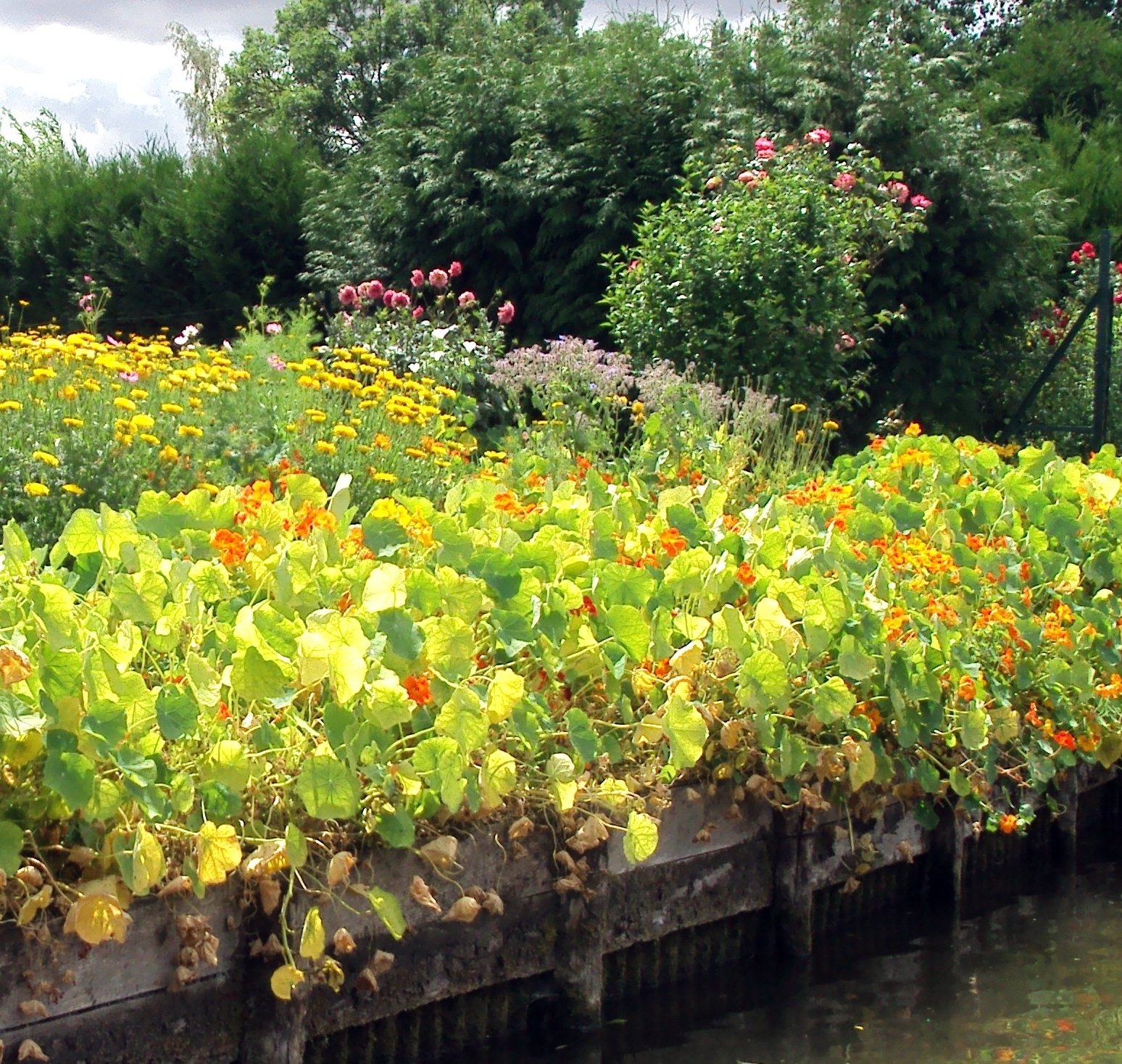
nasturtiums at hortillinonnageSpring has sprung, at least it appears that way at least some of the time between the dumps of snow.  The daffodils are struggling up and leaves coming into bud.  Over the last month my attention has started to turn to growing food.  We have winter lettuce outside which will give us our first few leaves in a few weeks.  But I’ve started planting up for the summer.  I have placed the seedlings by my wood burner rather than use the electric propagator.  So far I have planted and had germinate tomatoes, cucumbers, melons, peppers, lettuce, leeks and nasturtiums.   Nasturtiums are for those who don’t know it edible as well.  The flowers and leaves can be eaten, we put them in salad and they have a hot peppery taste.  I also put one short row of broad beans in outside but nothing has emerged yet.

I’m still using last years fruit up from the freezer.  I made blackcurrant jam this week which I have to say is very good.  Despite the terrible weather last summer gooseberries and blackcurrants did really well -something to bear in mind.  As we said in our book food is a big issue as far as peak oil is concerned.  Most of us cannot be self sufficient but we can grow something.  In last weeks Guardian magazine there was an article on a group of neighbours in London who were growing food in small spaces and a picture showed the most wonderful looking Raspberries in a window box.  So get out there and grow something!

Neil

Posted in Food, Peak oil, Uncategorized | Leave a comment

Choices to Change Your World

Guest post by Valerie Comer

Do you ever feel overwhelmed by the state of the planet? You turn on the television news, and poverty peers back at you. Read the paper, and terrorism attacks from the pages. Check your twitter feed, and a new international disaster-of-the-week comes to light. Add in human slavery, peak oil, genetically modified foods–the list goes on–and the tilt-a-whirl of insanity gains momentum.

Why do I need to know about all these troubles? What can I do about any of it? Not much. I’m a middle-aged wife, mother, and grandmother who lives on a farm in western Canada. I have no degrees behind my name. I’m not on the board of a major corporation. I’m not a politician, movie star, or public figure. Sure, I can sign petitions but, all in all, my sphere of influence is very small.

Am I the only one who gets overwhelmed? I don’t think so. It’s very common to feel insignificant. Our human response is one of two things: block it out and keep doing what we were doing because it doesn’t make a difference anyway, or curl up in a ball of depression and rock back and forth with our eyes closed.

I have good news, though. What you do does matter. There’s a middle ground between apathy and despair. It’s where we take a realistic look at our situation and make our part of the world, even if it’s just our house and yard, a better place. The impact may not be apparent ten miles from home, but it’s still worthwhile. At the very least, your family is healthier than they were. Isn’t that a huge benefit?

And if you do change your family’s impact on the planet, I guarantee someone else will notice. Your neighbors and friends may ask questions. . .and they may join you. Even an ordinary person like you and me can cause ripples that rock other people’s boats.

6-choices-to-change-your-world

What choices can you make?

1. Choose local food when it’s available. There are lots of options here, from growing a garden, to preserving local bounty, to cooking and baking with real ingredients. How about supporting your local farmers’ market? The supermarket may not notice the loss of your purchases, but your family will gain health, and that’s worth a lot.

2. Choose to support local businesses wherever possible. Help your neighbors earn a living and keep their shops open.

3. Choose quality over quantity in your purchases. Invest in products that will last. Resist the impulse to buy junk for gag gifts.

4. Choose to drive the most economical vehicle you can afford–and then use it as little as possible. Group your errands, car pool, and ride your bike when you can.

5. Choose to reduce dependency on finite natural resources. Switching off your lights, turning down your thermostat, and adding insulation to your home are all good places to start–and will save you money–but do something fun, too. Why not get started with solar cooking? It isn’t expensive or difficult but has positive global benefits.

6. Choose the 5 Rs: Reduce, Reduce, Reduce, Reuse, and Recycle. Did you notice the stuttering? (grin) Reducing what you buy (and often discard) is far more valuable than recycling. Think how much peace a clutter-free home can bring you.

You may not be able to change the world, but you can do plenty to impact your little corner of it. Your choices do make a difference. What will you choose?

Valerie-Comer-150x150Valerie Comer is an author and blogger at the intersection of food, faith, and fiction. She and her husband of over 30 years farm, garden, and keep bees on a small farm in Western Canada, where they grow much of their own food, preserving vast amounts of it by canning, freezing, and dehydrating. She believes taking good care of both the planet and her family is an act of worship and thankfulness to God the Creator. Valerie writes contemporary romantic fiction as a natural offshoot of her passions. To find out more, visit her website and subscribe to her blog. If you join her newsletter list, you’ll receive a bonus download Seasons from My Kitchen with ideas and recipes for seasonal local eating. Join her journey!

Image of ripples courtesy of seaskylab at Free Digital Photos

Posted in climate change, Food | Leave a comment

New economics

“Part of the problem in trying to critique the conventional economic view is that it is very dominant and few people work outside its current strictures. However, the growing realisation that climate change might threaten this world view has led to some new thinking on economics. Perhaps the best known is Sir Nicolas Stern who was chief economist at the World Bank. The UK government asked him to write a report on the economics of climate change, which he did in 2006. The “Stern Review on the Economics of Climate Change” was published predominately to get the world (and in particular the US) to sign a binding treaty on climate change and has to be seen that context. The review had verbal brickbats thrown at it by all sides of the argument. Whilst it has much that is useful in it, the Stern review does have some shortcomings. He seems to have overlooked resource constraints like peak oil as an issue. His headline recommendation was that we could head off the problem of climate change by spending only 1% of gross domestic product on measures to reduce emissions – a figure that seems absurdly low (if so why aren’t we doing this?). But its overarching conclusion was that ‘green growth’ (i.e. growth that does not damage the environment) was possible, this was reiterated in his book. In 2012 the World Bank has published a report saying the same thing. Criticism of this general view rests on the following points from a paper written by Professor Cleveland of Boston University.”  “No oil in the lamp” Chapter 7 excerpt.

Posted in Book | Leave a comment

One thing we have learnt this week

I have just found this article which anyone who thinks nuclear power might be a good idea might like to read first.  A secret French report on the cost of cleaning up after a nuclear disaster at a reactor in central France has been leaked to a French Sunday paper.  In it clean-up costs were estimated at 5.8 Trillion Euros.  After this the originators of the report the Institute for Radiological Protection and Nuclear Safety (IRSN) released a second version putting the costs at merely 430 billion euros.  The same organisation estimate Fukishima cleanup at a trillion euros according to IRSN Director General Jacques Repussard.  All this as the UK government is set to raise the liability of companies operating nuclear plants to £1 billion pounds for clean-up and seems set to reach agreement with EDF to build new reactors…

Neil

Posted in One thing we have learnt this week | Leave a comment

Fracking in the UK

On Wednesdays Guardian G2 cover there was a picture of the valley showing the church my grandparents attended in rural Somerset.  It was actually an advert for “Visit England” encouraging tourism to North Somerset.  How ironic then to read elsewhere in the same paper that large chunks of rural Somerset are threatened with fracking for shale gas.

I have very fond memories of the Mendips (the range of hills that cross this part of North Somerset) and of the church my Grandparents attended and their minister, a frustrated evangelical winding down to retirement in the church that was not of his taste.  Both sets of my Grandparents lived in what are described as “strip settlement” villages in the country.  In the village of one set of Grandparents the road was dangerous and the countryside all around was privately owned, meaning as children we could not wander freely.  At the set who lived at the bottom of the Mendips the situation was completely different.  Part of the range towered over the bungalow.  Walk a short distance cross the road and go through a field (on a right of way) and you reached on of the many small quarries in the area.  Go round it (or up it as my brother did) and you could walk to the top of the hill and then on for miles in either direction with the most fantastic views all around.  As kids we were allowed off on our own in a way and an age we would not let my children have done so.  Its not too much of an exaggeration to say I discovered my love for God’s creation and the outdoors in these hills.

I was upset then to read about the fracking threat.  In actual fact the bit I know very well is not threatened (at the moment).  However, the Petroleum Exploration and Development Licenses cover very large chunks of North East Somerset stretching almost to Bristol and Bath and taking in Keynsham, Shepton Mallet and Wells.  One threat is that fracking might contaminate the UK’s only hot springs at Bath.  (No one is exactly sure of the source of the hot water but one possibility is that it originates near Shepton Mallet.) These springs have had a fortune spent on them and have only just re-opened for public bathing.

When we started writing “No oil in the lamp” we didn’t know much about fracking but obviously had to research it.  The following passage is some of what we said;

”The last area of controversy and the one most relevant to this book – is this a game changer as far as the resource size is concerned? Could shale gas become a big provider of energy in the future? The wells deplete very fast (up to 65% in the first year), with each well being exhausted in 5-10 years, hence the need for so much drilling1. This rapid depletion, together with the energy needed to extract the gas effectively puts a floor under the market price for shale gas (higher than conventional gas). According to the USEIA 2010 report shale gas will boost the global recoverable reserves of natural gas by 40%2. However, whilst this report is conservative in terms of recoverable gas, it is probably optimistic on the size of the fields, basing its data in some cases on scant geological data. Recently one large shale gas field has had its reserves total lowered by 80%3. Comments by Sam Laidlaw, the CEO of Centrica (formerly British Gas) reported on the Guardian website are cautious: He sees shale gas making little contribution outside the US in the medium term and thinks the rapid depletion of the fields may limit its effectiveness. The think-tank Chatham House have produced a report suggesting shale gas may even push up prices of gas after 10 years since little exploration for conventional gas will take place whilst shale gas reserves are exploited in the intervening period4. As we are writing this book in early 2012, the rapid expansion of shale gas extraction in the US seems to have changed the energy picture as far as natural gas is concerned: stocks are up, prices are down, and the US has become a net exporter. It remains to be seen whether this change will be sustained over the longer term.”

1The Oil CrunchAwake-up call for the UK economySecond report of the UK Industry Task force on Peak Oil & Energy Security (ITPOES), February2010.

2 SeeWorld Shale Gas Resources: An Initial Assessment of14Region s Outside the United States“,US Energy information service 2011.

3 http://econintersect.com/b2evolution/blog1.php/2011/08/31/u-s-eia-slashes-marcellus-shale-estimates.

4 “The ‘Shale Gas Revolution’:Hype and Reality”, available at http://www.chathamhouse.org.uk/publications/papers/view/-/id/947/.

There seems to be a lot of ignorance about the shear number of wells that need to be drilled for any one field.  When I was writing this section the material from one of the references above truly shocked me.  Fort Worth in Texas ended up with hundreds of wells all around it, including in the urban area.  Do we really want this to happen here?  Finally another criticism of shale gas we would make now (which we should have put in the book) is that of the energy return on energy invested.  Again a surprise on researching the book was that the return on conventional gas is so low, about 10x on average now.  Unconventional gas is going to be lower because of all the drilling and its a nonsense to use high grade energy to extract lower grade energy.  Peak oil and gas will arrive sooner.  Something its political supporters like the chancellor would do well to recognise.

I have family links with all these places mentioned above.  My Grandfather was born in Bath and my Grandparents lived in Bristol until retirement.  I have family in Keynsham and know Wells because one of my Grandmothers friends lived there.  My Dads cousin was even in Shepton Mallet jail.  This makes all this for me very personal and I wish those trying to stop it all the best.

Neil

Posted in climate change, gas, Peak oil, Politics | Leave a comment

book excerpt

Having looked at the actions we can take individually to prepare for a lean energy future, in this chapter we look at what our church communities could do. Our experience is that the issues explored in this book are not on the radar of most churches. Even churches that have some interest in environmental issues have often not connected with peak oil and its implications. There are perhaps two main reasons for this: Firstly, they may simply be unaware of them – as are many if not most of the wider population. Secondly, they may not view issues of resource constraints as “spiritual” issues which churches should get involved in. As we have tried to make clear throughout this book, the shortfall in future energy supplies will cause a considerable challenge to our lives in many areas, and churches will not be exempt from the effects. We believe that energy constraints will provide the context for our lifestyle in the years ahead. How we “do” church will inevitably be affected: We will still be worshipping the same unchanging God, but the ways we have become used to doing this will almost certainly have to change. The ministry of Christians and the church, both in our own country and overseas, is likely to change too, as different needs arise, and different constraints affect us. The wider challenge for the church is not just to adapt to the changing circumstances that peak oil will force upon us, but also to recognise that the church has been part of the problem. Most Christians and churches have been full participants in the dominant culture of consumerism, globalisation and economic growth, not questioning it in any meaningful way. Peak oil will fundamentally undermine this paradigm and therefore challenge not just our society, but our faith. We need prophetic voices pointing out to us how our attitude to, and our behaviour toward God’s world and its resources have been infected by the dominant world-view, and we need teaching which guides us into different ways of thinking and living.”  Chapter 12. “No oil in the lamp”

Posted in Book, Faith | Leave a comment

The Pope’s legacy on peak oil and the environment

Joseph Aloisius Ratzinger (Pope Benedict the 16th) as the whole world knows has just resigned. He seems to have been one of the most controversial popes for a long time. His legacy will be discussed for many years. As a non Catholic I can kind of see why. He had been in the Hitler youth) and fought in the German army in the very end of the war (although he had no choice) and deserted his unit (although it may by then have ceased to exist). Very early on his papacy he made some negative remarks about the prophet Muhammad in a lecture. However, in recent years he seems to have been far less in the news and made efforts to build up better relations with both other branches of Christianity and other religions. He also made a very successful visit to the UK. (I went to the end of my road and watched him ride past in his pope mobile.) Probably the remaining controversy is brought about by the internal problems in the Vatican and the sex abuse scandals within the church. These are beyond the scope of this blog but I don’t think as an Anglican we can cast any stones… I also get the impression he was unpopular with ordinary Catholics. Personally I was neutral about him, although he went up in my opinion by resigning. (I think its sensible for people not to work until they drop, and what happened to the previous pope John Paul was tragic to see).

What from this blogs point of view is quite positive were his pronouncements on the environment and consumerism. I was also keen to see if Cardinal Ratzinger had made any pronouncements about peak oil. What I’ve found is really rather interesting. Pope Benedict produced an encyclical in 2009 http://www.vatican.va/holy_father/benedict_xvi/encyclicals/documents/hf_ben-xvi_enc_20090629_caritas-in-veritate_en.html.

Firstly on the environment Benedict said the following;

“Today the subject of development is also closely related to the duties arising from our relationship to the natural environment. The environment is God’s gift to everyone, and in our use of it we have a responsibility towards the poor, towards future generations and towards humanity as a whole. When nature, including the human being, is viewed as the result of mere chance or evolutionary determinism, our sense of responsibility wanes. In nature, the believer recognizes the wonderful result of God’s creative activity, which we may use responsibly to satisfy our legitimate needs, material or otherwise, while respecting the intrinsic balance of creation. If this vision is lost, we end up either considering nature an untouchable taboo or, on the contrary, abusing it. Neither attitude is consonant with the Christian vision of nature as the fruit of God’s creation.”

This is a very strong statement and emphasises our responsibility towards future generations which is is easy to forget. The encyclical goes on to expand on this statement stating that we can see God in nature (with some biblical references such as Roman1v20 cited), but warning against making the natural world either more or less important than mankind.

The encyclical then goes on to talk about energy use. Firstly, it covers some of the injustice of unequal access energy resources between rich and poor countries and a warning this can lead to conflict. Pope Benedict’s solution;

“The technologically advanced societies can and must lower their domestic energy consumption, either through an evolution in manufacturing methods or through greater ecological sensitivity among their citizens.”

He goes onto say.

“This responsibility is a global one, for it is concerned not just with energy but with the whole of creation, which must not be bequeathed to future generations depleted of its resources.”

and

“One of the greatest challenges facing the economy is to achieve the most efficient use — not abuse — of natural resources, based on a realization that the notion of “efficiency” is not value-free.”

Benedict went on to link the environmental crisis to consumerism. There is more than I can cover here in the encyclical and its well worth a read. Did Pope Benedict mention Peak oil? Not per se but resource depletion and stealing from future generations is there in his teachings. In addition there are some strong statements on the environment. In 2008 the Vatican installed solar panels which provide about 20% of its electricity. http://solarknowledge.blogspot.co.uk/2010/12/vatican-sets-example-with-solar.html http://news.bbc.co.uk/1/hi/world/europe/7642811.stm

All the above doesn’t seem a bad legacy to me.

Neil


Posted in Faith | Leave a comment