Lent carbon fast

With Lent fast approaching people are expressing ideas of what to give up. In recent years the idea of a lent carbon fast has emerged. The oil lamp is going to throw its hat in the ring and make a few suggestions under a number of different headings.

The problem with modern Western life is we are addicted to oil and more generally energy. This use is causing rises in temperature, environmental damage and an addiction which sooner or later (and we would argue sooner) is going to have to end.  Cutting this energy use is very difficult because the addiction we have goes beyond energy use into materials.  However,  there are some simple things you can do to make a start at getting it under control covered under a number of different headings…

Energy

  • Start by monitoring your use on a weekly basis, you may be surprised by how much you use.  Read your electricity and gas (if you use it) at roughly the same time on the same day each week.  Having done this we turn to ways to save a bit of energy.
  • One suggestion that has been made is to remove a bulb from a prominent light during lent.  There is a danger in our house that if we do that someone will merely leave another light on to replace it.  A better idea if this is a danger is to replace the bulb with a lower energy alternative.  As we have covered on this blog LED’s are now a viable alternative.  Despite their high up front cost they pay for themselves in 1-2 years (at European electricity rates).  I’m going to do this with two lights my daughters use.
  • Other simple ideas include turning the thermostat down a few degrees or even more radically switching the heating off when its mild.  Don’t switch your heating on an off throughout the day (letting the system cool in between).  The warm-up each time uses a lot of energy.
  • Only fill the kettle with the water you need when you need it.
  • Consider putting in more insulation.  Loft insulation is the easiest and most cost effective to do, but don’t forgot to insulate the loft hatch itself.

Driving

  • Drive less!  Don’t use the car for short journeys. Why not walk and pray at the same time.  Cycle.  If you do wear a helmet.
  • If you drive make sure your tyres are fully inflated and cut down on the use of air conditioning.
  • Drive carefully and don’t accelerate or brake wildly.

Stuff

Everything we use either has oil embedded in it in some way either because its derived from oil (plastics) or has been transported long distances.  Stuff and food (see below) are responsible for a lot of carbon emissions.

  • During lent cut down on what you buy.
  • Our homegroup is having a swap, share and donate next week (I will put up a short blog entry about it).
  • Recycle as much as possible.

Food

The modern food system has been described as a means of turning oil into food.  It takes a lot of energy to keep the industrial food system going.

  • The number on “No oil in the lamp” tip is grow your own.  Whilst during lent its probably impossible to bring something to the cropping stage you can plant stuff to harvest over the summer.  If you don’t have any land this is no excuse.  Did you know you can grow Strawberries and potatoes in containers?  Grow lettuce and herbs in window-boxes.
  • Make your own bread (the subject of another blog entry), in fact try to cook everything fresh.
  • Don’t throw food away.
  • Buy local if possible
  • Cut down on the meat, its better for you and the environment.  Be careful about buying fish though, many species are getting fished out.

This is a quick run through of some ideas and our book has more and in more detail.  Most of all have fun doing this and remember what lent is about.

We have a lent study guide based around our book available for download here. No oil in the lamp – Lent guide

Neil

Posted in climate change, Creation | 2 Comments

One thing we have learnt this week

I periodically check this page which shows real time data of where the UK’s electricity is coming from. I tend to check when its either very still or very windy. Its been very windy over the last week and a checked it a few days ago. Imagine my surprise when the wind capacity had jumped over that period by about 2GWp. Some very large offshore wind farms must have been finally connected to the grid, although I have not managed to find out which.

The page shows only the very large capacity renewables in wind, hydro and biomass (other) connected to the transmission network and not the smaller renewables on the distribution network (due to the way the electricity is sold).   The page overstates this smaller stuff, the blurb is not updated very often so in terms of wind there is probably another 2GWp meaning the capacity is nearly 10GWp.  Unfortunately it does not show solar or other micro-generation although once smart meters are introduced there is no technical reason why it should not.  The wind power predictions are usually very accurate by the way.

Neil

Posted in One thing we have learnt this week | Leave a comment

Andy interviewed

Andy is interviewed in this video by Valerie Comer about why Christians are disinterested in the environment. The quality is mostly OK (it was recorded on Skype).

Posted in Book, Film | Leave a comment

Guardian books sells “No oil in the lamp”

Guardian books sells our book. I’m so surprised I had to post this.

Neil

Posted in Book | Leave a comment

In praise of wood-burners

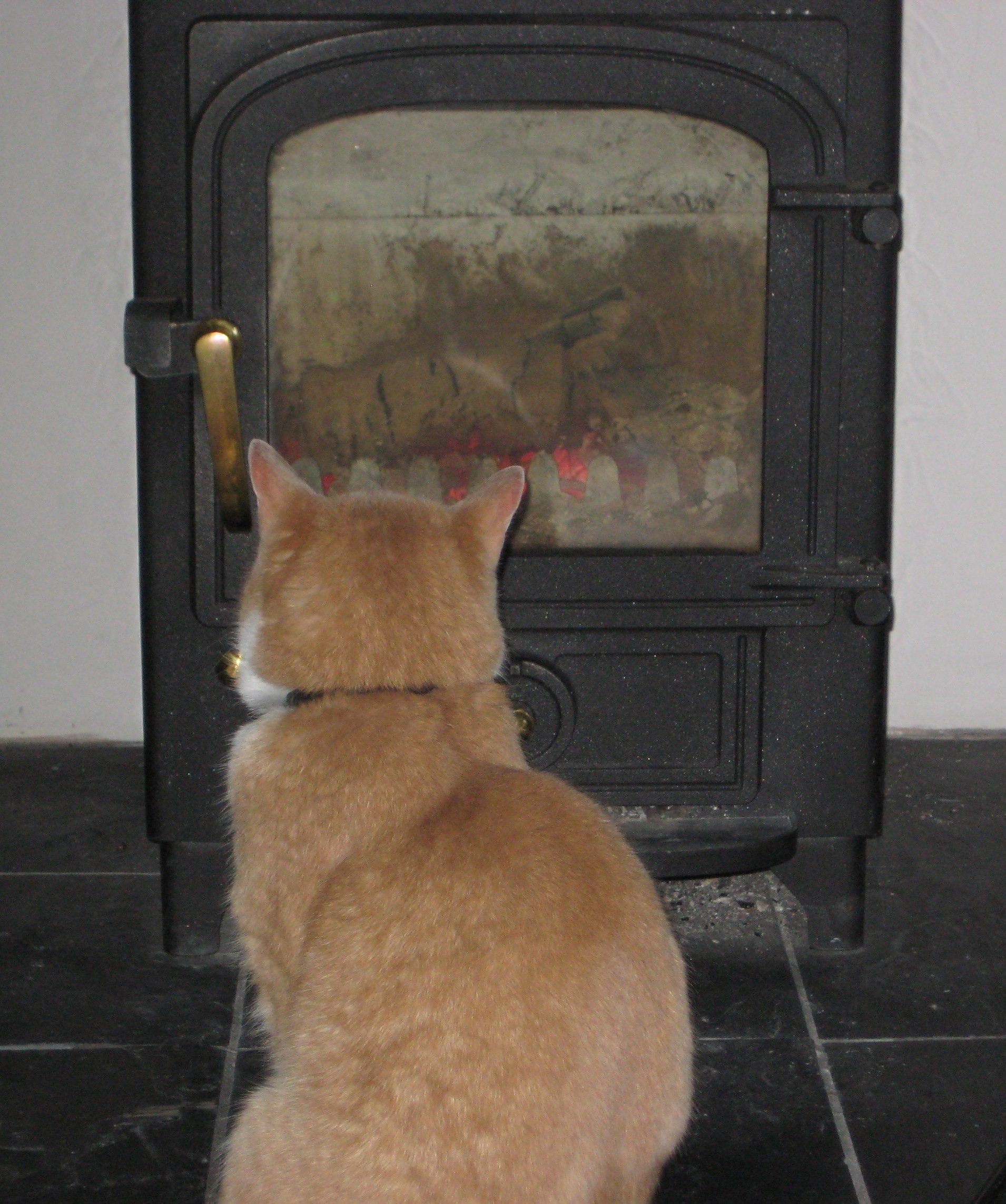
Our cat loves the wood-burner!

The Guardian newspaper has three editorials in the newsprint edition everyday.  Two of these are on global/local events from political perspective.  The other is a positive one on something or someone (in praise of…).  Last week it was on  “In praise of wood-burners”.  The mark of a Guardian reader is not just wearing sandals and eating muesli but now includes owning a wood-burner.   I do read the Guardian, I am not guilty of the first two but I am of the last one.

This editorial got quite a reaction with a number of letters published in the print edition slagging off wood-burners, mostly from the pollution and wood supply perspective.  I wrote a response but I don’t think it will be published.

On the pollution point the criticism was that people were using wood that was too wet and therefore too much smoke was coming out of the chimneys.  Now its true that water does not burn.  Wood needs to be seasoned.  Ash will burn green wet although presumably it burns better when dry.  However,  in my experience logs when split with an axe (along the grain) burn well after about 6 months of drying.  Leylandii and Cyprus dry in about 5-8 weeks. Leylandii burns well.  Cyprus although closely related is more mixed.

One person wrote that they produce smoke out of the chimney when the stoves temperature is less than 200°C.  This is not correct as far as my wood-burners documentation is concerned.  At any temperature above 120°C the stove is in clean burn mode and no smoke should be visible coming out of the chimney.  I get smoke emerging when I’m lighting it but as the stoves gets hotter this smoke diminishes.  I put loads of air through when lighting it, but once its hot load it up with wood and turn the air down so its almost closed off.  The wood burns with dancing mainly blue flames presumably since the wood is undergoing pyrolysis (the chemical decomposition without oxygen) forming hydrogen and methane.  There is almost no visible smoke from my chimney at this point,  or my neighbours chimneys.  In fact it took years to work out that they had wood-burners as well since I could smell the wood-smoke but not work out where it was coming from.  [In very cold weather steam is visible from the chimneys].  The writer complained people were using it as low level incinerators.  If they are they are making a mistake.  I don’t burn plastic or wood with paint on.  I do put small amounts of chicken bones and bacon rind in.  In the UK (I cannot speak for other countries) only stoves exempted under the clean air act can be used in built up areas.  This testing used to take five years.  So used properly stoves should not cause a pollution issue.

Another criticism is wood supply.  I get mine from two sources.  People who know me and are having trees taken down and scrap wood.  The scrap wood is either wooden floorboards, pallets or joists removed due to woodworm or rot, or joiners mistakes.  I am careful not to sit the old rotten or infested wood in the house and prioritise its burning.  Scrap wood of course is dry so burns well producing no smoke.  It tends to have nails in it though.  We cover wood supply in more detail in “No oil in the lamp”.  Suffice to say I would not rely on it for your heating.  I find scrap wood easy to find at the moment although I’m highly proactive.  But this ease may change in the future.  I heard a disturbing report on the news last week from Greece.  Due to the high oil price and extreme economic problems people there are demolishing ancient forests for firewood to keep warm this winter.  Hopefully not a sign of things to come.

Lastly everybody loves the stove; cat, children and home-group.  Last week on of our American members almost got in it!

Neil

Posted in Practical low carbon living, Renewables | Leave a comment

book sales

The book sales are picking up again.  Thanks to all have bought it.  If you want to buy it you can order it on-line from most on-line booksellers, but why not order it direct from our publisher DLT or at your local bookshop?

Posted in Book | Leave a comment

Carbon emissions 2012

Earlier on in the year I reported on my carbon emissions for 2012. This as the earlier post indicated are only those due to transport and energy. They do not relate to those due to food and consumer goods. This year we have mostly been successful at cutting our carbon (apart from my daughters flying trip of course). Everything is lower other than a bit of tube travel and the electricity use.

The increased electricity use is on way surprising since we doubled our PV capacity in late 2011. It reflects children being older and using laptops and lights to use facebook, I mean do homework till later, when the PV system is either not working or producing minimal power. The PV systems also underperformed by about 20% in 2012 due to the terrible weather. In addition we have nailed down our standby consumption during the day that we export the power to the grid. Its still a bit disappointing though. After a year of record renewable energy production here the carbon intensity of the grid must be lower but I have not managed to find these figures. There was markedly less train travel this year for family reasons and our train travel is returning to what would probably be its long term average. The lesson of all this is its hard to cut your energy use…

Neil

Posted in climate change | Leave a comment

One thing we have learnt this week

The annual richfest at Davos is on and here is a link to a video which is worth watching of some of the Guardian’s coverage. Apparently the circular economy is big at Davos this year. Why this is is not made entirely clear in the the interview but I would hope its got something to do with the high oil price. We’ve mentioned the circular economy in our book but there are some links here.

Neil

Posted in One thing we have learnt this week | Leave a comment

enoughfoodIF campaign

The enoughfood if campaign has been launched, details can be found here. This was referred to in a previous post and is an attempt by about 100 organisations to tackle global hunger.

Neil

Posted in Food | Leave a comment

Shrinking the footprint

I monitor both my churches energy use and I my own on a regular basis by the means of spreadsheets and meter readings.  Obviously I do mine myself (every week on a Sunday evening).  The churches’ are sent to me about every two weeks, although they are taken every week.  The spreadsheets I use are different for each.  For my own personal use I utilise the one developed by the Centre for alternative technology (CAT) for their ZeroCarbonBritain project.

In the 1970’s the Centre for alternative technology produced an energy report (this is still available somewhere on line).  Its remarkable how accurate some of their projections in this report are on for example, wind.  The ZeroCarbonBritain project is an update on this (a much longer and more detailed one).  The report is aimed at tackling climate change and peak oil simultaneously in the UK and assumes a carbon ration (something we cover in “No oil in the lamp”).  As part of this a number of volunteers were asked to fill in their energy use and send it back to CAT once a year.  Each year the amount of carbon we had to “live in” was reduced.  For some reason CAT stopped sending me new sheets but I’ve carried on using it and extended its capabilities a bit.  It this we recommend using in “No oil in the lamp”.  But I’ve forgotten to ask permission to put it up on this site and having been reminded by this post will attempt to do so.  For church energy use I developed my own simpler spreadsheet (not involving travel or journeys).

The advantage of monitoring is it gives you a baseline and something to work from.  You can also spot trends and look for spikes in energy usage for example if something is left on (more likely in a church situation).  The disadvantage (more from a church situation) is that you are always playing catchup.  Also I’m not on the staff so never quite know what the usage of the building is.  Our main building is used as a conference venue for Christian conferences, businesses and charities (as well as our own uses such as a very large parent and toddler group).  In winter, early spring and Autumn this does require heating the main building.  In 2011 we cut our gas use by about 30% in 2012 it increased but was still less than 2010.  Much of this use is due the building being used more.  What I have found is that there is no apparent pattern to the energy usage. Even in the buildings used as church offices the pattern of consumption fluctuates widely.  Its not even weather related.

The Church of England has a national environmental campaign called “Shrinking the Footprint”.  Their Facebook page is one of our likes on our Facebook page.  They are starting a campaign the aims are;

Church members are being encouraged to use January’s freezing temperatures as a starting point for monitoring their building’s energy useage, as part of the Shrinking the Footprint national energy audit, using sMeasure.

The free, easy to use toolkit from Shrinking the Footprint, the CofE’s national environmental campaign, enables all church buildings – historic and modern – to understand and reduce energy use and costs along with cutting their carbon footprint

Once 20 buildings in a diocese are taking part a diocesan peer group will be created on the website. This will allow the diocese to track energy use and

identify buildings that require additional support“.

It sounds a good idea and the Facebook page has some videos with some useful tips in them.  For Anglicans reading this I would encourage you to consider taking part.  Others can still find some ideas and suggestions present in their resources.  After all as we write in our book the price of energy is going to go only one way.

Neil

Posted in climate change, Peak oil, Renewables | 1 Comment