Greenbelt

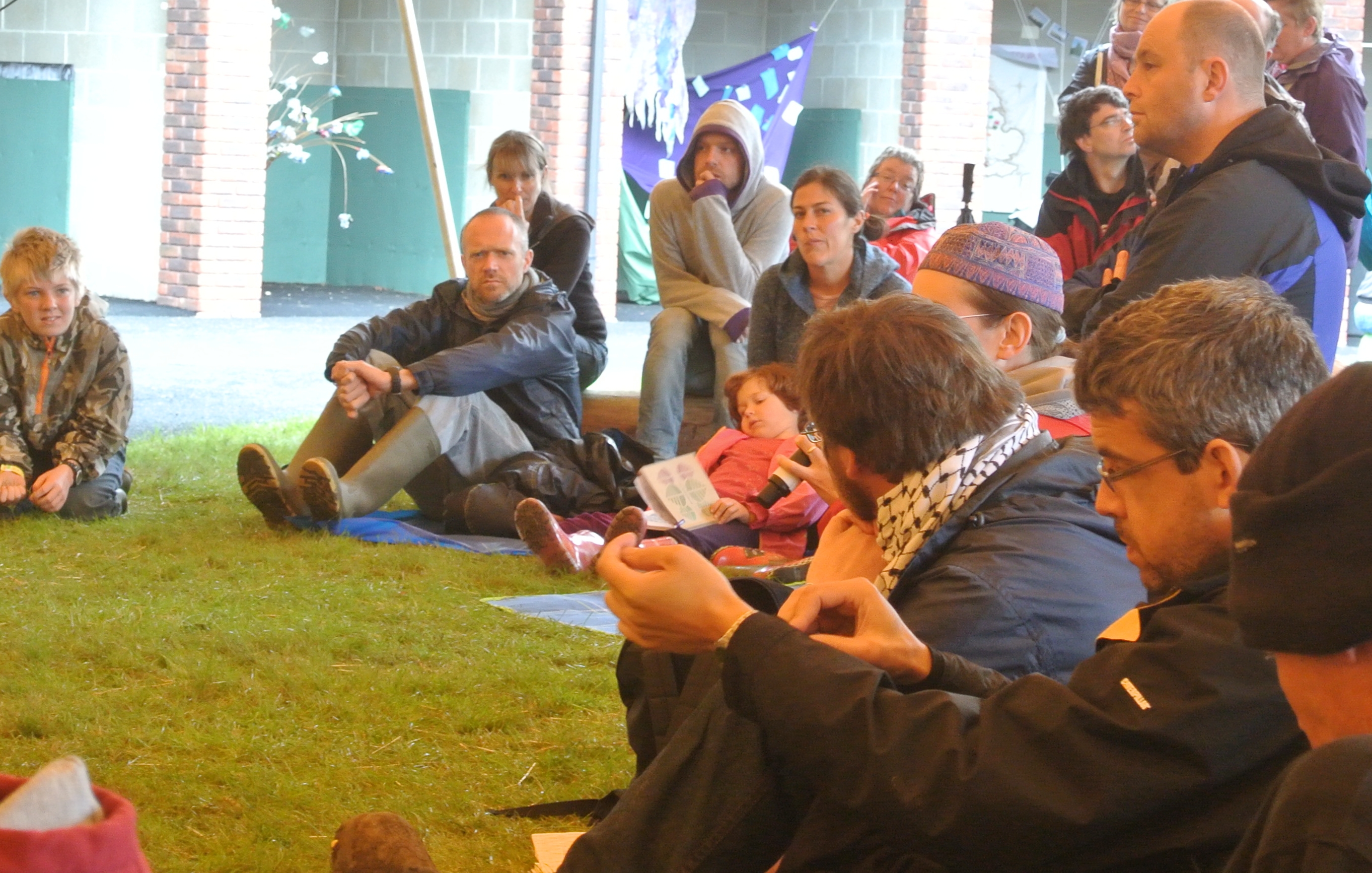
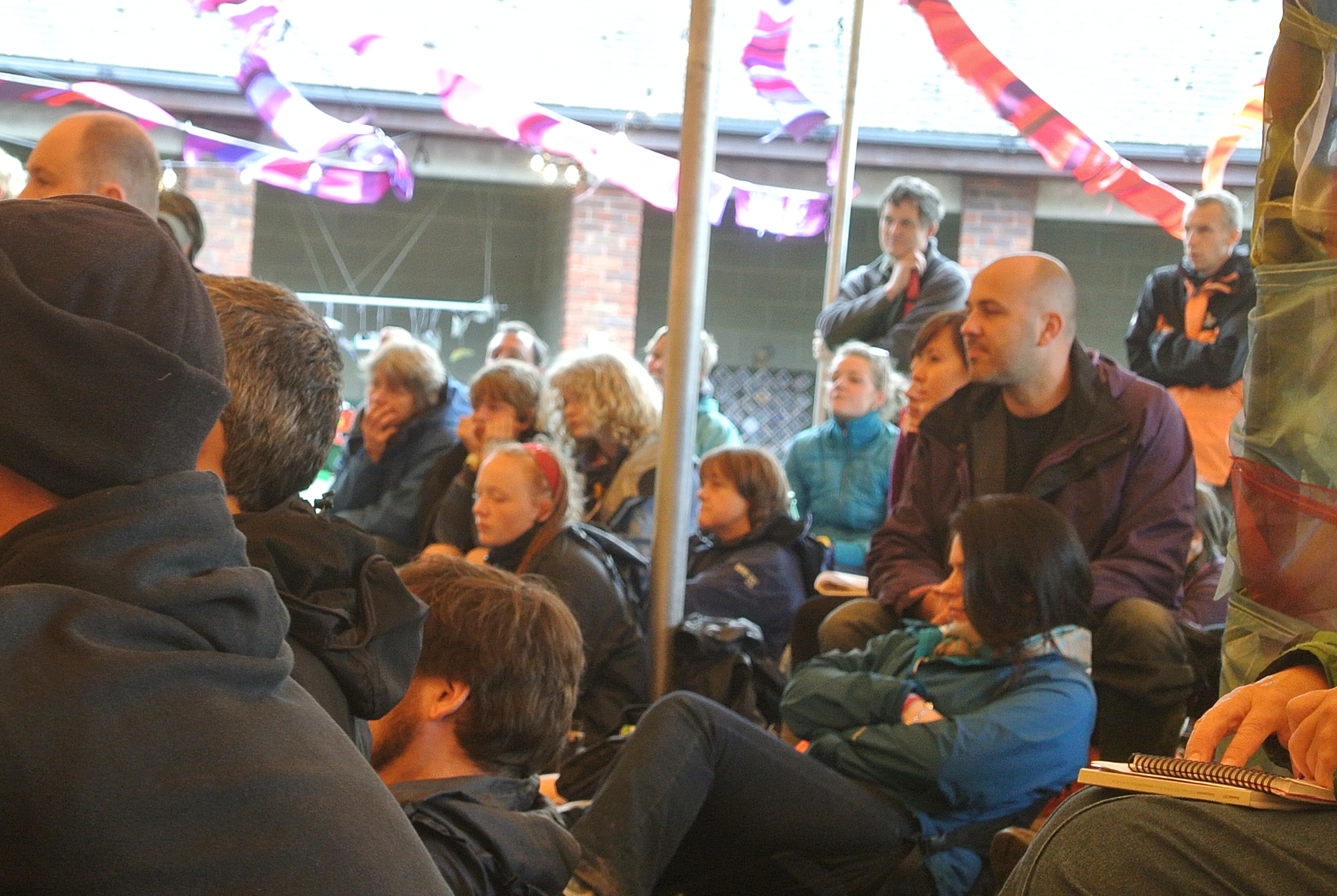
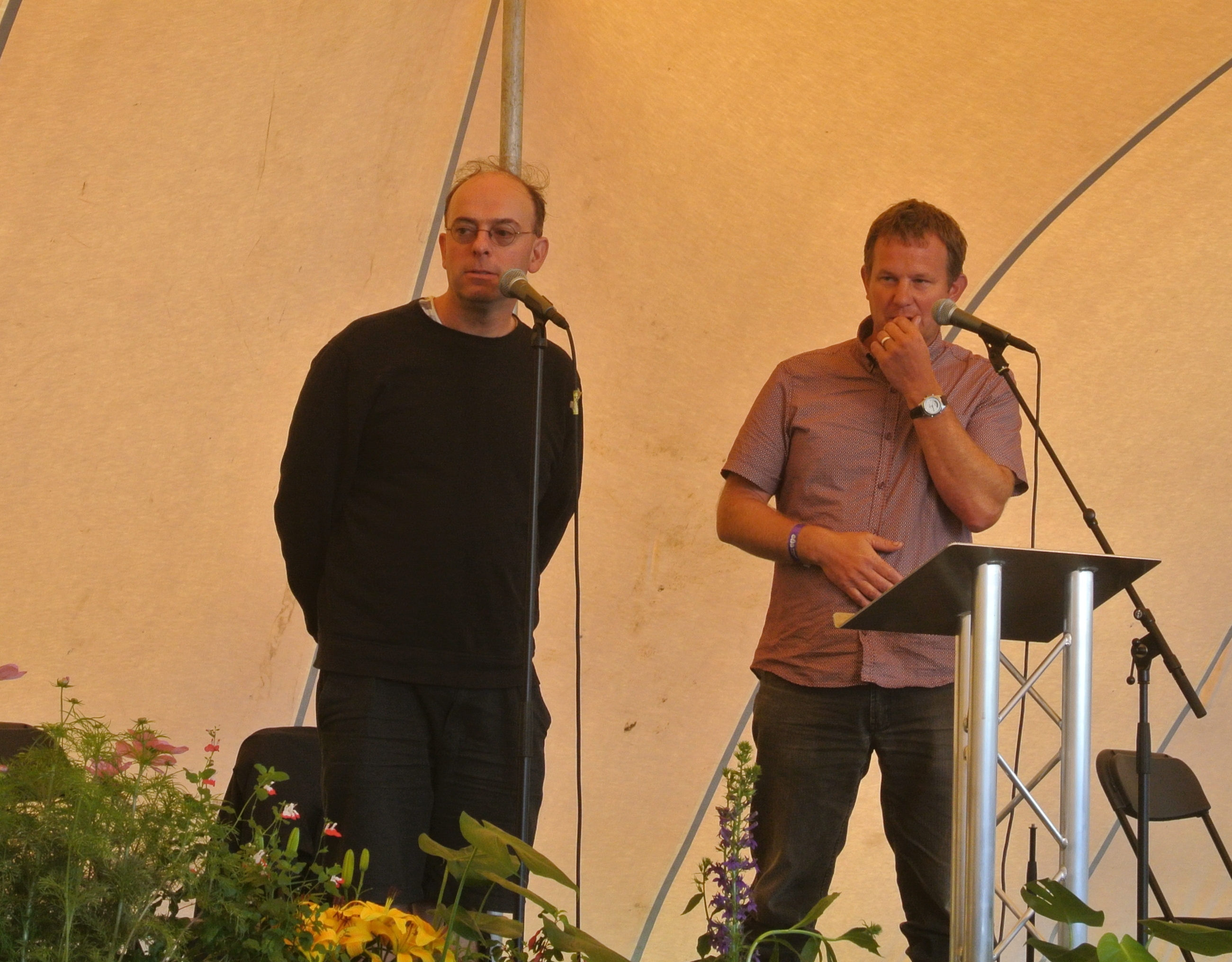
Greenbelt 2012 was a challenging experience in many ways due to the weather.  In addition our launch was on the Monday.  Both these factors may have reduced the numbers attending, but as the photos suggest the numbers weren’t bad considering.

Crowd at the launch of our book.

Another shot of those listening.

We ponder a question from the audience.

As you can see from the way everyone is wearing hats and coats the weather was freezing with a gale coming underneath the edge of the tent.  We were both freezing although we loved the venue and the way it had been set-up with the flowers and hay-bales.

We did not have time to cover all the material in the book (much less in any detail) so left out subjects such as economics and renewables.  I had just come from a talk given by Douglas Alexander who was very impressive, but when asked a question about economic growth and resource depletion didn’t seem to get the idea that endless growth in the way we have it now (or not), is impossible.

Thanks everyone for your questions and comments at the end.  If anyone would like to follow up or didn’t get picked then please post to the forum.  We enjoyed the experience.  We also enjoyed signing books and catching up with those we had not seen for a while.  Some people who did not attend the launch have bought the book and some of these people turned up to the signing.

Neil and Andy

Posted in Book, Faith | Leave a comment

Greenbelt 2012

Just got back from the book launch.  I will fill in the details when I have recovered.  Meanwhile here is a picture of the man- Bruce Cockburn.

Bruce Cockburn Main-stage Greenbelt 2012 singing “When a tree falls…”

What was depressing about it was thinking that I remember it being played on Radio 1 in 1987 and the deforestation situation has only changed slightly for the better.

Posted in Uncategorized | Leave a comment

If we are to cope with climate change we need a new moral order

Great blog by Andrew Brown at the Guardian today on whether we need to apply the moral obligation of religion to tackling climate change. For once many of the comments left are quite intelligent as well. I’m not going to comment on it any further. I left a quick but imperfect comment there. All I’ll say is read it.

Neil


Posted in climate change, Faith | Leave a comment

Reading list

Shasta Daisy in my garden

I posted earlier about my wife reading “Everyday God” by Paula Gooder, I said I was going to read it and I am using it in my own studies.  I have also read a short book by Maggie Dawn “The Accidental Pilgrim: New Journeys on Ancient Pathways” and I’m currently reading “In Praise of Slow: How a Worldwide Movement is Challenging the Cult of Speed” by Carl Honore.  All three books have things to tell us about finding meaning in the ordinary routine of life.  “Slow” is a secular book although Carl Honore  talks about religion a lot and quotes the bible several times.  The other two books are about finding God in the ordinary experiences of life.  I tend to think of my Christian life as a pilgrimage or journey perhaps because of my sinfulness.  But for a Christian there is the opportunity to find God in the everyday, such as the natural world.  Paula Gooder describes how we so often miss seeing this.  Oil has given us so much choice, its almost become a form of idolatry as we chase from travel/shopping experience to the next and miss out on so much stuff that is under our noses.Neil

Posted in Book, Faith | Leave a comment

About our book

Our book “No oil in the lamp Fuel, faith and the energy crisis” goes on sale on the 2oth of August.  We are having a book launch at Greenbelt on the 27th August 11am at Eden.  I have to be honest and say I’m very excited since I’ve never published anything before.When we started writing the book way back in 2009 there were no other books on Peak oil from a Christian perspective.  (In fact this is one of the questions the publishers ask you when you submit the first few chapters to them -are there any other books on this area?).  In those days we could honestly say no.  Since then two books have been published, beating us to it.  In a way this is encouraging since it shows there is growing interest and concern in Christian circles in this area and proves to our publisher they were right to back us.

The other books are in order of publication “The coming oil storm” by Ron Rhodes and “Let us be Human: Christianity for a collapsing culture” by Rev Sam Norton.

We have read the first of these.  I think its fair to say that Ron Rhodes theology is not shared by either of us.  He writes very well and his description of the problem is first class.  His theology of end times is not shared by us however.

Sam Norton’s book we have not read.  This is mostly because we were very close to a publishers deadline.  I was worried that if we read it we might want to add more to our book when it was already too long!  It has a fairly apocalyptic title but my understanding is that he rejects the end times theology of Ron Rhodes.  Its also mainly theology.  We would like to think that our book is complimentary to Sam Norton’s book. Here is a brief synopsis of our book.

Chapter 1.  “What’s the problem?”  We describe the background to peak oil and look at some of the moral issues facing Christians from oil use.

Chapter 2. “What about Christians?” We look at Christian attitudes to this issue but also those in popular culture.

Chapter 3. “Can’t we just make do with Coal, Gas or Nuclear power?”  We ask the question can any conventional energy sources save us? and we look at some of the moral issues facing Christians from use of these sources of energy.

Chapter 4. “What about alternative energy? Part 1: Renewable electricity”

Chapter 5. What about alternative energy? Part 2: Renewable heat and Transport”

One criticism of some of the secular books we have read on peak oil is that they either embrace or dismiss renewables (but either way without looking at the alternatives in depth).  We have and there are lot of them to cover, hence two chapters.  We have a more balanced view, neither thinking there is a technofix or dismissing them completely.  We also look at some of the moral issues facing Christians from these sources of energy.

Chapter 6. “But we don’t eat oil, do we?”  In this chapter we briefly look at the neglected area of food and chemicals.  These are two of the major challenges we face from peak oil.

Chapter 7. “Surely the Market will provide? – The Economics of resource depletion”.  In this chapter we critique the current economic system and briefly examine some the alternative models that may be compatible with a life after oil from a Christian perspective.

Chapter 8. “What are the consequences if we just carry on?”  We do a bit of futureology.

Chapter 9. “Transition – What’s the big idea?”  We look at the transition movement, a social movement that is a response to peak oil and climate change at the local level.

Chapter 10. “Does the Bible have anything to say here? (Towards a theology of peak oil).
At last we get to some theology.  We do not claim to be theologians but have a go…

Chapter 11. “What can I do?”  A very practical chapter.  We look at transport, energy, food and chemicals at three different levels of difficulty (and expense).

Chapter 12.  “What can my church do?”  We raise some questions about doing church in the 21st century and look at practical examples of what some churches have done to save energy etc. We also look at the Christian discipline of meditation as an aid to imagining a different future (not as weird as it sounds).

Chapter 13. “Where do we go from here? (Conclusion)”.  We wrap it up and look at the encouragements and discouragements as we go forward.  There is also a short glossary and the inevitable study guide.

Neil

Posted in Book, Faith, Peak oil | 4 Comments

George Monbiot on the food crisis

George Monbiot has entered the food versus biofuels debate. George blames rising food prices on the biofuels industry.  I largely agree (for what its worth) that biofuels are a disaster (with the possible exception of 2nd generation biofuels) in some instances.  For that section of our book I came across some government analysis from the US which did suggest biofuels of the 2nd generation (that is using non-edible parts of plants) could supply 30% of current US needs by 2050. (I checked their calculations after downloading some papers on crop yields and reached roughly the same conclusion.)  This work assumed almost entirely using waste from crops (not growing Willow for example specially) but with a small “woody” contribution.  The analysis did suggest that crop yields and harvesting technology would have to improve quite optimistically, but did not appear to assume any increase in fuel efficiency in cars.  With US cars at European mileage efficiency levels (roughly double the US ones) than it may be possible to meet 30-40% of US needs this way.  The US is blessed with a huge land area and a relatively low population density (although a rapidly increasing population).  In the UK we would need to turn over 80% of our land area to meet our driving needs so it would really would come down to eating versus driving.

This increase in crop yields of course relies on continuing supplies of fossil fuels and chemicals and the study took no account of this.  In addition as we are seeing with the current weather this year climate change will make reliably growing anything more difficult.  (A fact that seems lost on the climate naysayers posting on the Guardian’s website who say we can adapt.)  They also ignore that the food industry is global so a failure in one place pushes up prices everywhere.

As we write in the book just because something is possible doesn’t mean its a good idea.  There are lots of good reasons why we should drive less, which come under the general heading of health and environment.  Which brings us fairly neatly back to the biofuels debate.  After I read the article I had a look at the BP statistical energy review 2012 since for the last few years this gives renewable energy statistics.  A lot of the debate around biofuels in the US centres around energy security and reducing dependency on foreign oil.  What I keen to know was how much contribution biofuels were making compared to conventional oil.  The answer is surprisingly little but at the same time a vital amount.  Its 1.182 million barrels per day compared to 83.575 million barrels per day of conventional production (includes shale oil and tar sands).  This is 1.4% which is minute, but strip it out and global oil supply would not meet demand.  Incidentally its the same with tar sands I think removing most of Alberta’s surface contributes about 1.5 million barrels a day but remove it and again we would be in trouble from a supply point of view.  This is where I part company with George since I think global oil production is at the top of its peak.  How we react to this may determine our survival.  If we do a wholesale switch to biofuels and tar sands then we are b*****ed.  (There is an argument to say that a little 2nd generation biofuels production would provide us with some useful renewable chemical feedstocks to make pharmaceuticals for example -but we are talking a niche here).  Of course all this is a moral issue because its about altering our lifestyle so we could live without excessive use of fossil fuels or their biofuel equivalent and that brings us back to our book.

Neil

Posted in Food | Leave a comment

Food again

Food prices are leaping again. There are mixture of reasons, man made climate change induced crazy weather leading to drought in the US. But also the oil price is very high and moving upwards again. A sign of times to come?

Neil

Posted in Food | Leave a comment

Milk.

After my long blog on food here is a shorter one on milk.  Last week a guy turned up on the doorstep telling me he was from a local dairy.  His story was they were sick of being ripped off by the supermarkets and wanted to sell direct to the consumer.  Would we like to commit to a trial?  I was sympathetic and agreed.  Later I had doubts.  I usually as a point of principle never buy anything on the doorstep.  The guy scrawled everything in a notebook and had no business card.  However, I had agreed to buy 4 pints of milk once and not handed over any money in advance.  I emailed the company and its genuine so we will give it ago.  The food miles should be lower.  A problem is we buy variable amounts of milk in any one week.  We usually buy one bottle from the corner shop to top up and the milk we are being offered is more expensive than that from that source, although not by much.  The supermarket milk is an order of magnitude cheaper than either of course.  But as I posted earlier and as is covered in an article in today’s Observer newspaper (about all sorts of different foodstuffs) if we drive our farmers out of business we are going to be in trouble in a few years time as food prices really rocket due to the oil price and climate induced disaster.

Neil

Posted in Food | Leave a comment

Could PV output overtake other “renewable” generation sources in the UK in 2012?

I came across some interesting data (source DECC) on UK renewable energy capacity and output for last year.

First installed capacity.

Table 1. Capacity

Installed capacity (MW)

31/12/2010

31/12/2011

Capacity increase

Increase as %

Onshore wind

4,037

4,632

595

15%

Offshore wind

1,341

1,838

497

37%

Wave/tidal

3

3

0

0%

Solar PV

77

1,014

937

1219%

Hydro

1,648

1,660

12

1%

Landfill Gas

1,025

1,062

37

4%

Sewage gas

189

203

14

7%

Waste combustion

435

504

69

16%

Biomass

448

1,235

787

176%

Total

9,203

12,151

2,948

32%

Now look at the output in the following table.

Table 2. Output

Installed capacity (GWh)

31/12/2010

31/12/2011

Increase

Increase as %

Onshore wind

7,137

10,416

3279

46%

Offshore wind

3,044

5,109

2065

68%

Wave/tidal

2

1

-1

-61%

Solar PV

33

259

225

678%

Hydro

3,603

5,694

2091

58%

Landfill Gas

5,037

5,345

308

6%

Sewage gas

702

755

53

8%

Waste combustion

1,594

1,732

137

9%

Co-firing

2,506

3,061

555

22%

Biomass

2,076

2,383

307

15%

Total

25,734

34,755

9,019

35%

When I came across this data a number of things stood out.

  • Onshore wind isn’t completely useless even in a “still” year (2010) it produces a lot of electricity.
  • However Offshore wind is disproportionately effective.
  • The increase in PV electricity output has been massive and the data doesn’t do it justice.  Most capacity was added in late 2011 to beat the FIT cut deadline.  As I posted above the PV output in the first quarter of 2012 was 0.17TWh (170GWh).
  • This made me wonder could PV output overtake anything else in that table this year?  The first three months are not the best in terms of PV output and something like 500MWp of new capacity has been added since (and the year is not over).

It seems unlikely that PV will overtake either type of wind output yet, but it should overtake the lower entries in the table such as sewage gas and waste combustion and with a few more years of the current installation rate be lapping around hydro.

Quick update I’m going to stick my neck out and say PV electricity production in the UK will be close to 2TWh in the UK in 2012.

Encouraging, but as I have said before electricity is the easy bit of peak oil…

Neil

Posted in Peak oil, Renewables | Leave a comment

Food

The bible talks about food and eating a lot. In John 6v35 Jesus even uses food as a metaphor to describe himself, “I am the bread of life”.  Food is something its OK for Christians to take an interest in (although the bible condemns greed) and yet its something most Christians don’t stop very long to think about.  At least not where its come from, how its got to them, who grew it (and how) and whether they were justly paid.

As we mention in our book food is one of the biggest problems we will face on the downside of the oil peak.  Growing food is a highly energy and oil dependent business.  There are no easy solutions to this.  The energy inputs and oil dependency for organic food are lower than industrial agriculture, but still high.  One (partial) solution is to grow as much as you can yourself.  Most of us cannot hope to be self sufficient but we could make a contribution to own food supply, counter climate change and save ourselves money in a future when all food is likely to be very expensive.  There is precedent for growing food in our gardens or on any spare land and that is “Dig for Victory” in World War II.  Unfortunately in the UK this seemed to become associated with both the war and post-war austerity -meaning people lost interest and many allotments were sold off.  That is until recently when interest in locally grown food has been growing, the waiting list for allotments has soared and most areas is many years.  Gardens and back greens are a God given resource and one of the best decisions made by the UK coalition government is to stop “Garden grabbing” where people sell off houses and gardens which are generally demolished to make way for flats.

Although we are not self sufficient I have tried to grow more food over the last few years.  After the crazy weather we have had this year it was with some trepidation when I returned from holiday I went down the garden to the veg patch.  On the day we left it was so wet the garden was starting to flood and the the raised beds were made up of pools of water, something I had never seen before.  However, on return I was fairly pleased, the mangetout hadn’t rotted and the potatoes hadn’t got blight, most things had been in suspended animation and were exactly as we left them.

Here’s a potted update to inspire- not to boast- I find most fruit/veg is technically easy to grow and failures are usually weather and pest related…

Soft fruit successes

Gooseberries, we did not get round to picking these before we left, but two weeks later they were still sitting there.  The rain doesn’t rot them and the birds don’t bother them in my experience.  They were easy to find since gooseberry sawfly caterpillars had stripped at least one bush of most of its leaves.   This bush still gave us 3-4 kilos of fruit.  Also successful are blackcurrants and raspberries.  Most of the strawberries I have are new plants and I picked the flowers off.

Fruit failures

The biggest disaster has been the plum tree.  We had a taste of summer here in Edinburgh in March when on the 3rd Sunday afternoon we sat and read in the garden in our T-shirts.  I think this bought the tree into early flower and then a week later there was snow and frost which wasted the flowers.  Result no plums.  The apple tree has a reasonable number of apples mostly on its south side (cause its warmer?), but few elsewhere.  It was in flower for 5 weeks rather than 10 days, presumably due to the poor weather.

Vegetables

Its too early to say in many ways, some of the potatoes may have developed blight, but most are OK and I’ve tried spraying them with hydrogen peroxide.  They are certainly not going down like ninepins.  About half the tubers rotted before the shoots came above ground (never seen that before).  Mangetout have been attacked a lot by snails/slugs although it looks like the crop is going to be reasonable.  Lettuce -fantastic.  Carrots- some and no carrot fly.  Very few parsnips.  Courgettes coming on, squash plant healthy, but not sure we are going to get any off it.  A big worry at the moment is runner beans. I made the mistake of buying a non self-fertile variety and there are relatively few bumblebees and those present are not interested in them.  I’ve tried hand pollinating them with a tiny paintbrush.  Lots of other things like spinach and Pak choi either didn’t germinate or were eaten.  Tomatoes and cucumbers are inside and are coming on, but behind mainly because I managed to kill the plants in the spring and had to start from scratch…

The Future

For the future I’ve planted one desert apple and I’ve got another one waiting to go in when I can get an old tree root out.

In the news just before the Olympics were Farmers protests over milk prices.  Its important we think about where our food comes from and how the producer is treated.  At the moment we buy food from wherever in the world its cheapest – not necessarily giving the growers a fair price.  This relies on cheap energy and this era is coming to an end.  If we have put all our domestic producers out of business then what are we going to do?

Neil


Posted in Faith, Food, Peak oil | 3 Comments